Buffalo Grove Epoxy Flooring has spent more than 20 years on epoxy-flooring in Antioch and across the north suburbs, and the work that tests us most is a production floor that cannot be dirty for long. Our approach starts with the slab itself: we open it with a diamond grinder or a shot blaster, never an acid etch, so the coating bites into a measured profile rather than a smooth trowel skin.
Before a price is final, the written scope includes a moisture test, and the proposal names the product line, the coat count and the finished thickness so you can hold the installed floor against the quote. Cracks, spalls and failing old coatings are mapped on a walk-through first. When a slab needs repair or replacement before it should be coated, we tell you that plainly instead of selling a coating over the problem.
This page is about one kind of floor in particular: a ceramics plant where wet material lands on concrete every shift. Garages, basements and shops in the village get the same grinding, testing and written scope, but a factory floor that has to be cleaned without a broom raises questions a garage never does, and those questions shape everything below.
A Fine-China Factory on Pickard Avenue
Pickard China has made porcelain at 782 Pickard Avenue since 1937, when its Antioch production facility opened; the company began in 1893-94 as a china-decorating studio and produced its first experimental china in 1930. The building is still its headquarters. Its fine china includes dinnerware, decorative accessories and art ware, among them the State Department service with an embossed gold border.
What the Building Holds Today
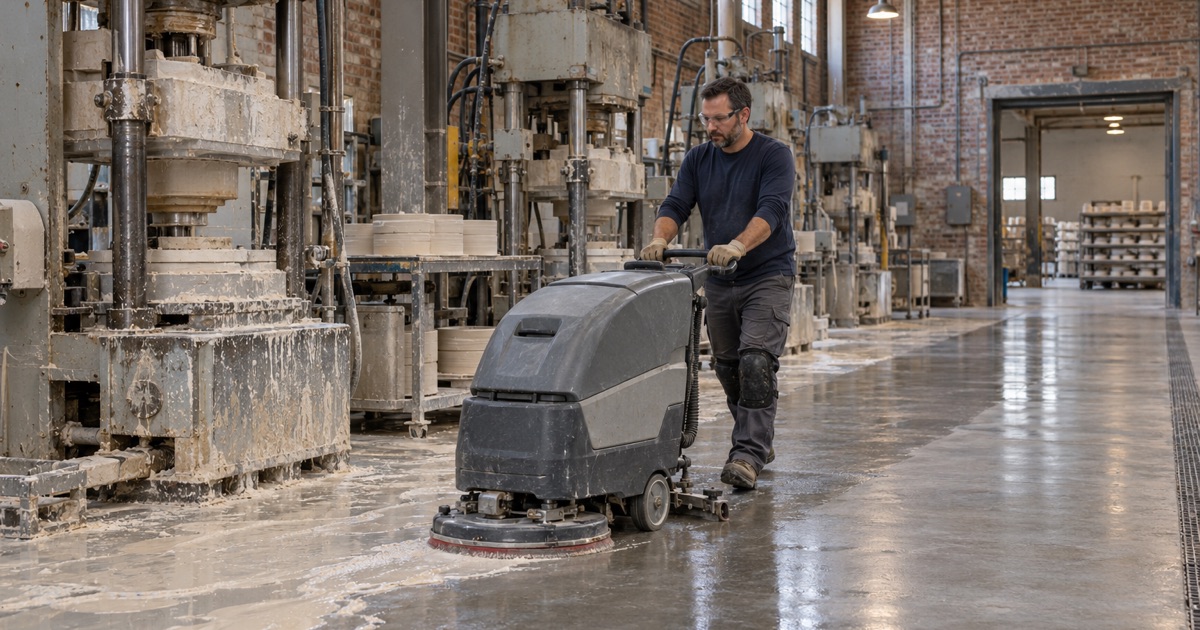
NPR reported on October 3, 2026, that Chicago artist Theaster Gates had bought Pickard China. The story described the factory as a cavernous space full of hulking, noisy, clay-splattered machines, and Gates put the building at 60,000 square feet. Twelve full-time staff work there, including a team of gilders who handpaint plates, cups and other high-end porcelain homewares.
The same report called it the last American maker of high-end china, with output roughly a quarter of its 1970s peak. We raise it not as a past job, since we have never worked there or seen its floors, but because a plant like it is the clearest picture of the problem this page addresses: clay on concrete, every day.
Production Floor and Outlet Under One Roof
A factory outlet is listed at the same Pickard Avenue address, with weekday hours of about 8:30 a.m. to 4:30 p.m. and, per a county visitor listing, visits by appointment. That means one building can hold two very different floors: a production area that takes wet clay and glaze, and a retail room where visitors walk past shelves of finished porcelain.
We scope those as separate jobs even under one roof. A showroom floor is judged on appearance and on how it looks after foot traffic, while a production floor is judged on how fast it gives up whatever was spilled on it. Mixing the two specifications to save a mobilization usually shortchanges one of them.
Where the Village Fits In
The factory sits inside the Village of Antioch, in Antioch Township and Lake County, and permit questions for commercial work go to the village Building Department and Community Development office. We check those questions with the village before a date is set, not after the grinder is on site.
Looking for epoxy-flooring closer to Winfield? See Epoxy-Flooring in Winfield.
Clay Slip on Concrete: Wet Today, Dust Tomorrow
Clay slip is liquid clay, and in a porcelain plant it ends up on the floor around casting, forming and glazing work. While it is wet it is a slip hazard and a mess. Once it dries on bare concrete it becomes something worse, because porcelain bodies carry crystalline silica and dried slip breaks down into fine dust that the next pass of foot or cart traffic lifts.
Why Bare Concrete Holds On to Slip
Concrete is porous. Wet slip that lands on an unsealed slab wicks into the surface pores and into hairline cracks, and the water leaves while the clay stays. Scrubbing gets the top layer but not what has settled into the texture, so the floor keeps releasing a little dust every time it dries out and is walked on again.
An old coating that has worn through in traffic lanes behaves the same way, only worse, because the edges of the failed film trap slip in a ridge. On an older plant floor we map those worn lanes, spalls and cracks before writing anything, since each one is a place slip collects and a place a new coating could fail early.
What OSHA’s Silica Rule Says About Sweeping
OSHA’s respirable crystalline silica standard for general industry, 29 CFR 1910.1053, speaks to housekeeping directly. Paragraph (h)(1) says the employer shall not allow dry sweeping or dry brushing where it could contribute to employee exposure, unless wet sweeping, HEPA-filtered vacuuming or other methods that minimize exposure are not feasible. OSHA’s own fact sheet lists pottery and porcelain manufacturing among exposed operations.
Paragraph (h)(2) adds a limit on compressed air for cleaning surfaces unless a ventilation system captures the dust cloud or no alternative is feasible. Put together, where silica dust is in play the broom and the air hose are both off the table in most cases, and the floor has to be cleaned wet or by vacuum. That is a cleaning question first and a flooring question second.
What a Coating Can and Cannot Do Here
A floor coating does not control silica exposure and does not make a plant compliant with anything. Air monitoring, ventilation, respirators and the written exposure plan belong to the employer and whoever handles its industrial hygiene. What a sealed floor can do is narrower: give wet slip nothing to soak into, so the wet cleaning the rule favors actually removes it.
A Sealed Floor That Squeegees and Wet-Mops Clean
Grinding the Profile First
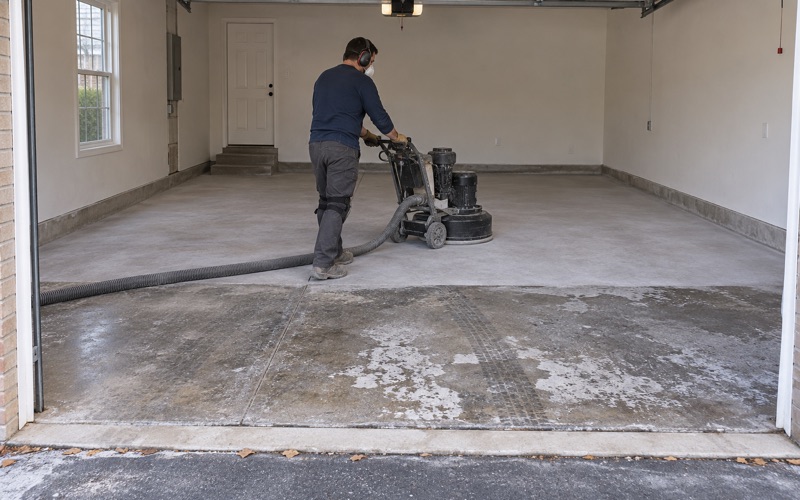
Wet cleaning only works on a coating that stays bonded, and bond starts with the profile. We diamond grind or shot blast to an ICRI concrete surface profile matched to the system’s thickness, and grinding dust is captured at the machine by vacuum rather than washed toward a floor drain or sump. In a building that already worries about dust, that matters twice.
Clay that has soaked into the old surface is ground out with it, which is the point. An acid etch would leave that residue in place and add a rinse step that sends slurry across the floor. On a slab that has taken clay for decades, we expect to grind deeper in the worst lanes than in the corners.
Testing the Slab Before Sealing It
A floor that gets wet-mopped every shift is a floor that may also carry moisture from below, and the two are easy to confuse. We test before we commit to a system, using ASTM F2170 in-situ relative humidity probes or ASTM F1869 calcium chloride testing, depending on the slab and the product’s own limits.
If the reading is high, a moisture-mitigation primer goes into the scope as a line item rather than a surprise. Moisture vapor transmission is also the first exclusion we name in any coating warranty, and we explain that exclusion before the job is sold, not after a blister shows up near a machine.
Smooth Enough to Squeegee, Textured Enough to Walk
The surface has to let a squeegee pull slip to a collection point in one pass, which argues for a dense, smooth finish such as 100% solids epoxy with a polyaspartic topcoat, or a urethane cement system where the floor sees constant wet cleaning. Vinyl flake is a poor fit here, since the chip edges can hold fine clay.
Smooth and wet is also slippery, so slip resistance is specified by the broadcast and topcoat, not promised as a slogan. A fine quartz aggregate broadcast, locked in by the topcoat, gives grip without the deep texture that would trap slip again. We set the grit where people walk and keep it finer where the squeegee does most of its work.
Roof First, Then Floor: Sequencing an Old Plant’s Repairs
Gates told NPR the Antioch building needs a new roof and HVAC system, among other urgent repairs. Whatever any particular owner decides, the order of work in an aging plant is not a matter of taste. A roof that leaks onto fresh resin, or a heating system that cannot hold the slab at temperature, will undo a floor faster than any spill.
Why the Roof Goes First
We will not coat under a roof that is due for replacement. Roof work drops debris, water and sometimes torch or adhesive residue onto the floor, and a leak over a curing coating leaves blush, blisters or a bond that never forms. When a building owner tells us the roof is next, our advice is to schedule the floor after it.
The same logic applies inside. Mechanical work that sets new equipment, cuts trenches or runs new lines should finish before coating, because every anchor drilled through a new floor is a breach in the seal. We walk the planned repairs with the owner and write the floor scope around whatever still has to happen overhead and underfoot.
Heat, Dew Point and the Cure Schedule
A large plant waiting on new HVAC can run cold at floor level through a Lake County winter. Resin cures to slab temperature and dew point, not to the calendar, and a slab near the dew point invites amine blush on epoxy. We take surface readings before each coat and tell an owner plainly when the right answer is to wait.
Phasing Around a Working Plant
A factory with a small staff and an outlet open on weekdays usually cannot close for a week. We phase production floors in sections around operating hours, using overnight and weekend windows where a space cannot shut, so one area cures while another keeps working. The outlet floor can often run on its own schedule entirely.
Product choice follows the same constraints. Lake County sits in the Chicago 2015 ozone nonattainment area, and Illinois Part 223 sets VOC limits of 250 grams per liter for floor coatings and 340 for industrial maintenance coatings, limits that bind whoever applies them. Low-odor, low-VOC systems also make it easier to keep work going in the next bay.
- 20+ Years in Business
- Moisture Test in Every Scope
- Diamond-Ground, Never Acid-Etched