Buffalo Grove Epoxy Flooring has spent more than 20 years on epoxy flooring in Barrington, and on most resin floors we install, the coating is the short part of the job. The long part is opening the concrete so the resin has something to grip, and on a commercial or public floor that means grinding. Grinding makes dust, and how that dust is handled decides whether a building can stay open while we work.
Federal rules already settle most of that question. OSHA’s construction silica standard lists floor grinders by tool and tells the employer which controls to run with each one, from the dust collector on a walk-behind machine to the shroud on a hand grinder at the wall. We plan every preparation pass around that table rather than around what is quickest, because the quickest way to clean a ground floor is also the one the rule restricts.
This page walks through what that looks like on a floor in a building that cannot close: the machine controls, the edge work and its respirator threshold, the cleanup between passes, and how a crew keeps grinding dust off shelves and equipment. It is written for facility managers, boards and owners who want to know what to ask before a resin floor goes out to bid.
Preparation Is the Dusty Part of a Resin Floor
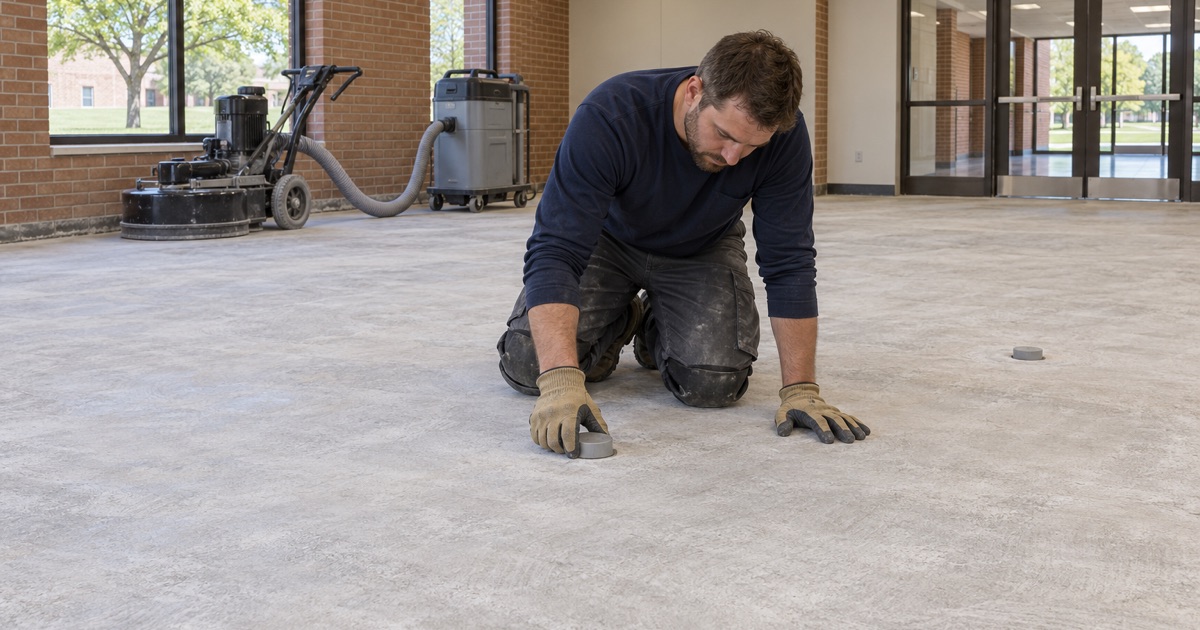
A resin floor holds only as well as its bond to the concrete underneath. Sealed, troweled or previously coated concrete has to be cut back to clean, open material before any primer goes down. That cutting is the step that fills a room with fine concrete dust when nothing captures it, and it takes longer than any coat that follows.
Diamond Grinding Instead of Acid Etching
We open every slab with a diamond grinder or a shot blaster and never with an acid etch. Acid leaves residue and an uneven, shallow profile, while mechanical preparation produces a measurable surface the coating can lock into. The trade describes that surface on the ICRI scale of concrete surface profiles, CSP 1 through 10, and each product sheet names the range it needs.
A thin 100% solids epoxy primer wants a lighter profile than a thick urethane cement or a quartz aggregate broadcast system. Matching the grind to the product keeps us from cutting deeper than necessary, which in an occupied building means fewer passes and less dust to manage.
Mapping the Slab Before the Price
Before a number is final we map cracks, spalls, joints and old coatings, and we run a moisture test as part of the written scope. Our usual tools are ASTM F2170 in-situ relative humidity probes or ASTM F1869 calcium chloride tests. If a slab needs repair before it should be coated, the proposal says so, along with the product line, number of coats and finished thickness.
Mapping also tells us how much grinding the job really holds. A floor with a failing old coating can take several passes to strip, and each pass is another round of dust control. Knowing that up front is what lets a facility plan closures realistically instead of discovering them halfway through.
Moisture and Warranty Exclusions
Coating warranties commonly exclude failures driven by moisture vapor transmission or hydrostatic pressure, and we name that exclusion first, before the job is sold. Grinding also exposes whatever the slab has been holding, so the moisture reading taken after preparation can differ from the one taken over an old coating. We test again when the surface changes enough to matter.
Looking for epoxy-flooring closer to Wauconda? See Wauconda Epoxy-Flooring.
OSHA’s Rule for Walk-Behind Floor Grinders
The construction silica standard, 29 CFR 1926.1153, includes Table 1, which pairs common tasks with specific engineering controls. Walk-behind milling machines and floor grinders have their own entry, and it is short and specific. We treat that entry as the starting specification for every large-floor pass, not as a target to work around.
Dust Collection With a 99% Filter
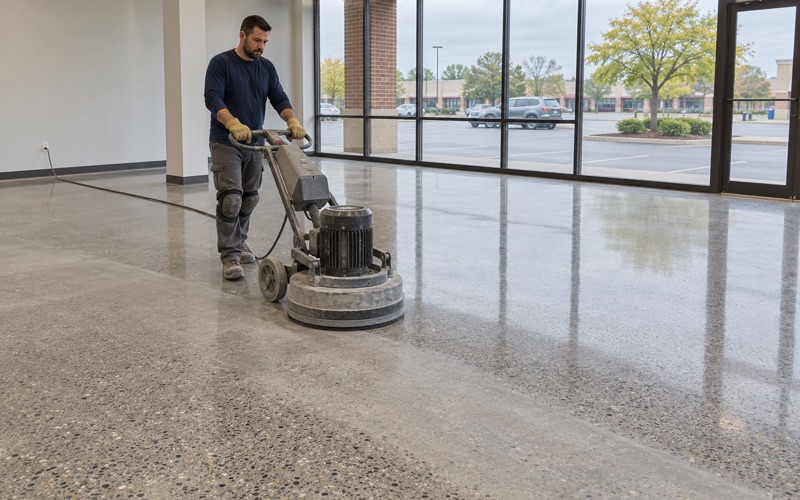
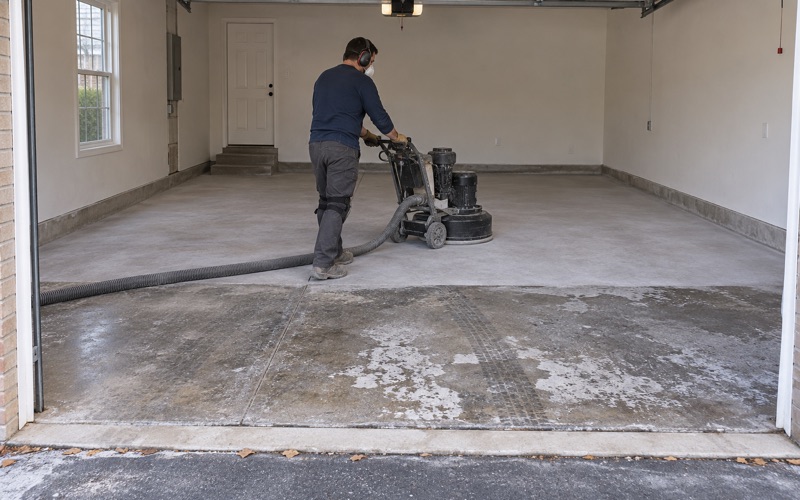
The table offers two options for a walk-behind grinder: water fed continuously to the cutting surface, or the dust collection system the manufacturer recommends. Indoors on a floor that will be coated, wet grinding leaves slurry and moisture we do not want in the slab, so we run the machine dry with its collector attached.
That collector has to deliver the airflow the manufacturer recommends or more, and it needs a filter rated at 99% efficiency or better plus a filter-cleaning mechanism. A clogged filter quietly drops airflow, so we clear it on the schedule the machine maker sets rather than waiting for dust to show at the grinding head.
HEPA Vacuuming Between Passes
Indoors or in an enclosed area, the same entry adds one more control: a HEPA-filtered vacuum removes loose dust between passes. Grinding rarely finishes in one pass, and the fines left by the first cut get thrown back into the air by the second if they stay on the floor.
We vacuum the whole worked area after each pass, not just the visible piles, and again before primer. With those controls in place, the table lists no required respirator for the walk-behind grinder operator at any shift length, which is a practical reason to do as much of a floor as possible with the large machine.
No Dry Sweeping, No Compressed Air
The standard’s housekeeping section bars dry sweeping or dry brushing where it could add to worker exposure, unless wet sweeping, HEPA vacuuming or similar methods are not feasible. It also bars compressed air for cleaning surfaces unless it is paired with ventilation that captures the dust cloud or no alternative is feasible.
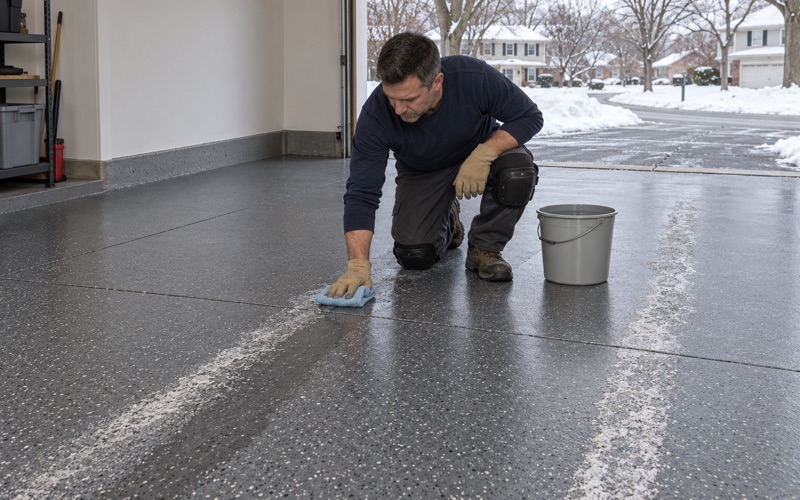
On our crews there is no broom and no blowgun on a ground floor. A push broom lifts fines into the room’s air, and compressed air sends them into ductwork, onto shelf tops and through any gap in a barrier. Grinding dust is captured at the machine and vacuumed, never rinsed toward a floor drain or sump.
Edges, Shelving Bases and the Four-Hour Respirator Line
A walk-behind grinder cannot reach the last few inches along a wall, around column bases, under casework toe kicks or against fixed shelving. Those strips are done with handheld grinders, and the silica table treats them as a separate task with separate rules. On a floor full of shelving, the edge footage can rival the open floor.
Shrouded Hand Grinders
For handheld grinders used for anything other than mortar removal, water delivery is an option outdoors only. Indoors the table calls for a commercially available shroud and dust collection system that moves at least 25 cubic feet per minute of air for every inch of wheel diameter.
In practice the shroud has to fit the wheel and the vacuum has to keep up with it. By that arithmetic a 5-inch cup wheel calls for 125 cubic feet per minute or more, so we match each vacuum to its grinder before edge work starts rather than sharing one undersized unit across tools.
When a Worker Passes 4 Hours
The handheld entry carries a time line the walk-behind entry does not. A worker running a shrouded grinder indoors for 4 hours or less in a shift needs no respirator under the table. Once that worker runs one for more than 4 hours in the shift, the required protection is a respirator with an assigned protection factor of 10.
The clock is per worker, not per crew. On a large edge job we track each operator’s time on the hand grinder through the day, and anyone headed past the line is fitted with the right respirator before they get there, not after.
Splitting Edge Work Across a Crew
Rotating the hand grinder between trained crew members keeps each person’s time down, and it also keeps the edge passes fresh and consistent. Where a room has long runs of fixed shelving bases, we plan that rotation into the schedule so the edge work does not become one person’s eight-hour shift.
Keeping Dust Off Books, Computers and the MakerLab
Barrington Area Library at 505 N. Northwest Highway shows why this matters in a public building. It is open 9:00 a.m. to 9:00 p.m. on weekdays, 9:00 a.m. to 5:00 p.m. on Saturday and 1:00 to 5:00 p.m. on Sunday. A building with those hours closes only overnight, so any floor work there would have to fit around the patrons who fill it the rest of the week.
A Library Board’s Recent Contracts
In November 2023 the library board awarded Administration, Maker Space and Generator contracts for not more than $1,735,826, with Benchmark Flooring among the trades. We had no part in that work and did not read its floor scope. The MakerLab sits on the first floor in the Business & Technology Center, with 3D printers, a laser cutter, a sublimation printer, a vinyl cutter and heat presses.
Fine concrete dust is a poor neighbor for any of that. It settles into printer mechanisms and laser optics, coats computer intakes and works into the pages and bindings of shelved books. Those are the stakes any open building with collections and electronics brings to a resin floor project, whoever does the work.
Closing Off the Work Area
Our approach in a building like that starts with isolation. The work zone is closed with floor-to-ceiling barriers, doors sealed, and nearby equipment and open shelving covered before the first pass. Return-air openings inside the zone are covered as well, so the building’s own system does not carry fines into rooms that are still open.
Capture at the tool does most of the work and barriers catch what escapes. Together with HEPA vacuuming, they are what lets one wing or room be prepared while the rest of a building keeps its published hours.
Scheduling the Dusty Hours
Heavy grinding goes into the hours a building is closed, which for a weekday library schedule means overnight, with edge work and vacuuming finished before doors open. Office, lab and shop floors get the same treatment, phased around operating hours with overnight and weekend windows when a space cannot close.
Public owners can also write the expectation into the bid. The Village of Barrington’s own 2026 floor contract asks for a dust-free grinding method, and a board can ask any bidder to describe the machine controls, edge tooling, vacuum filtration and cleanup it will use before a contract is signed.
- 20+ Years in Business
- Moisture Test in Every Scope
- Diamond-Ground, Never Acid-Etched