Buffalo Grove Epoxy Flooring installs basement floor epoxy in Buffalo Grove, IL, serving surrounding cities including Prospect Heights, Deerfield, Lake Zurich, Lake Forest and Barrington. We have been coating concrete for more than 20 years, and basement floors are where that experience matters most, because what is happening under the slab decides whether a coating lasts.
A basement slab sits in the ground. Moisture can move up through it as vapor, push up through it as water under pressure, or come in through the walls and spread across it. A coating that looks perfect on install day can blister and peel months later if any of that was missed, so every basement we quote starts with a written moisture test and a careful look for signs of past water.
When we do coat, the slab is ground with a diamond grinder rather than etched, repaired where it needs it and built up to the thickness stated in the proposal. The proposal also explains what the coating warranty does not cover, beginning with moisture vapor and hydrostatic pressure, before you agree to anything.
Reading a Basement Floor Before We Coat It
Signs of Past Water
Water leaves a record on concrete. Tide lines along the walls, rust rings where shelving stood, mineral stains around cracks and staining near the floor drain all tell us where water has been. We look for them in every basement, including finished ones where carpet or laminate is coming up.
If the signs point to an active problem, such as a crack that still weeps or a wall that leaks in spring, that needs a repair from the right trade before any coating. A coated floor over an unsolved leak simply moves the failure from the concrete to the coating.
Efflorescence and White Powder
White, crusty or powdery deposits on a basement floor are usually efflorescence: salts carried to the surface as moisture moves through the concrete and evaporates. Their presence is a clear sign that this slab is passing water vapor, sometimes a lot of it.
We brush and grind efflorescence away, then retest once the source has been dealt with. Coating directly over it gives the resin a crumbly, salty base, and the deposits can keep growing underneath until the coating lets go.
Moisture Tests That Go in Writing
Our testing depends on the slab. A plastic sheet test is a fast screen, a calcium chloride test measures how much vapor the surface releases, and in-slab relative humidity probes read conditions within the concrete itself. The coating maker’s limits decide what each reading means for the system.
The results are written into the scope with their locations. If one corner reads high near a foundation crack while the rest of the floor passes, you will see that on paper and know why the proposal treats that corner differently.
Basement Slabs in Buffalo Grove Homes
Full and Partial Basements From the 1970s and 1980s
Most houses in the village were built in the 1970s and 1980s, and on the Cook side a large majority have a full or partial basement. Slabs that age often carry several generations of finishes: painted concrete, glued-down tile, carpet pad residue and patches where plumbing was moved.
Each of those layers has to come off before a coating can bond. We grind or strip to sound concrete, test any old black mastic before we disturb it, and price the removal as its own line so the proposal shows what your particular floor requires.
Sump Pits, Floor Drains and Ejector Pumps
In Buffalo Grove, basement floor drains are routed to a sump that discharges to the sanitary sewer under village code. Many basements also have an ejector pit for a bathroom or laundry below the sewer line. Each of those openings needs a clean coating edge and continued access.
We tape off and protect every pit and drain during grinding so dust and chips never reach the pump. The coating stops at a neat line at each rim, and lids, cleanouts and check valves stay reachable without cutting into the new floor.
Flood History and Buffalo Creek
Buffalo Creek is the main flood source on the Cook side of the village, and the village sits just downstream of the Buffalo Creek Reservoir. Homes that have taken on water from the creek or from sewer backups may carry moisture in the slab long after the surface looks dry.
After any flooding, we wait for the slab to dry and retest before coating. FEMA’s flood-resistant materials guidance treats concrete as tolerant of water, but coatings and the adhesives under them are a different matter, which is why we plan the floor around the risk rather than promising it away.
Building the Right System for a Basement
Moisture-Mitigation Primers
When readings run above what a standard epoxy primer tolerates, a moisture-mitigation primer rated for the measured level can go down first. It is designed to hold back vapor that would otherwise build pressure under the coating.
We name the product and its rated level in the proposal, list it as a separate price, and explain that it manages vapor, not liquid water. A slab with standing water or active leaks is not a candidate for any primer.
Base Coats, Broadcasts and Topcoats
Above the primer, most basement floors get a 100% solids epoxy base and a vinyl flake or quartz broadcast, finished with a clear topcoat. Flake hides the variation of an older slab, while a solid color can brighten a utility area.
The topcoat sets texture and sheen. A satin finish with a little grit stays safer in a laundry room where water spills, while a smoother, glossier coat suits a family room where socks and slippers are more common than wet floors.
Cure Times in a Cool Basement
Basements are often cooler than the rest of the house, especially in late fall and early spring. We check the slab temperature and the dew point spread at the surface before mixing, because a cold, damp slab slows the cure and can cause amine blush on epoxy.
If the space is too cool, we may ask for temporary heat in the days before and during the work. The schedule we give you follows what we measure, not a promise made before we saw the room.
How Basement Floors Get Used
Laundry Rooms and Utility Areas
Laundry rooms see detergent spills, the occasional washer leak and water dripping from wet clothes. A seamless coating with a textured topcoat makes those spills easy to wipe up and keeps the floor from becoming slick.
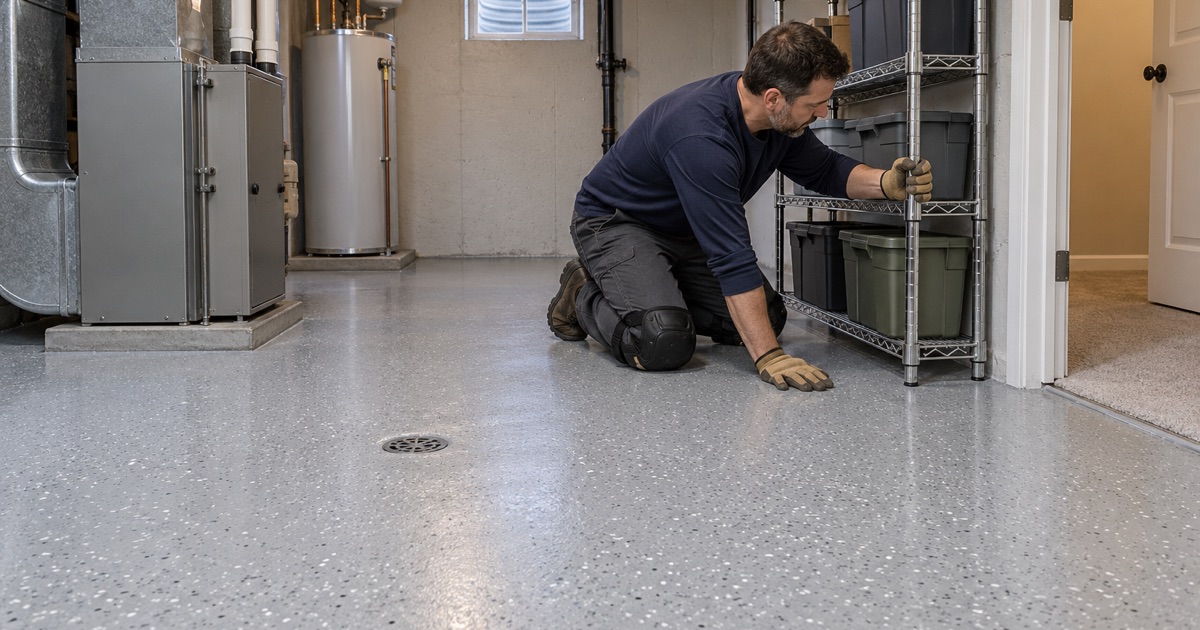
We keep the area around the water heater, furnace and softener accessible and coat around equipment we cannot move rather than under it, so service technicians can reach everything later.
Workshops and Storage
A basement workshop takes dropped tools, rolling tool chests and solvent drips. We build those areas thicker and use a topcoat that resists the chemicals you actually use, whether that is mineral spirits, oil or wood stain.
Home Gyms and Playrooms
Gym areas get a coating that rubber mats will not stain and a texture that holds sneakers, with mats placed over the floor where weights are dropped. Playrooms usually get a softer-looking flake blend and a satin sheen that hides scuffs between cleanings.
- 20+ Years in Business
- Moisture Test in Every Scope
- Diamond-Ground, Never Acid-Etched