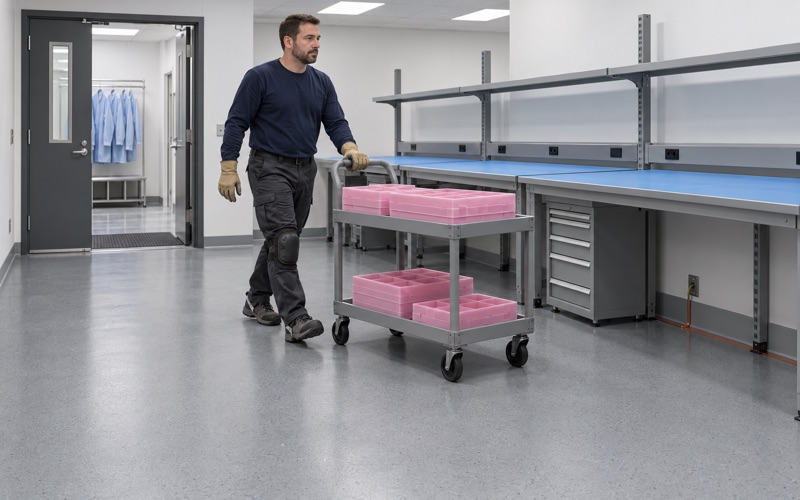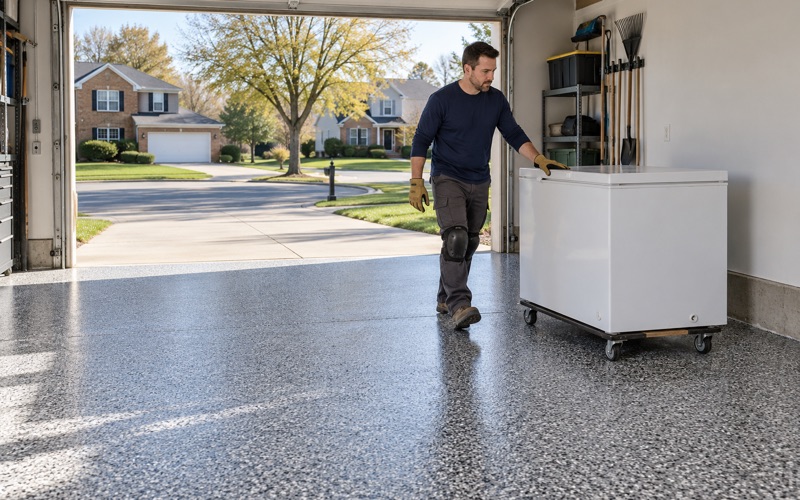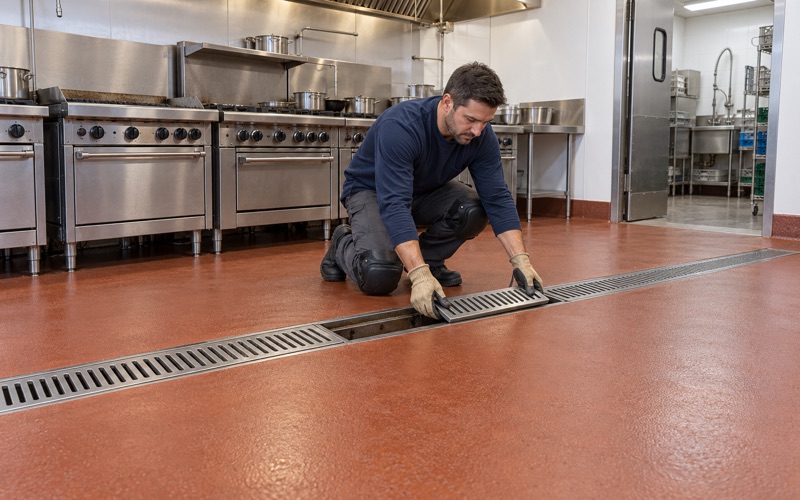
Buffalo Grove Epoxy Flooring has spent more than 20 years on epoxy-flooring in Beach Park and the wider north suburbs, and one request deserves a straight answer before any quote. A homeowner has a backyard building, plans to turn it into a workshop or home gym, and wants the same hard, glossy floor the garage got. Our first question is what that floor is actually made of.
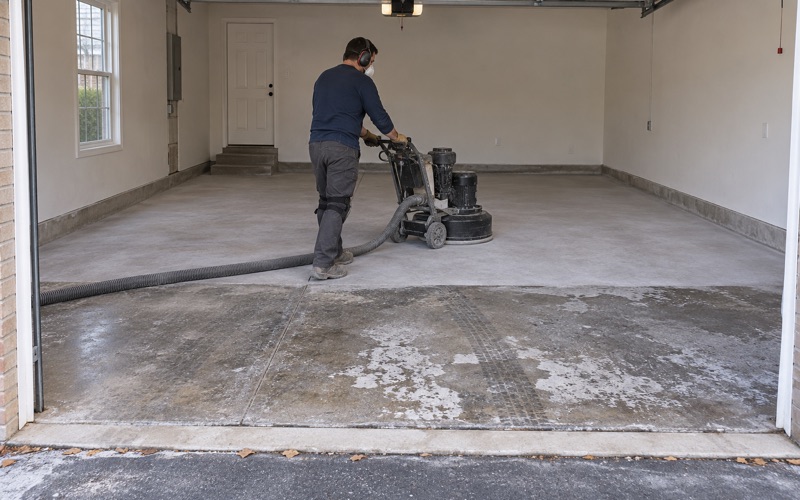
If the answer is concrete, the work looks like any garage job: we open the slab with a diamond grinder or shot blaster, test it for moisture, and put the product, coat count and finished thickness in writing. If the answer is wood, the honest advice is different. A rigid garage resin does not belong on boards that move, and we would rather say so than sell a floor that chips.
This page covers both paths for shed owners in Beach Park: what usually sits under a prefab shed, why epoxy and wood make a poor pair, how long treated decking needs before any finish, and when it makes sense to pour a slab and save the resin floor for later. The goal is a floor that lasts as long as the building does.
A Shed Lot on Wadsworth Road and the Floor Underneath
The He Shed She Shed Lot
The Village of Beach Park business directory lists He Shed She Shed at 11411 Wadsworth Road under shed sales, and the lot sits inside the village in Benton Township. Its website forwards to Old Hickory Buildings, the maker whose sheds it sells. We are not connected to either business; we mention them because their published specs show what a typical backyard building rests on.
Those buildings get bought as storage, but plenty end up as something else. A she-shed for crafts or reading, a he-shed full of tools, a backyard workshop with a bench along one wall, a home gym with a rack and rubber plates. Once a shed becomes a room people stand and work in, the owner starts wanting a garage-style floor in it.
Skids, Joists and Decking
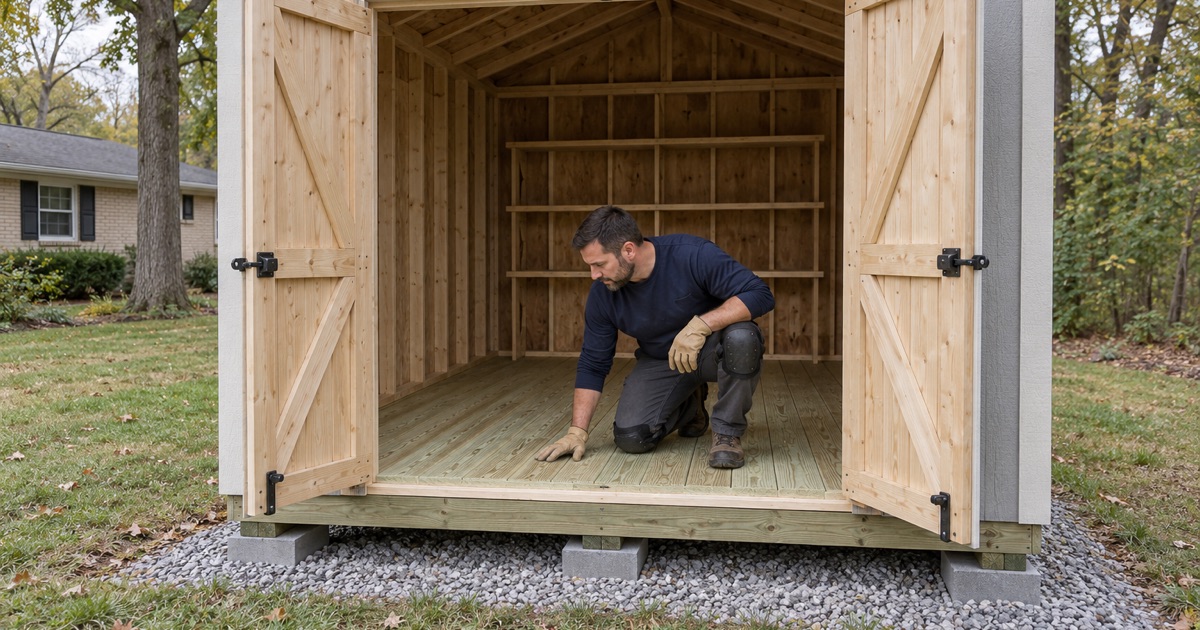
Old Hickory’s own page describes the floor system plainly. Each shed sits on 4x6-inch pressure-treated skids, notched at 12 or 16 inches on center, with the floor joists recessed into the notches and toenailed in place. Over the joists goes the decking, offered as engineered tongue-and-groove panels or pressure-treated square-edge boards. Larger models step up, and the garage package spaces its floor joists 12 inches on center.
That is a sound, practical floor for a shed. It is also a wood floor, built from separate pieces that flex underfoot, swell and shrink with humidity, and move slightly as the building is loaded. None of that is a defect. It simply means the surface behaves nothing like a concrete slab, and the coating has to be chosen for what is actually there.
Leveled on Blocks, Not Poured
Old Hickory says no site preparation is needed if the spot is no more than 3 feet out of level in any direction. Within 30 miles of the lot, delivery includes leveling the shed on concrete blocks the customer supplies, with pressure-treated shims. The building ends up resting on blocks over the ground, with air and soil beneath the skids rather than a slab.
We have not looked at the floor under any particular Beach Park shed, and owners do set buildings on slabs or gravel pads of their own. We also have not read any village rule on shed foundations, so ask Beach Park’s Building and Zoning office before planning one. The point is to know which floor you have before anyone talks about coating it.
Looking for epoxy-flooring closer to Bellwood? See Epoxy-Flooring Services in Bellwood.
Why a Garage Epoxy Cracks on a Wood Floor
Rigid Resin Over a Moving Substrate
A garage epoxy cures hard and stiff, which is exactly what a concrete slab needs. Concrete barely moves, so a thin, rigid film bonded to a ground surface stays put for years. Wood decking moves with every season and every step, and a film that cannot stretch has nowhere to go but apart, starting along board joints and fastener heads.
Rust-Oleum’s support team said as much when a customer asked about its EpoxyShield garage-floor coating. The answer was that the product is not suitable for wood, because epoxy cures stiff and rigid, cannot flex with the boards, and will crack and chip off. That is a coating maker steering business away from itself, which makes it worth taking seriously.
The Data Sheet Sets the Boundary
The same product’s data sheet describes it as a two-part water-based epoxy for concrete garage floors in good, sound condition, and not for floors with a moisture problem. Read that way, a pressure-treated shed floor fails twice: it is not concrete, and freshly treated decking often carries plenty of moisture of its own. Using it there means running the product outside its own stated limits.
We read data sheets this way on every job, slab or not. Our proposals name the product line, the number of coats and the finished thickness, so a homeowner can hold the installed floor up against what was quoted. A product used outside its own stated substrate would make that check meaningless.
Stiffness Decides, Not the Coating
Resin makers who do allow certain systems over wood set the bar at the structure, not the finish. One published guideline calls for plywood subfloors designed to an L/480 deflection limit under dynamic load before an epoxy, polyurethane or polyaspartic system goes down. We have not measured a shed floor against that limit, and we would not assume one meets it.
A home gym makes the problem plain. Dropped plates, a rack loaded on one side, and repeated jumps all flex the decking between joists. On concrete, a rigid floor shrugs that off. On boards, every impact is a small bend in a film that was never meant to bend, which is why we point gym owners toward a different answer.
Treated Lumber Has to Dry Before Any Finish
Wet From the Treatment Plant
Pressure-treated decking often arrives wet, because the preservative goes in under pressure in a water-based solution. Trade guidance on finishing it is consistent on one point: let it dry before any stain, paint or sealer goes on. Depending on the wood and the weather, that drying can take from a few weeks to several months.
A shed that went up on a delivery day and gets a finish the next weekend is a common mistake. Any coating sealed over wet treated lumber is fighting the moisture coming out of the boards, and even a flexible product can peel or blister when that happens. Patience costs nothing here, while a failed finish costs a strip-and-redo.
The Water-Sprinkle Test
The simplest check is a few drops of water on the decking. If the boards absorb it within about 10 minutes, the wood is generally ready for a finish. If the water beads up and sits on the surface, the boards are still too wet and need more time open to the air.
Test in several spots, including boards near the door and boards deeper inside, since a shed interior dries unevenly. A floor that passes near the door and beads in a back corner is not ready, and the finish waits for the slowest board, not the fastest.
A Meter Reading Settles It
A moisture meter gives a number instead of a judgment call. Sources quote readiness thresholds of 12 to 15 percent moisture content, and they do not all agree on the exact figure, so we treat the lower end as the safer target. It is the same habit that makes us test a concrete slab before pricing a resin floor on it.
On concrete, that test is written into the scope: a calcium chloride test under ASTM F1869, in-situ relative humidity probes under ASTM F2170, or a plastic sheet test under ASTM D4263, depending on the slab. Moisture is also the first exclusion we name when we walk through what a coating warranty does not cover.
A Wood-Rated Coating Now, or a Slab and a Resin Floor Later
Finishing the Wood Floor You Have
For a shed that stays on its skids, the right finish is one rated for wood, flexible enough to move with the decking, applied once the boards pass the dry test. A good rubber mat is often the better choice under gym equipment or a workbench, because it cushions impact rather than resisting it.
We do not install our garage resin systems on wood shed floors, and we will not pretend a thicker coat or a different primer changes that. What we can do is talk through the difference between a wood-rated finish and a concrete coating, so the product on the shelf matches the floor in the yard.
Pouring a Slab First
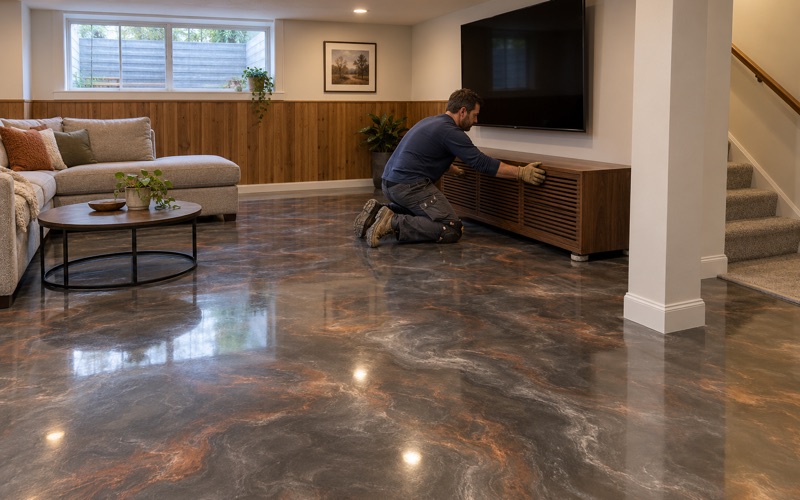
Some owners decide the building is worth a real foundation, especially when it will hold a workshop or a gym for years. A poured slab under a new shed, or under one that will be moved and reset, changes everything about the floor. Once it has cured and passed a moisture test, it can take the same systems a garage does.
Pouring the slab, and any permit question about it, sit with the concrete contractor and the village. Our part begins when the concrete is ready. Grinding dust from that work is captured at the machine with a vacuum, and nothing gets rinsed toward a storm drain, which matters under the village’s stormwater program.
What a Shed Slab Gets From Us
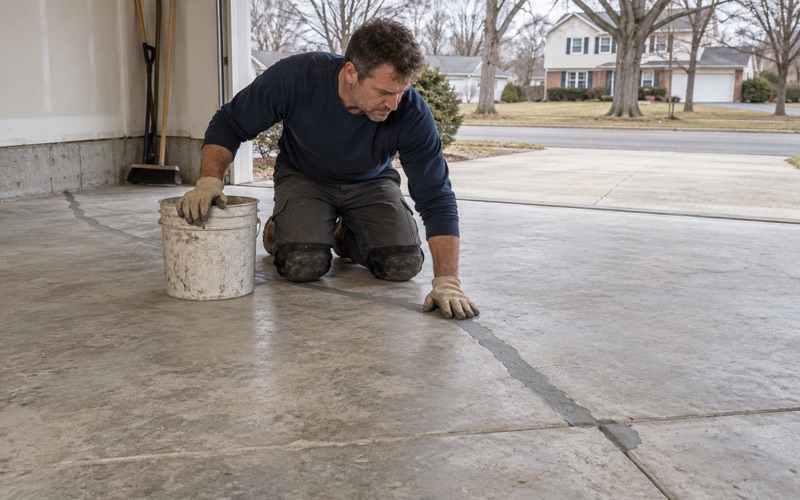
On a new shed slab we treat the work like a small garage floor. The surface is opened with a diamond grinder or shot blaster to a real profile, never an acid etch, and the slab is checked for cracks and spalls before anything is mixed. The cure schedule follows slab temperature and dew point, so an unheated shed in deep winter waits.
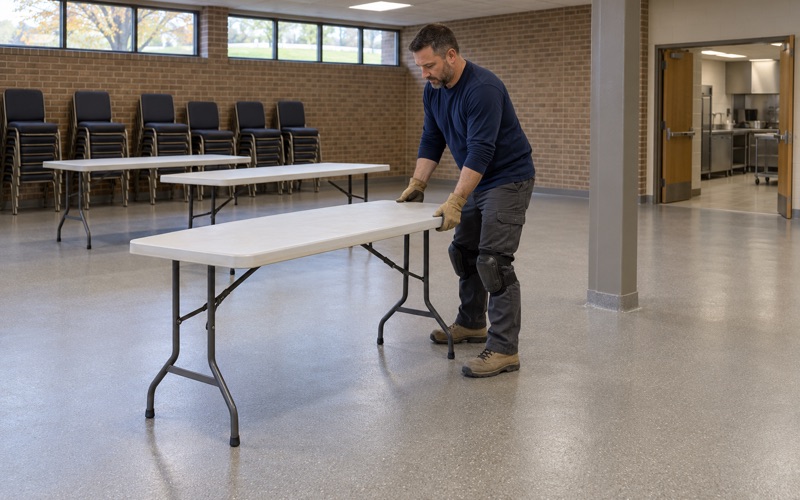
For a workshop, a 100% solids epoxy base with a quartz aggregate broadcast gives a texture that stays grippy around a bench. For a home gym, a vinyl flake broadcast under a polyaspartic topcoat is a common pairing. Either way, the slip-resistant texture is specified by the broadcast and topcoat in the proposal, not promised as a slogan.
- 20+ Years in Business
- Moisture Test in Every Scope
- Diamond-Ground, Never Acid-Etched