Buffalo Grove Epoxy Flooring has put more than 20 years into epoxy flooring in Bellwood and the surrounding region, and some of the most demanding floors we plan are the ones that have to keep two metals apart. In a repair shop that works steel and aluminum under one roof, the floor is where their dust meets. We treat it as a boundary to be drawn, not just a surface to be coated.
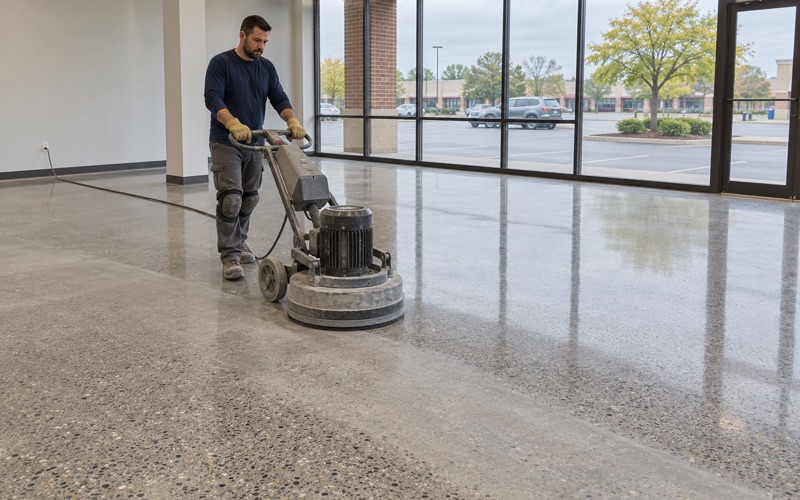
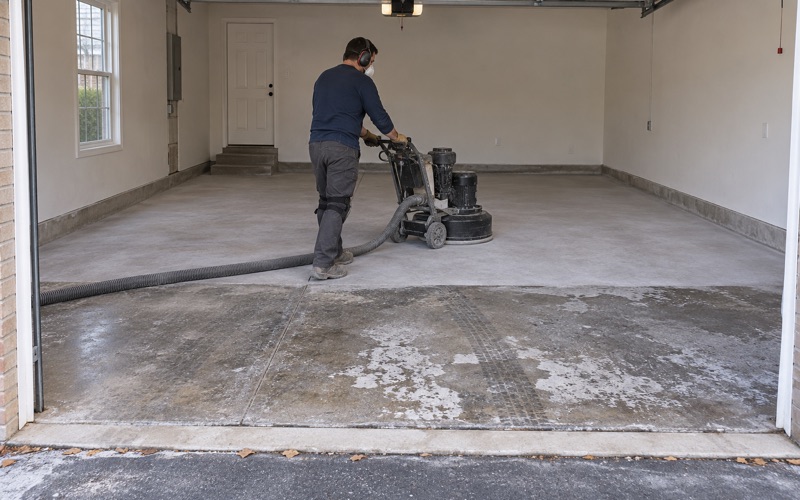
Every job starts the same way. We open the slab with a diamond grinder or a shot blaster rather than an acid etch, map cracks, spalls and old coatings before pricing, and run a moisture test as part of the written scope. Where a slab needs repair before it should carry a coating, we say so in writing instead of coating over the problem.
The proposal names the product line, the coat count and the finished thickness, so a shop owner can hold the installed floor against the quote. What follows is how that approach applies to collision work, where automaker repair procedures already ask for a separate aluminum room, and what a floor can and cannot contribute to that separation.
An Aluminum Clean Room on St. Paul Avenue
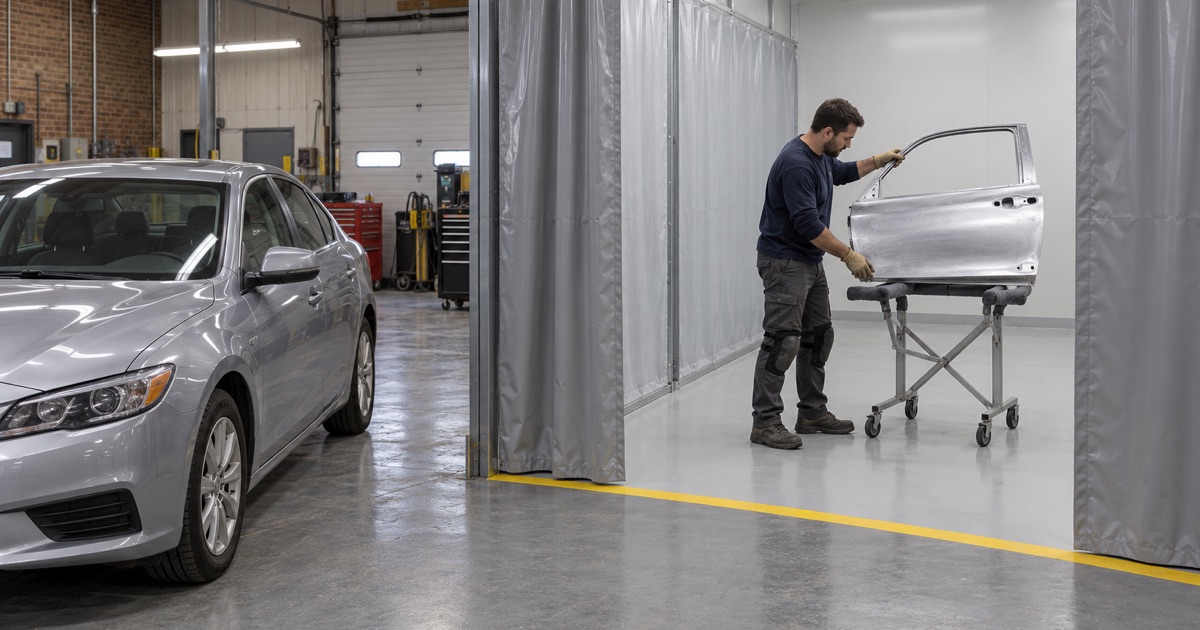
Turi’s Auto Body, at 4012 St. Paul Avenue and family-owned since 1989 by its own account, lists a dedicated aluminum clean room and a contamination-free environment on its Tesla repair page. We have no relationship with the shop and have not seen its floors. Its pages also do not say which of its two locations holds the room, but the listing shows what collision repair in Bellwood now involves.
What the Automaker Bulletins Ask For
Stellantis Collision Service Bulletin 31-001-25, revised in August 2025, says aluminum grinding, sanding and prep work must be done in a separate room away from ferrous material, using only clean abrasives. It also warns against sharing tools or abrasives between steel and aluminum parts. I-CAR made the same point in 2013, telling shops they would need an isolated area for aluminum-intensive vehicles.
Those documents govern the repair, not the floor, and no coating makes a room meet them. What a floor can do is stop working against the separation. A room whose concrete holds yesterday’s steel grit in its pores and joints is harder to keep clean than one with a sealed, continuous surface.
Reading the Slab Before the Room Is Planned
Much of Bellwood was built before 1960, including 69.9 percent of its housing by census count, and older shop slabs often carry oil, patches and coatings left by earlier tenants. We map cracks, spalls and old film before quoting an aluminum room, because a room is only as easy to clean as its worst joint.
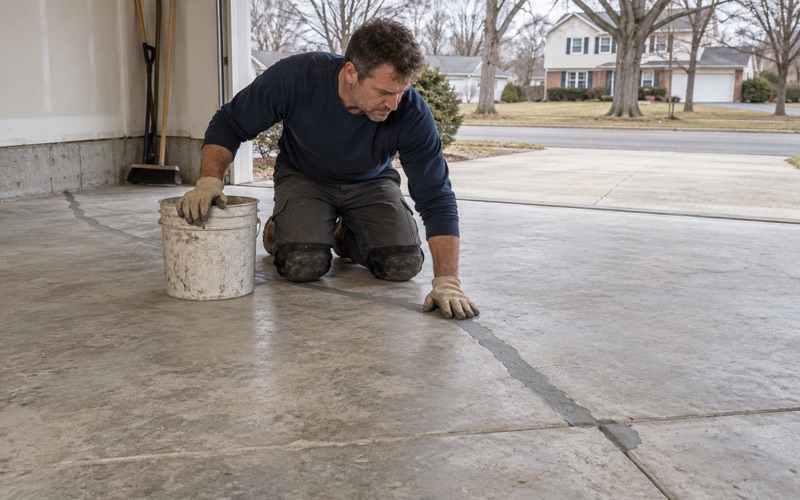
Oil-soaked concrete will not hold a primer, so degreasing and a bond test come before any coating. Where a slab is cracked through or spalled deep, we say it needs repair first, and sometimes that the section should be replaced. Coating over a failing slab only hides the problem until it comes back through.
Moisture Under an Old Slab
A shop slab poured long before modern under-slab vapor retarder practice can push moisture up into a coating. We test with ASTM F2170 relative humidity probes or ASTM F1869 calcium chloride kits as part of the written scope, and the price is not final until the numbers are in. A high reading changes the primer, not just the schedule.
Where readings run high, a moisture-mitigation primer goes down before the build coats. We also explain, before the job is sold, that most coating warranties exclude moisture vapor transmission and hydrostatic pressure, so nobody learns about that exclusion after a blister appears in the middle of the aluminum bay.
Looking for epoxy-flooring closer to River Forest? See River Forest Epoxy-Flooring.
Why Steel Dust and Aluminum Panels Cannot Share a Floor
Galvanic corrosion is the reason the room exists. When steel particles land on bare aluminum and moisture joins them, the two metals form a small cell and the aluminum corrodes around each speck. The Stellantis bulletin ties exactly that cross-contamination to galvanic corrosion and a sub-standard finish, which is why the separation reaches past the bench to everything that touches the panel.
How Steel Grit Travels
Steel dust rarely walks into an aluminum room on purpose. It rides in on boot soles, cart wheels, hose reels and the bottoms of parts dollies, and it settles into whatever the floor offers: open saw cuts, pitted concrete, a peeling patch of old paint. Then the next sweep or the next draft lifts it again, right beside an aluminum panel.
That is why we treat the room’s floor as one continuous surface. Joints are filled, cracks are routed and repaired, and the coating runs unbroken to the walls, so there is no seam where dust from one job waits for the next. Bare or partly coated concrete is the hardest surface in the shop to keep honestly clean.
Thermiting and Why Dusts Stay Apart
The Aluminum Association adds a second reason to keep the dusts separate. When aluminum dust and rusty iron dust mix in an enclosed collector, aluminum can reduce the iron oxide and release heat, a reaction called thermiting. Its 2017 guidance on collision dust says plainly not to mix dusts from steel and aluminum, and to handle them separately.
The same guidance treats both collision dusts as a combustibility hazard to be managed, with fine sanding dust the bigger concern. That is a housekeeping matter, not a reason for alarm, and a floor coating is neither dust collection nor fire protection. It simply makes the daily cleanup more complete.
Choosing a Color That Shows Gray Dust
Aluminum and steel dust are both gray, and a dark gray floor hides them well. For an aluminum room we usually suggest a light, solid color, often with only a sparse flake broadcast or none at all, so a technician can see at a glance whether the morning cleanup actually reached the corners.
Texture is a balance here. A slip-resistant finish comes from the broadcast and topcoat we specify, but heavy aggregate gives fine dust more places to lodge. We size the texture to the room’s real wet and dry conditions and write it into the proposal, rather than promising grip as a slogan.
Brush, Scoop and No Compressed Air: The Daily Routine
The Aluminum Association’s management practices are specific. Dust is cleaned up daily and removed from the work area, manual cleanup uses natural fiber brushes and conductive scoops, compressed air cleanup is not recommended, and standard shop vacs are not recommended because they can increase the combustion hazard. Wet dust collection is the preferred method.
A Floor Built for a Brush, Not a Blower
No compressed air means the floor has to give up its dust to a brush stroke. A smooth, sealed coating lets a natural fiber brush move fine particles toward a scoop in one pass, while open concrete holds them in its pores. The fewer places dust can sit, the less temptation there is to reach for an air nozzle.
Cove details help too. Where the coating turns up the wall a few inches instead of stopping at a sharp corner, the brush has a curve to follow rather than a crack to miss. We quote coved edges as a line item so the shop can decide whether the room warrants them.
Coatings That Survive Daily Sweeping
A floor swept every day, with carts and stands rolling across it, wears at the traffic lanes first. We usually build an aluminum room on 100% solids epoxy with a polyaspartic or urethane topcoat chosen for abrasion resistance, and we add build where the main lane and the doorway take the most passes.
Solvent wipe-downs are common in collision prep, so the topcoat also has to shrug off the cleaners a shop actually uses. We ask for the product list before choosing, and we pick coatings within the Illinois VOC limits for floor and industrial coatings, which apply to us as the applicator.
Capturing Our Own Grinding Dust
Preparing an aluminum room’s floor creates concrete dust of its own, and in a working shop it cannot drift into the aluminum bay or the paint booth. We capture grinding dust at the machine with a vacuum rather than rinsing it toward a drain, and we seal the work area off from adjoining rooms while we prepare the slab.
Shops rarely close for a floor. We phase the work around operating hours, with weekend and overnight windows where the room cannot be emptied during the week, and cure schedules follow slab temperature and dew point rather than a calendar date.
Marking the Line Between Steel and Aluminum Work
A separate room is the procedure, but a room has a doorway, and the doorway is where the separation is tested. Marking the boundary on the floor itself turns an unwritten rule into something every technician sees. The same thinking scales down to a home garage where someone works on both metals.
Color Bands and Threshold Lines
We can lay a contrasting band of coating across the aluminum room’s threshold, or run the room in a different color from the steel side entirely, so a cart or a parts stand crossing the line is obvious. Lines are cut into the build and topcoated over, not painted on top, so they survive daily brushing.
A marked floor does not enforce anything by itself. It works alongside the shop’s own rules, such as dedicated aluminum tools and abrasives, and it makes a lapse visible before it becomes a corrosion complaint on a customer’s car.
Walk-Off Space at the Door
A short zone just inside the boundary, brushed first and most often, catches whatever boots and wheels carry across. We leave that zone smooth and light so it reads as clean or not clean, and we keep the doorway transition low enough that carts roll over it without a jolt that shakes debris loose.
The Same Rule in a Home Garage
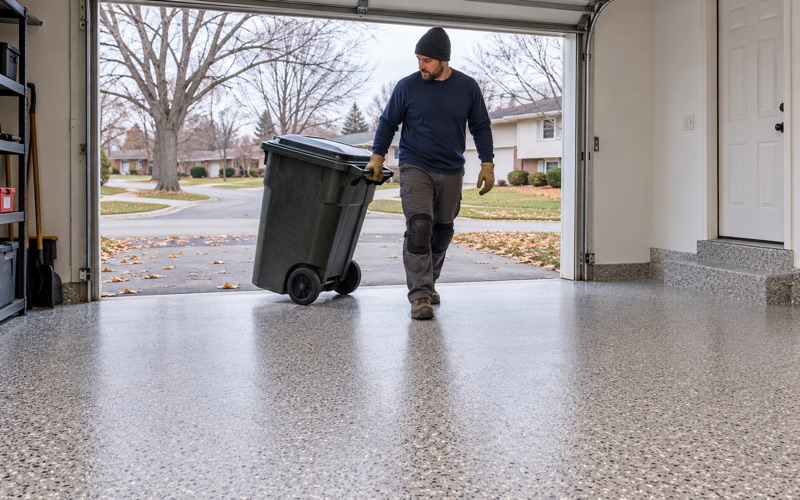
With 4,669 single-family detached homes in the census count, Bellwood has plenty of garages where steel may be ground one weekend and an aluminum panel sanded the next. The bulletin’s logic holds at a smaller scale: separate the two jobs in time or space, and clean thoroughly between them.
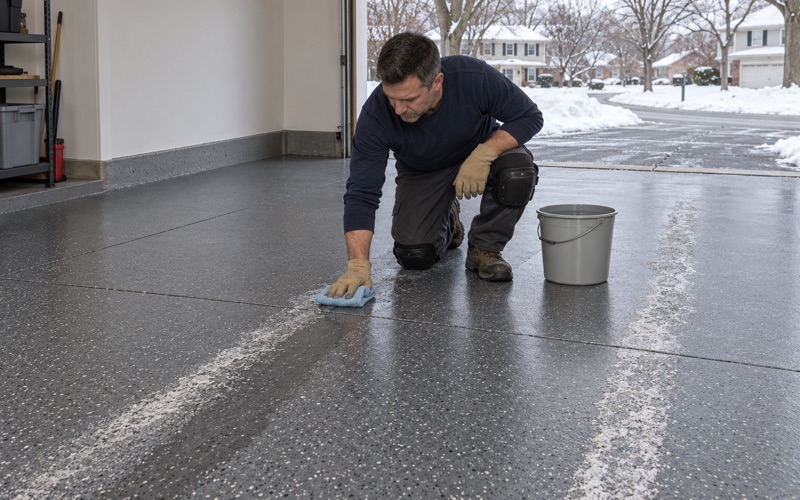
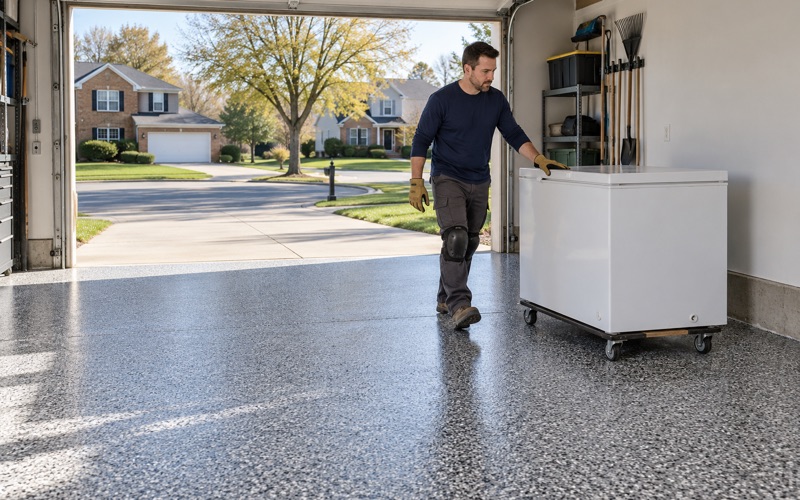
A light, continuous garage floor makes that cleaning practical with a brush and dustpan instead of a leaf blower. Garage systems we install are also chosen to stand up to the brine and rock salt tires bring in all winter, and an unheated garage in deep winter is told to wait for warmer slab temperatures.
Home jobs above the Illinois threshold get a written contract and the Home Repair: Know Your Consumer Rights pamphlet before any grinding starts. Any permit question goes to the Village of Bellwood Building Department before we put the job on the calendar.
- 20+ Years in Business
- Moisture Test in Every Scope
- Diamond-Ground, Never Acid-Etched