Buffalo Grove Epoxy Flooring takes on epoxy-flooring in Bensenville with more than 20 years of slab work behind us, and the floors we think hardest about here are the ones that hold packages nobody wants to mix. Every job starts with a diamond grinder or a shot blaster rather than an acid etch, so the resin bonds to a real profile instead of a dusty surface.
Before a price is final, our written scope includes a moisture test, along with a map of cracks, spalls and old coatings. When a slab needs repair or replacement before it should be coated, we say so plainly. The proposal names the product line, the number of coats and the finished thickness, so anyone can check the floor against the quote.
On industrial floors the coating is one layer in a larger plan that includes racking, labeling, procedures and the people who run the room. This page walks through a single kind of floor found in this village, one where incompatible materials sit a few feet apart, and explains what a seamless resin surface can contribute and where its job ends.
Fixing Frustrated Dangerous Goods on Eastern Avenue
Freight the Airlines Refused to Fly
Restricted Article Specialists, at 501 Eastern Avenue in the DuPage County part of the village, has handled dangerous goods since 1977. The company was founded to repair and correct hazardous shipments that airlines rejected, rather than sending them back to the shipper. In the trade those packages are called frustrated freight, and fixing them is the work the company was built around.
Its listed services read like a checklist of what goes wrong with an air shipment: UN certified packaging, overpacks, lithium batteries, dry ice, dangerous-goods pre-checks and inspections, marking and labeling, palletizing and crating. There is also a 24-hour emergency phone line. Each of those services implies a package that arrived in one condition and must leave in another.
Packages That Wait Their Turn
A shop like this does not choose what arrives on a given morning. A carton of corrosive liquid can land beside a drum of something flammable and an oxidizer in a damaged box, and all three wait to be opened, repacked and relabeled. That waiting time is when the floor matters, because a package that was rejected once is not always a package that is sealed tight.
Bensenville sits against the southwest corner of O’Hare International Airport and is home to one of the largest industrial parks in Illinois, so freight-handling floors are a familiar type here. What sets a dangerous-goods repair floor apart is that the cargo is mixed by hazard class and the condition of each package is the reason it is there in the first place.
What We Can Say From the Outside
We have not seen the floor or the bay layout at 501 Eastern Avenue, and nothing on this page describes them. What follows is how we would approach any room where frustrated dangerous goods wait for repair, using the federal segregation rule as the starting point and the slab as one tool among several that keep incompatible materials apart.
Bensenville Fire Protection District No. 2, a taxing district separate from the village, conducts annual inspections of non-residential businesses. Building permit questions go to the Village of Bensenville Community Development, and the bay plan itself comes from the operator’s own dangerous-goods staff and advisers. We confirm both before a start date is set.
Looking for epoxy-flooring closer to Cary? See Epoxy-Flooring Services in Cary.
What the Segregation Table Says About Storing Classes Together
X, O and the Leakage Test
The rule is 49 CFR 177.848, which governs segregation of hazardous materials, including storage incidental to transportation. Its table marks pairs of hazard classes that need separation. An X means the two may not be loaded, transported or stored together in the same vehicle or storage facility. An O means the same, unless they are separated so that a leak would not let them commingle.
That O condition is the part a floor contractor should read twice. The wording ties separation to leakage from packages under conditions normally incident to transportation, so the test is not distance alone but what happens to liquid once it escapes a container. A neat aisle between two pallets is not separation if a spill can cross it.
Corrosives Beside Flammables and Oxidizers
The rule also names specific pairings. Class 8 corrosive liquids may not be loaded above or adjacent to Class 4 flammable or Class 5 oxidizing materials. A separate provision says cyanides may not be stored with acids where a mixture would generate hydrogen cyanide. These are the combinations where a floor that lets liquid wander creates the very contact the rule exists to prevent.
In a repair shop, a corrosive may be the very package that came in leaking. A cracked bottle inside an overpack, a damaged inner liner or a carton stained on one corner can be the reason a shipment was rejected. Planning the floor around the assumption that some packages will drip is simply planning around the work the room exists to do.
When a Leak Is the Test
Picture the floor under a weeping carton. On a cracked or open-jointed slab, liquid finds the joint and runs along it, travels under the pallet next door, and soaks into porous concrete that holds it after the visible puddle is gone. Each of those paths is a way for one class to reach another without anyone moving a package.
A seamless, sealed floor changes the path. Liquid stays on the surface where it can be seen, it does not ride a joint into the next bay, and cleanup removes it rather than pushing it into the concrete. That is the reasoning behind coating a dangerous-goods room, and it is an inference about how floors behave, not a reading of any particular company’s procedures.
Laying Out a Floor in Bays by Hazard Class
Opening the Slab Before Any Line Goes Down
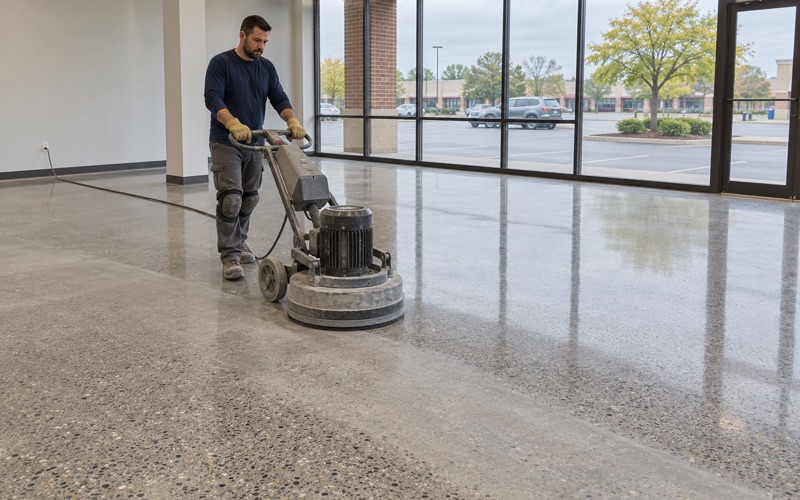
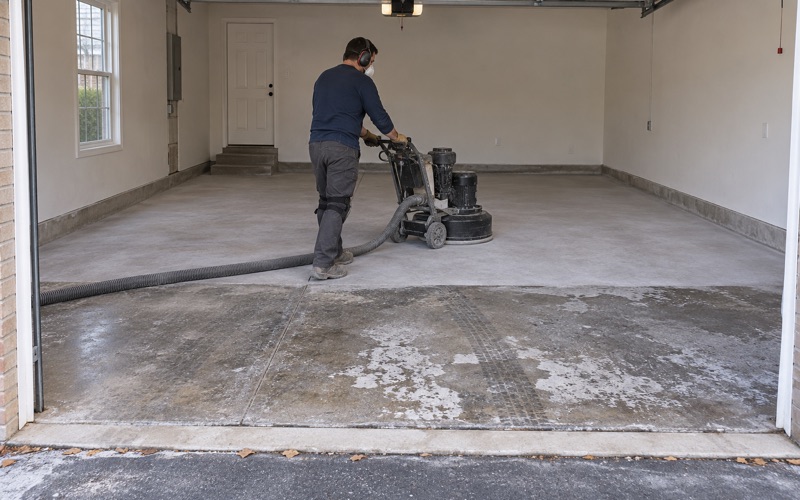
Bay lines only last on a coating that is bonded, and bonding starts with the profile. We open the slab with diamond grinding or shot blasting to an ICRI concrete surface profile suited to the system, capture the dust at the machine with a vacuum, and never rinse it toward a floor drain or sump. In a room that handles chemicals, the drains are no place for anything extra.
A moving crack running across the room would carry a leak from one bay to the next no matter how good the topcoat is, so we flag it and talk through repair before a bay plan is drawn on top of it. Old coatings peeling at the edges come off during grinding rather than being coated over, since a new layer bonded to a failing one only moves the gap up.
Color and Markings by Class
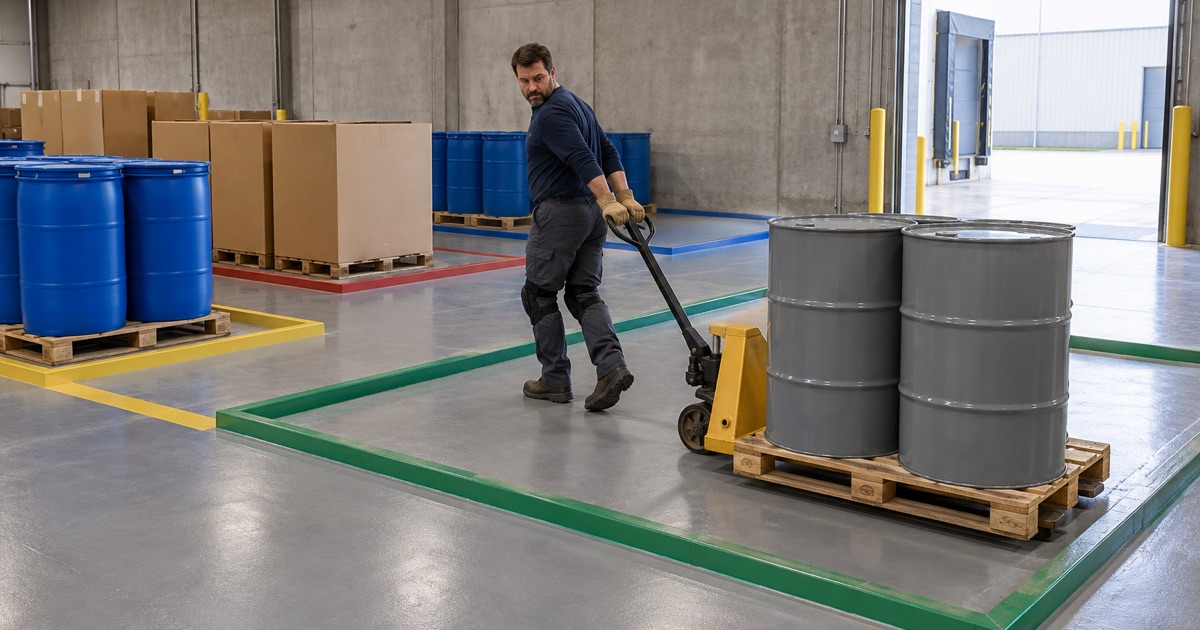
Once the base system is down, bays can be laid out in the coating itself, with lines, borders and colored fields marking where each hazard class is meant to wait. Marked floors do not replace labels, placards or the shop’s written procedures, but they make the plan visible to anyone with a pallet jack at the moment a load is set down.
The layout comes from the operator, not from us. Which classes must go to separate facilities, which pairs can share a room with O-level separation, and where corrosives sit relative to flammables are decisions for the people who hold the dangerous-goods training. Our part is to put their plan into the floor accurately and durably.
Lips and Curbs Between Incompatible Bays
Where two bays hold classes that must not meet, a raised lip or curb between them adds a physical edge that a coating alone cannot provide. Resin can be built into a cove at walls and columns and carried over a curb so the surface stays continuous, with no seam where the curb meets the slab for a leak to find.
That curb work is planned around forklift and pallet jack traffic, because a lip that tips a load creates a different spill. We discuss heights and ramped transitions with the operator, and if a bay needs real containment volume, that is an engineering question for the facility and its advisers rather than something a floor coating provides.
Seamless Floors and What a Coating Is Not
Closing Joints So Liquid Stays Put
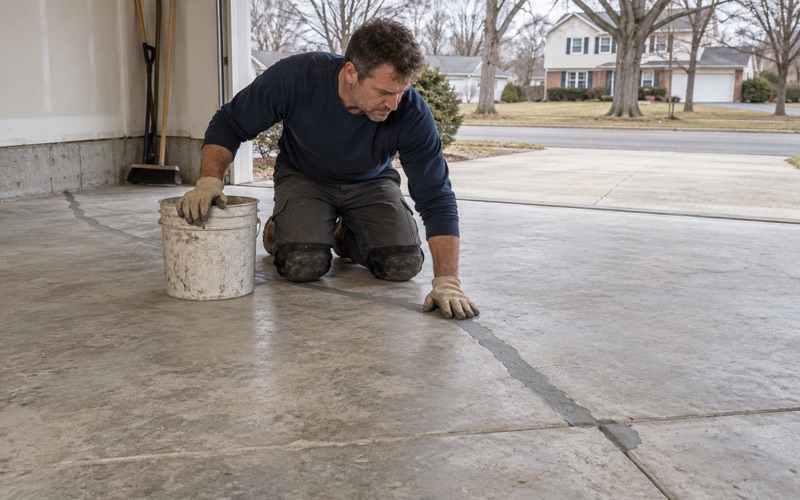
Saw-cut control joints are where a seamless floor is won or lost. In a room planned around leaks, we fill and detail joints so liquid cannot run along them, using a filler matched to the 100% solids epoxy body coat. We also tell the owner which joints are expected to move and will need attention over the life of the floor.
A joint that moves will eventually crack any rigid filler laid over it, so those lines get a flexible material and a place on the maintenance list rather than a promise that they will never open. Seamless is a description of the finished surface, not a guarantee about the concrete under it.
A Surface That Cleans Back to Resin
A chemical floor is judged by what is left after a spill is cleaned up. A smooth or lightly textured 100% solids epoxy or urethane cement system, with a polyaspartic topcoat where it suits, lets spill pads and mops lift residue off the surface instead of leaving it in the pores of bare concrete. Slip resistance is specified by the broadcast and topcoat, not promised as a slogan.
Texture is a trade-off here. A coarse quartz aggregate broadcast gives traction but holds residue, while a smooth surface wipes clean but can be slick when wet. We settle that bay by bay with the operator, since the floor that holds corrosive liquids may need a different finish than the aisle that carries the pallet jack.
Not Containment and Not a Compliance Stamp
Segregation under 49 CFR 177.848 comes from how packages are placed, how bays are laid out, what the procedures say and how leaks are handled. A resin floor is not secondary containment, and no finish puts a room in line with that rule by itself. The floor supports the system by keeping a spill visible, on the surface and out of the joints, so trained people can deal with it.
We explain what a coating warranty leaves out before the job is sold, and moisture vapor coming up through the slab is the first exclusion we name. Cure follows slab temperature and dew point rather than the calendar, and work in an operating shop is phased around its hours, with overnight or weekend windows when a room cannot close.
- 20+ Years in Business
- Moisture Test in Every Scope
- Diamond-Ground, Never Acid-Etched