Buffalo Grove Epoxy Flooring brings more than 20 years of epoxy flooring work to Brookfield, and this page is about a floor most people never look at: the strip of concrete around a training mat. Where people train barefoot, the floor beside the mat is part of the training surface, whether anyone planned it that way or not. We coat those margins as seamless, sealed surfaces built to be scrubbed every day.
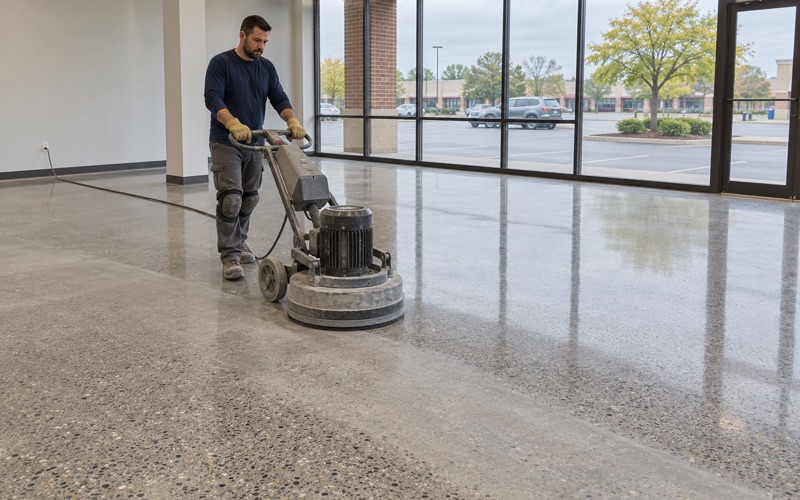
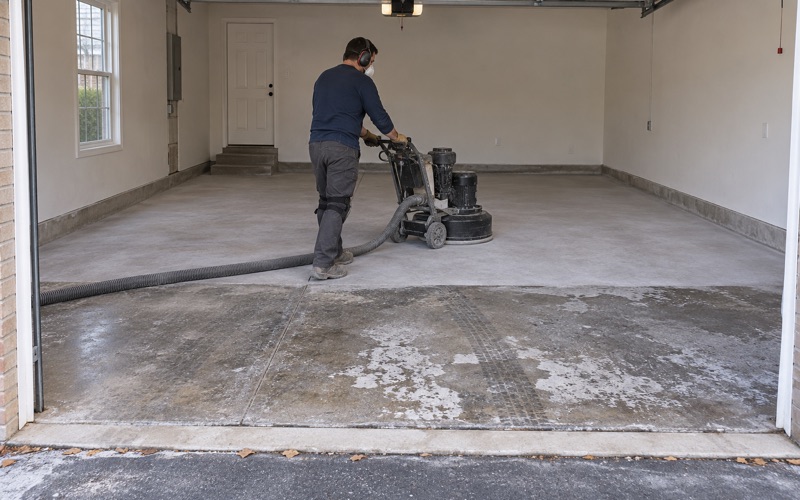
The work starts the same way on a commercial gym floor or a basement mat room. We open the slab with a diamond grinder or a shot blaster rather than an acid etch, so the primer bites into a real profile, and we map cracks, spalls and any old coating before quoting. If the slab needs repair first, or should not be coated at all, we tell you so.
Our proposals name the product line, the number of coats and the finished thickness, so you can hold the finished floor against the quote. A moisture test is written into the scope before the price is final. One thing we will not sell: a coating is not a disinfectant and does nothing on its own against what spreads in a gym. Cleaning does that work, and a sound coating is what lets cleaning reach the whole surface.
A Martial-Arts Mat on Ogden Avenue
Galloping Ghost Gym and Martial Arts sits at 9201 Ogden Avenue, inside Brookfield village and Lyons Township. The operator describes a gym founded in 2019 with free weights, strength and cardio machines, and a large open mat for classes and martial arts programs. It is a separate business from the Galloping Ghost arcade and pinball rooms farther along the same stretch.
We have not worked there, and we have not seen its floor finish, its mat brand or its cleaning routine. We use it here because it shows the layout plainly: a big mat in a room that also holds weights and machines, with people stepping on and off that mat all session long.
The Floor Around the Mat Is a Bare-Foot Floor
Martial arts classes are usually trained barefoot. Students walk from the changing area to the mat, leave it for the restroom or a water break, and walk back on. Every one of those trips crosses the concrete or coating around the mat, and whatever the soles pick up there is carried onto the surface where people grapple and fall.
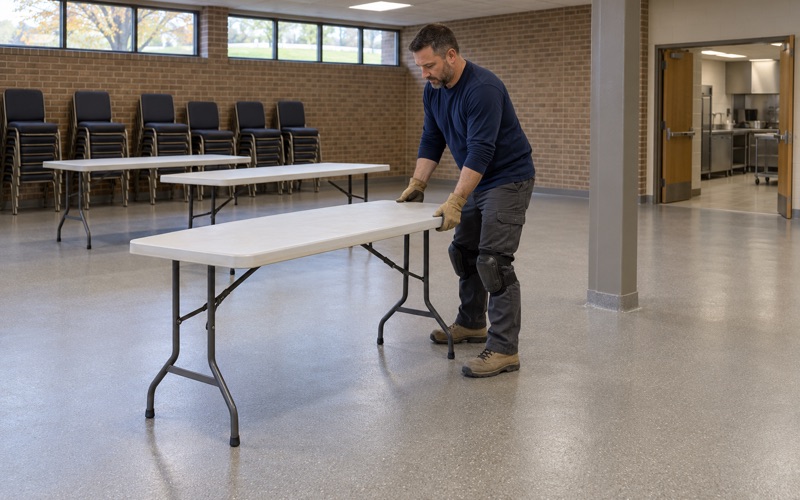
That makes the mat margin a bare skin contact surface in practice, even though nobody trains on it. We treat it that way in the scope: a continuous coat with no open seams, edges sealed where the coating meets the mat border and the walls, and a topcoat that stands up to daily scrubbing.
Street Shoes and Bare Feet on One Floor
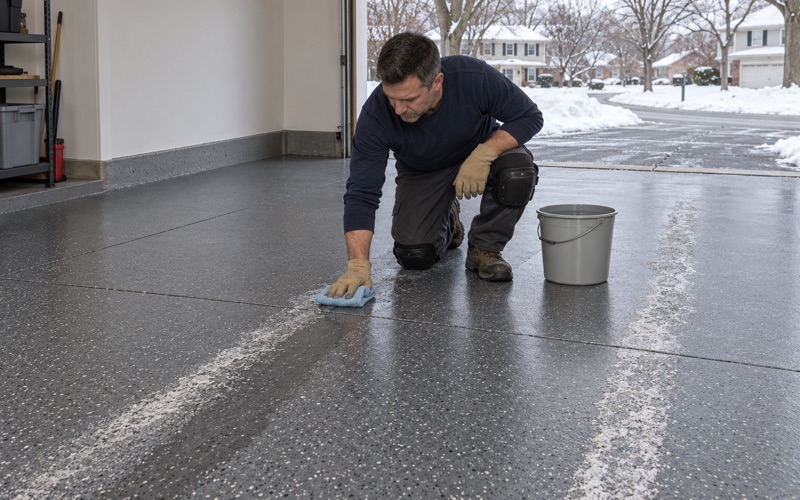
In a mixed room, the same margin also takes street shoes from the weight area and the front door. Grit and winter salt tracked in on soles grind at a coating and end up under bare feet. Where a gym sets footwear rules, a clearly bounded coated zone around the mat makes the line easy to see and easy to keep clean.
We can mark that boundary in the coating itself with a color change or a contrasting stripe, which outlasts tape. The choice is yours; the point is a margin that reads as part of the training floor, not as leftover hallway.
Where the Mat Edge Meets the Coating
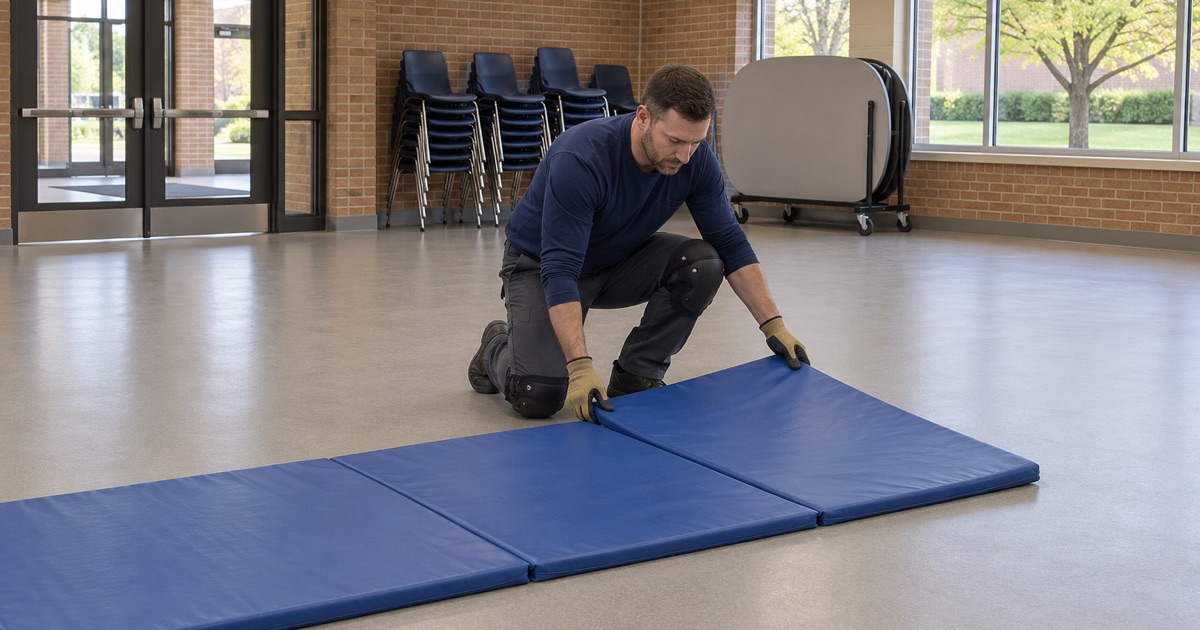
Mats shift, and their edges are where water, sweat and dust collect. A coating that stops short of the mat, or runs under it with a raw cut edge, leaves a strip of bare concrete that cannot be wiped clean. We carry the coat fully under the mat footprint where the layout allows, so the mat can be lifted and the floor beneath washed too.
Looking for epoxy-flooring closer to Pingree Grove? See Epoxy-Flooring Services in Pingree Grove.
What CDC Says to Clean in a Gym, and How Often
The CDC’s guidance for athletic facilities on MRSA prevention says to keep facilities and shared equipment clean whether or not anyone has been infected. It tells facilities to focus on surfaces that come into direct contact with people’s bare skin each day. The page does not name floors or mats specifically, but a barefoot mat margin fits that description closely.
We are not aware of any infection problem at the Ogden Avenue gym or anywhere in Brookfield. The guidance is written as routine practice, which is exactly why a floor has to be built for it. Daily cleaning is the baseline, not a reaction to a problem.
Bleach, Detergents and List H Products
CDC names three ways to remove MRSA from surfaces: household bleach mixed at 1/4 cup of 5.25 to 6.0 percent bleach per gallon of water, detergent-based cleaners, or EPA List H disinfectants. Whichever a gym uses, the floor sees it daily, along with the scrubbing and rinsing that go with it.
So we pick the topcoat for chemical resistance to the cleaner the facility actually uses, and we ask for its label before we specify. Polyaspartic and polyurea topcoats and many 100% solids epoxy systems tolerate dilute bleach well, but a manufacturer’s resistance chart, not a general rule, is what we put in the proposal.
Let It Dry Before Feet Return
CDC also says to clean shared equipment after each use and let it dry before the next use. On a floor, drying time depends on the surface. A nonabsorbent coating sheds the solution and dries evenly, while bare or worn concrete soaks it up and stays damp in patches long after the mop has passed.
That is one reason we avoid a heavy aggregate texture on a barefoot margin. Deep texture holds water and cleaner in its valleys. A light broadcast under the topcoat gives some traction while still letting a squeegee clear the surface.
Scheduling Around Open Hours
A gym that cannot close for a week still needs its margin coated. We phase that work around operating hours, using overnight and weekend windows, and we set the cure schedule by slab temperature and dew point rather than the calendar. Fast-curing polyaspartic topcoats can shorten the time before foot traffic returns, and the proposal states when that is.
A Chipped Coating Is a Surface You Cannot Clean
The same CDC page tells facilities to repair or dispose of equipment and furniture with damaged surfaces that do not allow for adequate cleaning. Apply that to a barefoot floor and a chip stops being cosmetic. The broken edge, the exposed concrete underneath and the gap where coating has lifted all hold moisture and soil that a mop slides over.
Why Coatings Chip and Lift
Most coating failures trace back to preparation. A floor that was acid etched, or coated over a sealer, a curing compound or oil, never had a sound bond to lose. We grind or shot blast to a measured ICRI concrete surface profile, so the primer has something to hold, and we test for residue before any coating goes down.
Moisture is the other common cause. Vapor pushing up through a slab can lift a coating from below, which is why we test before we coat, using ASTM F2170 in-situ relative humidity probes or an ASTM F1869 calcium chloride test, and why moisture is the first exclusion we name in any coating warranty.
Repair as a Hygiene Item
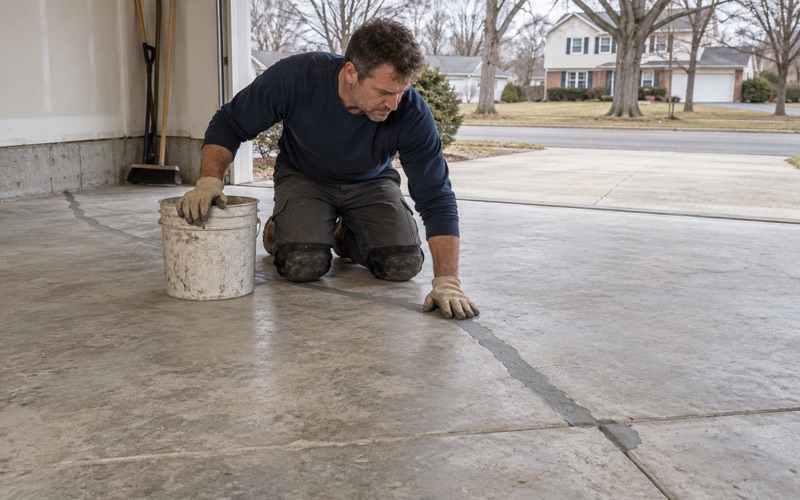
When a margin chips, we treat the repair as part of keeping the room cleanable, not as touch-up paint. That means cutting back to sound coating, grinding the edges so the patch feathers in, and rebuilding the full system in that spot rather than dabbing topcoat over the hole.
If a coating is lifting across a wide area, spot repairs will keep failing at their edges. In that case we say so and quote removal and a recoat, because a floor that keeps opening up is the damaged surface the guidance describes.
Seams, Joints and Cove Edges
Control joints and the line where floor meets wall are where soil builds up first. We fill joints with a flexible filler compatible with the coating, and where a gym wants it, we run the coating a few inches up the wall as a cove so there is no corner for a mop to miss.
Home Mat Rooms and Garage Gyms in Brookfield
The same reasoning holds at home. Brookfield’s housing is mostly single-family detached, and much of it was built before 1960, so a home gym often lands in an older basement or a garage fitted with puzzle mats and a heavy bag. If people walk on and off those mats barefoot, the floor around them is a bare-foot floor too.
Basement Mat Rooms
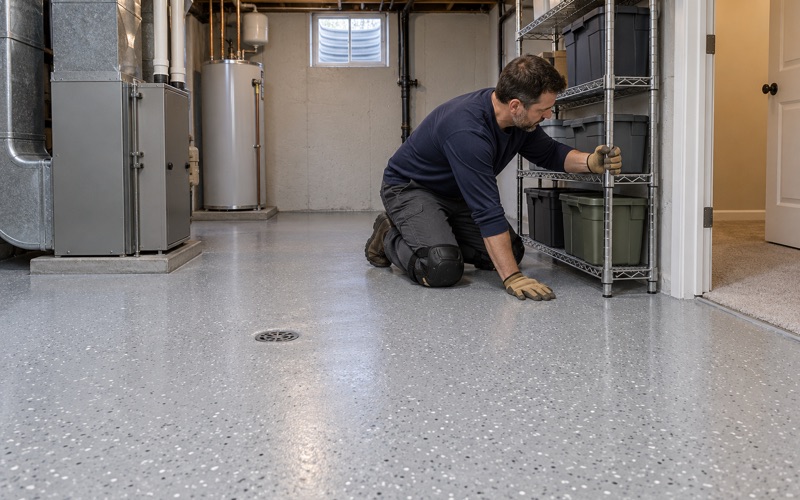
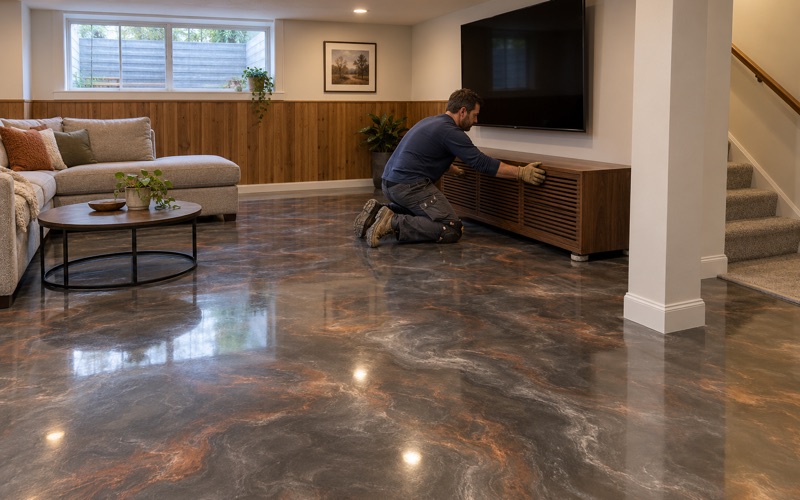
A coating does not stop seepage or fix a sump that cannot keep up, so we read a basement for past water before quoting. Puzzle mats laid over a damp slab trap moisture against the floor and smell long before they look bad, which makes the room harder to keep clean, not easier.
When the slab tests dry enough, a 100% solids epoxy base with a polyaspartic topcoat gives a mat room a seamless floor that takes a bleach solution. When it does not, we talk through a moisture-mitigation primer, or we tell you to deal with the water first.
Garage Training Spaces
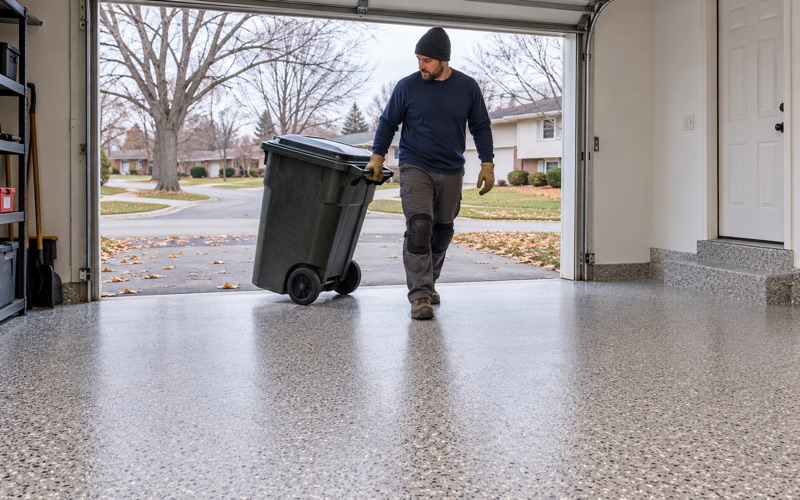
A garage gym often shares its floor with cars for part of the year, and that brings brine and rock salt in on the tires all winter. We choose garage systems to hold up to that salt and to hot tire pickup, then lay the mat zone out so salty meltwater does not drain toward where people train barefoot.
We tell the owner of an unheated garage to wait out deep winter. Epoxy that cures below its temperature range or too close to the dew point can blush and bond poorly, and a weak bond is the start of the chips this page is about.
Contracts and Dust on Home Jobs
Home jobs over the state threshold get a written contract and the Illinois Home Repair: Know Your Consumer Rights pamphlet before any grinding starts. Inside a house, grinding dust is captured at the machine with a vacuum, not rinsed toward a floor drain or a sump, which matters in a basement where the drain is the room’s low point.
Before a date is set, we walk the room with you, mark where the mats will sit and where bare feet will travel, and price the coated margin to match. The proposal then lists the system, the coats and the thickness for that exact footprint.
- 20+ Years in Business
- Moisture Test in Every Scope
- Diamond-Ground, Never Acid-Etched