Buffalo Grove Epoxy Flooring has spent more than 20 years putting epoxy flooring in Cary shops, plants and garages where something spills and has to come back up. On this page we look at one kind of spill in particular: solvent-borne paint, stain and thinner. On bare concrete it soaks in and stays, and on a sealed resin floor it dries on top and scrapes off.
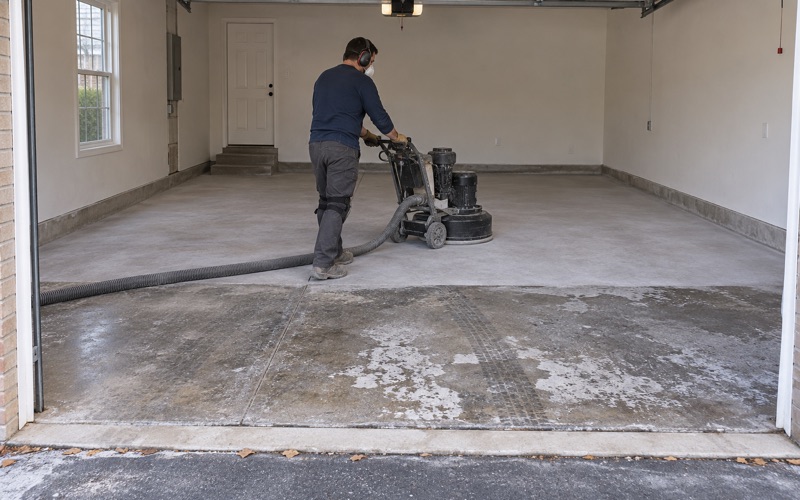
Every job starts the same way. We open the slab with a diamond grinder or a shot blaster, never an acid etch, so the coating has a real profile to grip. The moisture test goes into the written scope before the price is final, because a floor that fails from below fails no matter how good the resin is.
Our proposals name the product line, the number of coats and the finished thickness, so whoever signs off can hold the floor up against the quote. That matters to a plant engineer in Cary, Illinois, and it matters just as much to a homeowner who stains furniture in the garage and wants to know what the floor will take.
Fifty Years of Paint on Jandus Road

Cary has had a paint plant on Jandus Road since 1976. By a 2023 trade-press account it covers more than 600,000 square feet of manufacturing space, and True Value Manufacturing is named among the major employers that make manufacturing Cary’s top sector. A floor contractor reads a plant like that for what lands on the concrete, every shift, for decades.
Oil and Latex, Stains and Aerosols
The published list is specific: oil and latex paints, stains, cleaning chemicals, aerosols and paint applicators. The plant added a filling line that photographs every can and fills latex architectural paint at up to 90 gallons per minute. That is a lot of liquid moving through a building, and the oil-based share of it does not behave like latex.
A latex spill dries where it lands. An alkyd paint, an oil-based stain or the thinner used to clean up after either one carries solvent, and solvent is what turns a housekeeping question into a fire-protection question. We cover that distinction because it decides what the floor underneath has to do, on a filling line and on a home workbench alike.
A Change of Hands Announced in 2026
On June 8, 2026, Do it Best and Sherwin-Williams announced that Sherwin-Williams will take on the Cary paint manufacturing facility, assume its lease structure and retain the Cary team. No closing date was given, so as of this writing the deal is announced rather than done. Do it Best had completed its purchase of True Value, paint plants included, in November 2024.
We have no relationship with any of these companies and have not seen the plant’s floors, its solvents or its cleanup practice. What follows is how we would think about a floor in a building that handles flammable liquids, worked out from the published federal rule, not a report on any particular plant.
Looking for epoxy-flooring closer to Schiller Park? See Schiller Park Epoxy-Flooring.
What OSHA’s Flammable-Liquids Housekeeping Rule Asks of the Floor
OSHA rule 29 CFR 1910.106(e) covers flammable liquids in industrial plants where those liquids are incidental to the main business or handled in operations such as mixing and filtering. Whether the Cary plant falls under that paragraph or another one was not determined, so we treat its housekeeping section as a useful standard for any floor where solvent is opened, not a verdict on a specific building.
Spills Shall Be Cleaned Up Promptly
Paragraph (e)(9)(i) asks for maintenance and operating practices that control leakage and prevent accidental escape of flammable liquids, and then says it plainly: spills shall be cleaned up promptly. A rule like that assumes the spill can actually come up. On a surface that drinks the liquid, prompt cleanup removes what is on top and leaves the rest in the slab.
That is the floor’s first job in a solvent area. It has to give a crew a smooth, closed surface where a squeegee, absorbent and a scraper finish the work instead of starting it. A coating is not a compliance program; it makes the cleanup the rule already requires possible to do well.
Residue Kept to a Minimum and Removed Daily
Paragraph (e)(9)(iii) wants combustible waste material and residues in an operating area kept to a minimum, stored in covered metal receptacles and disposed of daily. Rags and swept-up absorbent go in the can. The question a floor contractor asks is what happens to the part of a spill nobody can sweep up. On bare concrete that part never makes it to the can at all.
Aisles Clear for People and Fire Equipment
Paragraph (e)(9)(ii) asks for adequate aisles maintained for unobstructed movement of personnel, and so that fire protection equipment can reach any part of the flammable-liquid storage, use or operating area. Painted lines are the usual way to show where an aisle is, and on bare concrete those lines wear through under forklift traffic and go soft wherever solvent touches them.
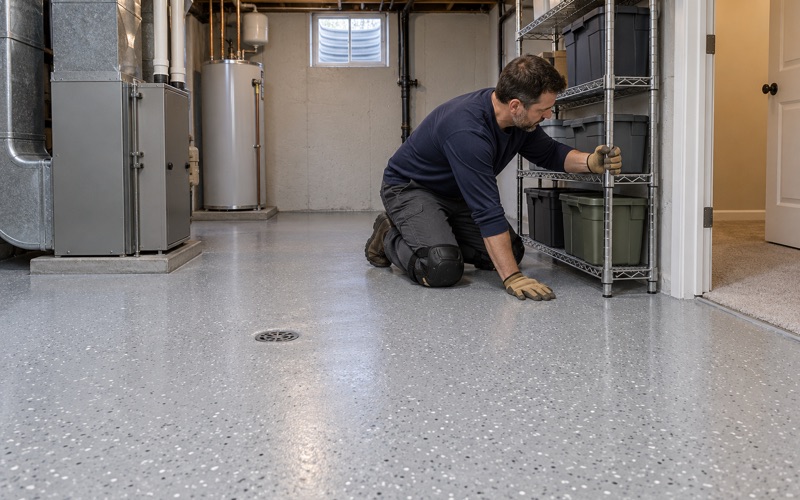
A related provision, (e)(3)(iv)(a), calls for emergency drainage that sends leakage and fire protection water to a safe location, which may mean curbs, scuppers or special drainage. A floor coating has to be detailed around those features rather than over them, so drains and curbs are mapped before anything is priced.
Combustible Residue and the Floor That Sheds It
Why Bare Concrete Keeps the Spill
Concrete is porous. An oil-based paint or stain that hits bare slab wicks into the cement paste before anyone reaches it with absorbent, and then cures in the pores where it landed. Scraping takes off the skin on top; the solvent-borne material below the surface is still there, and so is the combustible residue it carries.
Years of that build up into a dark, stained floor that no daily cleanup can bring back to clean concrete. Wherever the goal is residues kept to a minimum, bare slab works against the crew every shift. Solvent-borne paint soaked into concrete is residue that never leaves.
A Surface Dried Paint Lets Go Of
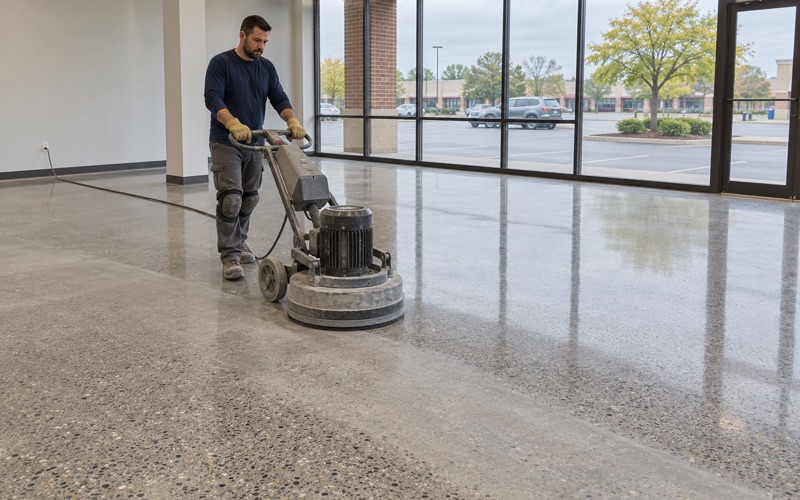
The answer is to close the surface. We grind the slab to a measured ICRI concrete surface profile, then build it up with 100% solids epoxy and a topcoat chosen for the chemistry it will see. The result is dense and smooth, so a dried paint skin can be scraped off without tearing the floor beneath it.
Texture is the trade-off. A slip-resistant floor needs some grit, and grit holds paint. We specify the broadcast and topcoat that set the texture, usually a fine quartz aggregate, and keep it lighter where spills are scraped and heavier on ramps and wash-down zones, so the slip resistance is a line item rather than a slogan.
Checked Against the Plant’s Own Cleanup Solvent
A floor in a paint plant gets cleaned with whatever the plant uses to clean up paint, such as mineral spirits or another solvent. That solvent, not a generic resistance chart, is the test. We ask what the crew actually wipes the floor with, how long it sits and how often, and we choose the topcoat for that exposure.
Where a sample is practical, we put the solvent on a cured test patch and let it dwell before anyone commits to the whole floor. A topcoat that softens or dulls under the plant’s own cleaner is the wrong one, however good its brochure reads. Products are also picked inside the Illinois VOC limits for floor and industrial coatings, which bind whoever applies them.
Marked Aisles That Survive the Scraper
Aisle lines go into the coating system rather than on top of bare concrete. Laid as a pigmented coat under or within the clear topcoat, a line takes the same scraping and the same solvent wipe as the field around it. The aisle stays visible, which is what keeps people and fire equipment moving where they need to go.
A working plant rarely closes for a floor. We phase the job in bays, with overnight and weekend windows when a line cannot stop, and grinding dust is captured at the machine by vacuum rather than washed toward a floor drain. Each bay goes back into service on its measured cure, not on a date picked in advance.
Oil-Based Stain and Thinner in a Cary Garage
The same logic shrinks to fit a house. Cary village has 6,677 housing units, 5,142 of them single-family detached, and in a house like that the garage workbench is the usual place to open a can of stain. A tipped can on bare concrete behaves exactly as it would on a plant floor.
The Workbench Corner
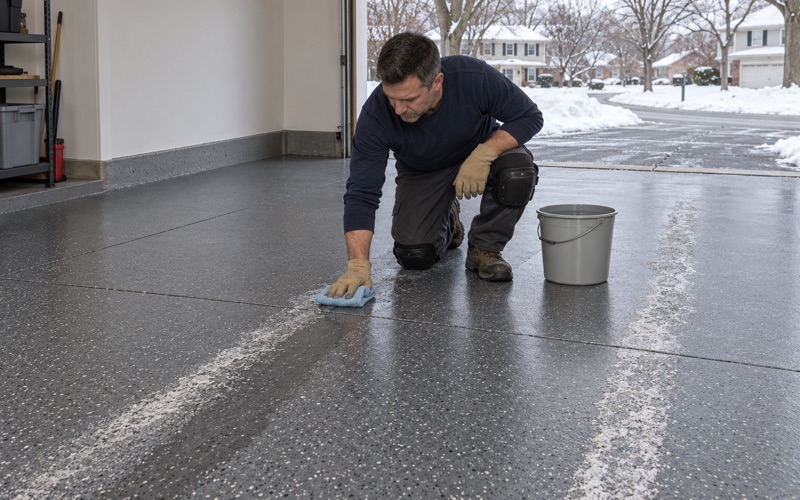
A workbench corner is where a garage floor meets solvent most often. Thinner wiped off a brush, a drip of stain and a rag set down wet all land in the same few square feet. We treat that corner the way a plant would treat a solvent area: a closed surface, a topcoat chosen for the thinner on the shelf, and no bare concrete left exposed.
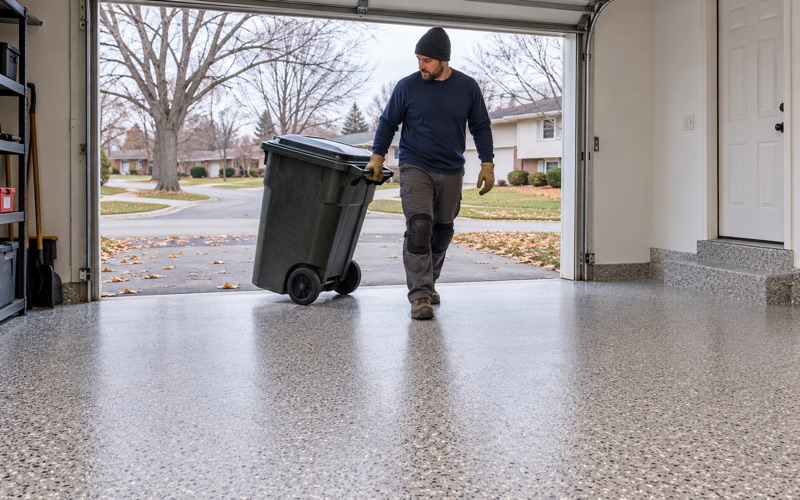
Oily rags belong in a covered metal can, emptied outside, which is the home version of the daily-disposal rule. The floor’s part is to make the drip that missed the can easy to lift. A garage system also has to stand up to the brine and rock salt that ride in on tires every winter, so we build for both exposures at once.
Slab Age, Moisture and What the Warranty Leaves Out
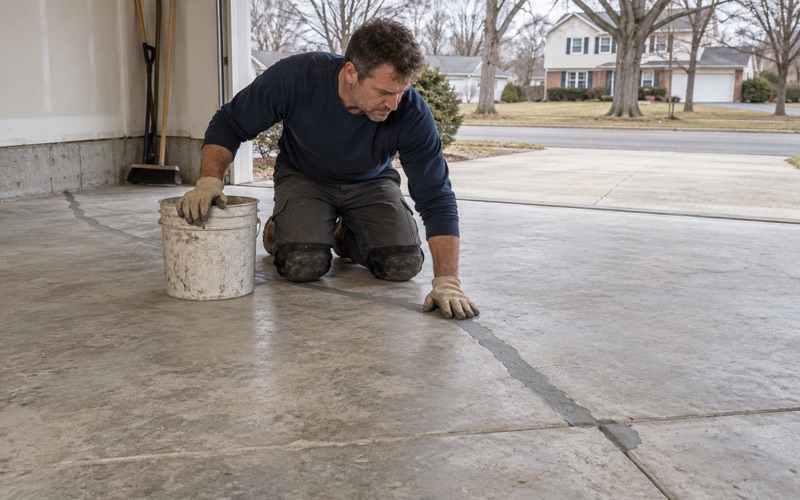
Cary’s housing went up steadily over four decades, with 5,108 units built from 1970 through 2009, so a forty-five-year-old slab and a twenty-year-old one can sit on neighboring streets. We map cracks, spalls and old coatings first and say so when a slab needs repair or replacement before it should be coated.
Moisture is the first exclusion we name when we explain what a coating warranty does not cover. Cure schedules follow slab temperature and dew point, so an unheated Cary garage in deep winter is told to wait. Home jobs over the state threshold get a written contract and the Illinois consumer-rights pamphlet before any grinding starts.
Who Signs Off in Cary
Work inside the village answers to the Village of Cary for building questions, and the fire authority is the Cary Fire Protection District, a separate district with two stations rather than a village department. Cary also takes in a portion of Lake County through Cuba Township, while the industrial addresses on this page sit in McHenry County’s Algonquin Township.
We check permit and registration questions with the right office before a job is scheduled. A floor coating is never sold as radon reduction, because in Illinois that is licensed mitigation work, and it is never sold as a fix for seepage or a sump that cannot keep up.
- 20+ Years in Business
- Moisture Test in Every Scope
- Diamond-Ground, Never Acid-Etched