Buffalo Grove Epoxy Flooring installs commercial epoxy flooring in Buffalo Grove, IL, serving surrounding cities including Prospect Heights, Deerfield, Lake Zurich, Lake Forest and Barrington. Over more than 20 years we have learned that commercial floors succeed or fail on planning as much as on product: what is under the slab, what the room is used for and how the work fits around a business that cannot stop.
Every commercial job starts with the slab. We grind or shot blast it rather than etch it, test it for moisture in writing, and map cracks, joints and old coatings before the price is final. The proposal names the product line, coat count and finished thickness, which gives facility managers something concrete to check against the installed floor.
We then plan the schedule around the building. Offices, labs, shops and kitchens are phased by area, with overnight and weekend windows when a space cannot close, and dust is captured at the grinder so the rest of the building keeps working normally.
Commercial Floors in Buffalo Grove’s Business Districts
Corporate Parks and Office Buildings
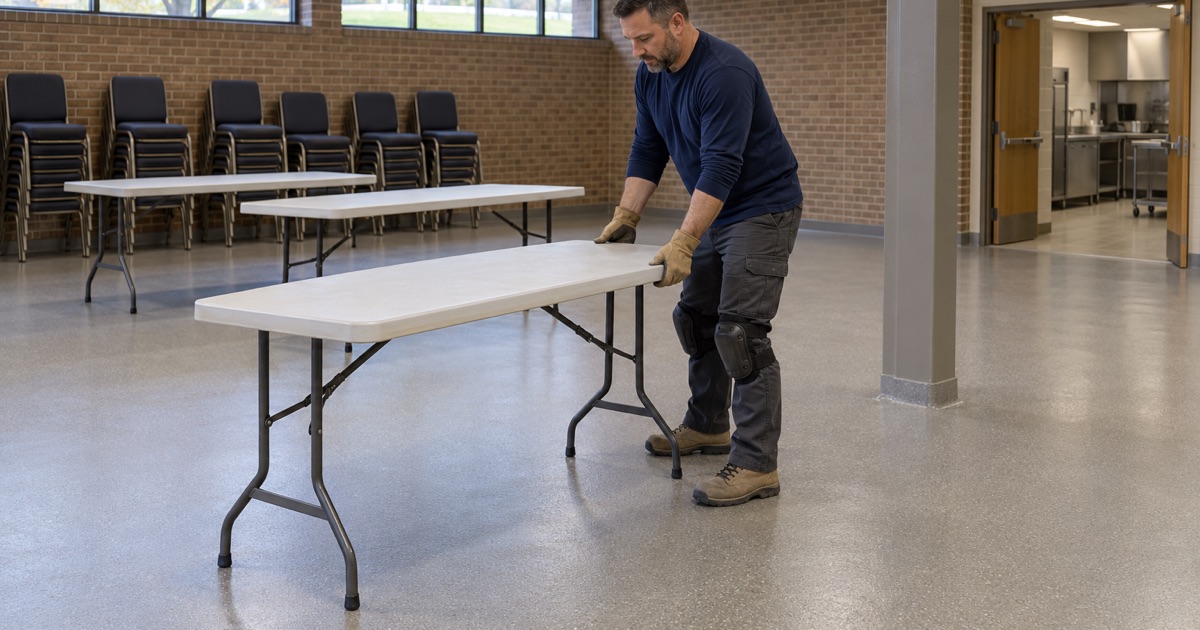
Buffalo Grove’s commercial base is largely corporate and light industrial, from large employers such as Siemens Building Technologies to multi-tenant buildings in Corporate Grove off Busch Parkway, Chevy Chase Business Park on Johnson Drive and Aptakisic Creek Corporate Park at Aptakisic Road and Industrial Drive. Those buildings mix lobbies, break rooms, restrooms, labs and loading areas under one roof.
Each of those rooms needs a different floor. A decorative flake system suits a break room, a chemical-resistant coat suits a lab, and a thick, durable system suits a corridor that carts and pallet jacks cross every day. We specify by room rather than applying one product everywhere.
Retail Along Lake Cook Road and Route 83
Stores and showrooms along the village’s main retail corridors need floors that look clean under display lighting, handle carts and survive winter salt tracked in from parking lots. Epoxy with a flake or quartz broadcast, finished with a UV-stable topcoat, does that well.
Retail floors are usually done after hours in sections, so the store can open each morning. We plan where fixtures will be moved, which aisles close on which night, and how long each section needs before it can take carts again.
Multi-Tenant and Flex Buildings
Flex buildings combine office space at the front with warehouse or shop space at the back. The floor needs change at the door between them, and so does the schedule, since the office side may be busy while the warehouse runs a different shift. We coordinate with tenants and property managers so each area is coated when it is least disruptive.
Choosing the Right Commercial System
100% Solids Epoxy Systems
A 100% solids epoxy builds real thickness in each coat and bonds strongly to ground concrete. It is the backbone of most commercial floors we install, whether as a smooth coat in a storage area or as the base for a broadcast system in a high-traffic corridor.
Thickness is specified to match traffic. A light-duty storage room may need a thin film, while a corridor under carts and pallet jacks needs a broadcast system built several times thicker. The proposal states which applies to each area.
Broadcast Systems for Texture and Durability
Quartz aggregate or vinyl flake broadcast into the base coat adds both durability and slip resistance. The size of the broadcast and the number of topcoats set how textured the finished surface is, which we choose based on whether the floor gets wet, oily or simply dusty.
We never promise slip resistance as a slogan. The texture is written into the specification by broadcast and topcoat, so it can be checked and reproduced when the floor is recoated years later.
Polyaspartic and Urethane Topcoats
The topcoat takes the wear. Polyaspartic and polyurethane topcoats resist abrasion and ultraviolet ambering better than epoxy alone, and they can be recoated later without grinding off the whole system. In areas with harsh cleaners or chemicals, we choose a topcoat rated for the products in use.
When Epoxy Is Not the Answer
Some commercial rooms need a different resin. Kitchens and wash-down areas under hot water often need urethane cement, and electronics areas may need a static-control system. We tell you when another system fits the room better, even when it means a different product line in the proposal.
Moisture, Slabs and Warranties
Testing Commercial Slabs
Commercial slabs vary widely in age and construction. Some have a vapor retarder beneath them and some do not, and older buildings may have had floors removed, patched or replaced in sections. We test with in-slab relative humidity probes or calcium chloride tests as the project calls for, and record the readings by location.
Where readings exceed what the chosen product allows, a moisture-mitigation primer can be added as its own line item. That keeps the decision transparent for the owner and the property manager.
Warranty Exclusions Explained Up Front
Commercial coating warranties almost always exclude failures caused by moisture vapor transmission and hydrostatic pressure. We explain those exclusions, and any others in the product warranty, before the contract is signed so there are no surprises if a problem appears later.
Working Around an Operating Business
Phasing, Nights and Weekends
We break large floors into phases and agree on a sequence with the owner or facility manager. Work can run overnight or over weekends, and fast-curing topcoats let some areas reopen within hours. Each phase has a written start, finish and return-to-service time.
Dust, Odor and Air Quality
Every grinder runs with a vacuum at the shroud, and we seal off the work area from occupied rooms. Products are picked inside the Illinois VOC limits for floor and industrial maintenance coatings, and we coordinate ventilation with the building’s engineers so odor does not travel through shared air handling.
- 20+ Years in Business
- Moisture Test in Every Scope
- Diamond-Ground, Never Acid-Etched