
Buffalo Grove Epoxy Flooring installs commercial kitchen flooring in Buffalo Grove, IL, serving surrounding cities including Prospect Heights, Deerfield, Lake Zurich, Lake Forest and Barrington. A restaurant or bakery kitchen is one of the hardest places for any floor, and in more than 20 years of resin work we have learned that kitchens punish shortcuts faster than any other room.
A commercial kitchen floor takes boiling water, steam cleaning, fryer oil, food acids, sanitizers and heavy carts every day, often within a few hours of each other. It has to stay seamless so bacteria have nowhere to hide, keep staff on their feet when grease and water are on it, and survive temperature swings that crack ordinary coatings.
We start every kitchen job with the slab and the review. The concrete is ground, tested for moisture and repaired, and we confirm what the plan reviewer expects for the room before we specify the system. The proposal names the product, the number of coats, the finished thickness and the texture for each area of the kitchen.
Choosing the Right Kitchen Floor System
Urethane Cement for Heat and Moisture
Urethane cement is the workhorse of commercial kitchen floors. It is a hybrid of resin and cement that tolerates hot water, steam cleaning and thermal shock, the sudden swing from a boiling spill to a cold rinse that can crack or soften standard epoxy.
Urethane cement also tolerates higher moisture in the slab than most epoxies, which helps in kitchens built on older concrete. We still test the slab and record the readings, because every product has limits and the warranty excludes failures caused by moisture beyond them.
Where Epoxy Still Fits
Not every room in a food business needs urethane cement. Dry storage, offices, restrooms and front-of-house areas can take an epoxy or polyaspartic system with a flake or quartz broadcast. We match the system to each room rather than pricing the whole space as the most demanding area.
Texture and Slip Resistance
Kitchen floors need grip. We broadcast quartz or other aggregate into the system and set the topcoat so the texture stays where it is needed. The FDA Food Code allows antislip floor finishes for safety, as an exception to its smooth-floor rule, and that is the balance we strike.
Texture is specified by area. The cook line, fryer station and dish area get the most grip, while prep areas and walkways get a finer texture that is easier to squeegee and mop.
Seamless Floors, Coves and Drains
Coved Floor-to-Wall Junctures
The FDA Food Code calls for coved and sealed floor-wall junctures in areas cleaned by water flushing, so water and debris cannot collect in a corner. We form the cove from the same resin as the floor, typically several inches up the wall, so floor and base are one continuous surface with no seam.
The height and detail of the cove depend on the room and the reviewer’s expectations, which we confirm before we start. Coving is built in place, so it adds time and cost, and the proposal lists it separately.
Floor Drains and Slope
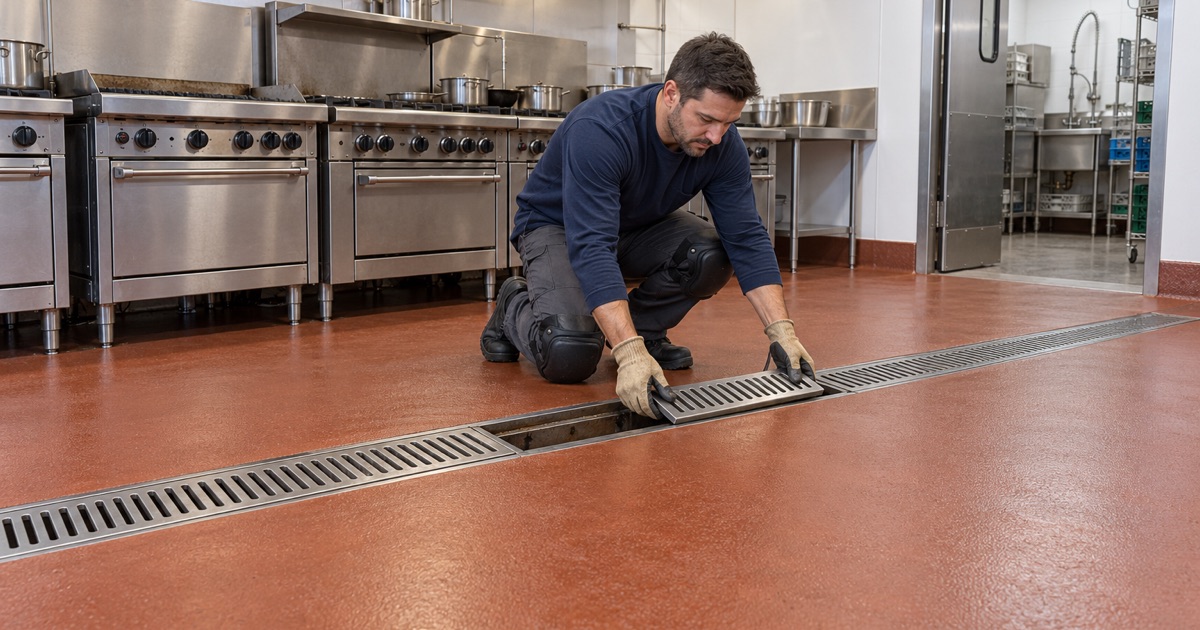
Kitchen drains need the floor around them to pitch toward the grate so water does not pool. Where the existing slab pitches poorly, we can build slope into the system with a trowel-applied mortar before topcoating. We terminate the floor at each drain body with a clean, sealed edge.
Drains and sinks are where most kitchen floors fail first. Water that gets under the coating at a drain edge spreads out and lifts it, so we pay closest attention to those details.
Equipment, Walk-Ins and Transitions
Cooking lines, walk-in coolers and freezers, and heavy equipment complicate a kitchen floor. We coordinate with the owner and any equipment contractor about what can be moved, coat under movable equipment, and terminate cleanly around fixed items while leaving service access.
Walk-in coolers and freezers have their own temperature and moisture conditions. We discuss whether the walk-in floor is part of the scope and whether its insulated panels and existing finish allow a coating at all.
Food Service Rules in Buffalo Grove
Village Health Review
Food establishments in Buffalo Grove answer to the village’s own Health Officer under Chapter 8.08 of the municipal code, with plan review by the village rather than by Cook or Lake County. That applies on both the Cook County and the Lake County sides of the village, so a kitchen’s address within Buffalo Grove does not change who reviews it.
We ask the owner or the village about what the reviewer expects for the floor, base and drains before installation, so the new floor is not questioned at inspection. Where a project involves a new or remodeled kitchen, the floor details belong in the plans the village reviews.
Restaurants Along Lake Cook Road and Route 83
Many of the village’s restaurants, bakeries and cafes sit along Lake Cook Road and Route 83 and in the town center. They rarely close for long, so we work overnight, on closed days or between services, phasing the kitchen by station where needed.
Installation Around Service Hours
Phasing and Fast-Cure Systems
Fast-curing urethane cement systems can be installed and returned to light traffic quickly, which helps a restaurant reopen on schedule. Larger kitchens can be split into phases, with the line coated one night and the dish area another, so the business can keep operating.
Odor, Dust and Food Safety During the Work
We seal off the work area from food storage and front-of-house spaces, capture grinding dust at the machine and ventilate to the outside. Products are chosen inside the Illinois VOC limits, and we time the work so the space is clean and cured before food prep resumes.
- 20+ Years in Business
- Moisture Test in Every Scope
- Diamond-Ground, Never Acid-Etched