
Buffalo Grove Epoxy Flooring installs ESD flooring in Buffalo Grove, IL, serving surrounding cities including Prospect Heights, Deerfield, Lake Zurich, Lake Forest and Barrington. With more than 20 years of resin floor work behind us, we treat static-control floors as part of an engineered system, because a floor that looks right but tests wrong protects nothing.
Electrostatic discharge can damage electronic components without leaving a visible mark, and the damage may not show up until a product fails in the field. An ESD floor gives that static charge a controlled path to ground through the people and equipment standing on it. The floor has to meet a defined electrical resistance range, and that range comes from your ESD control program, not from a product brochure.
We start every ESD job with the specification, the slab and the ground. The concrete is diamond ground and tested for moisture, the grounding points are planned with your facilities team, and the proposal names the product line, number of coats, finished thickness and the resistance range the floor must meet when it is tested.
Understanding ESD Floor Requirements
Conductive and Static-Dissipative Ranges
ESD floors fall into two broad groups. Conductive floors have lower resistance and drain charge quickly, while static-dissipative floors have higher resistance and drain it more gradually. Which one you need depends on the parts being handled, the equipment in the room and the standards your program follows.
Many electronics programs follow ANSI/ESD S20.20, and floor resistance is commonly measured with the test methods the ESD Association publishes. We read your program’s requirements and build the floor to the range they set rather than choosing a product first and hoping it fits.
The Floor as Part of a System
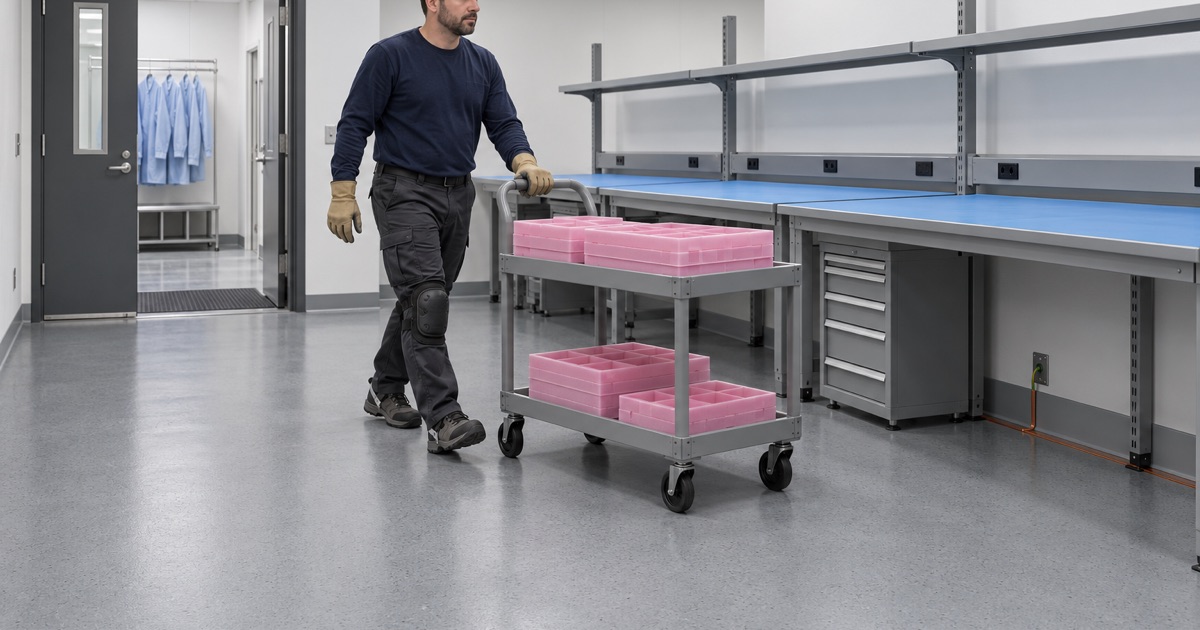
A floor alone does not control static. People need conductive footwear or heel straps, chairs and carts need conductive casters or drag chains, and workbenches need their own grounding. The floor ties those together and gives every connected item a path to ground.
We ask about the footwear, carts and benches in use before we specify the floor, since a floor that performs well with one type of footwear may read differently with another.
Where ESD Floors Belong
ESD floors make sense in electronics assembly and repair, test labs, cleanrooms, data and server rooms, and some munitions or chemical handling areas. They are not needed in break rooms, offices or warehouses that never handle sensitive parts, and we do not recommend them where they add cost without a purpose.
In mixed buildings we often coat the ESD zone with a static-control system and the surrounding corridors with a standard resin floor. A color change or border at the boundary tells staff where footwear rules begin, and it keeps the cost of the static-control product to the area that needs it.
How an ESD Resin Floor Is Built
Slab Preparation and Moisture Testing
Like any resin floor, an ESD system needs sound, open concrete. We diamond grind or shot blast the slab, repair cracks and joints, and test for moisture. High moisture can affect both the bond and the electrical readings, so the results go into the written scope before the price is final.
Old coatings, adhesives and sealers have to come off completely, because a leftover insulating layer under the grounding strips can isolate part of the floor. Grinding dust is captured at the machine, which matters doubly in a building where fine dust is unwelcome near equipment and clean benches.
Copper Grounding Strips and Ground Points
Most conductive and dissipative resin systems use copper tape or grounding strips laid on the primed slab, connected to verified building ground points. The number and spacing of those connections depend on the product and the area, and we plan them with your facilities or electrical team before installation.
Ground points are marked and documented so they can be checked and tested later. A floor whose ground connection is lost or never made reads as an insulator, regardless of how good the coating is.
Conductive Primer, Body Coat and Topcoat
Over the grounding layer goes a conductive primer, then a body coat containing conductive fibers or fillers that carry charge through the film. Some systems add a topcoat chosen for the required range and the wear expected. Coat thickness affects resistance, so we apply each layer at the coverage the manufacturer specifies.
The finished floor can be a solid color or, in some systems, include a decorative chip. We confirm the color and appearance options before ordering, since not every product line offers the same range.
Testing and Documentation
Resistance Testing After Cure
Once the floor has cured, we test it using the method your specification names, usually point-to-point and point-to-ground readings across the area at set locations. Readings are recorded on a floor plan so your quality team can see the results by zone.
If a reading falls outside the range, we investigate before handover. A loose ground connection, a thin area or contamination on the surface can all affect results, and each has a different fix.
Ongoing Checks and Cleaning
An ESD floor’s performance can drift over time with wear and cleaning. Many waxes and general-purpose cleaners leave an insulating film that raises resistance. We provide cleaning instructions and recommend periodic retesting so problems are found before they affect production.
Winter adds its own challenge. Indoor air in a heated building is often very dry in the coldest months, which makes static charge easier to build up. That is when a well-maintained, correctly grounded floor earns its cost, and a good time to schedule a check of the readings.
ESD Flooring in Buffalo Grove Facilities
Electronics and Technology Employers
Buffalo Grove’s principal employers include building technology and electronics manufacturing firms, and its business parks along Busch Parkway, Johnson Drive and Aptakisic Road house a mix of assembly, lab and test spaces. Those are the rooms where static control matters most.
Many of those buildings were built for one tenant and later divided or refitted for another. A room that once held offices may now be a test lab, and its slab may still carry carpet adhesive or vinyl tile mastic, which we remove before any static-control system goes down.
Phasing Around Production
Production lines and labs rarely close for long. We phase ESD installations by zone, work nights and weekends when needed, and coordinate cure and testing windows with production schedules, so equipment can return to a floor that has already passed its readings.
- 20+ Years in Business
- Moisture Test in Every Scope
- Diamond-Ground, Never Acid-Etched