Buffalo Grove Epoxy Flooring installs flake epoxy floor systems in Buffalo Grove, IL, serving surrounding cities including Prospect Heights, Deerfield, Lake Zurich, Lake Forest and Barrington. A flake floor is the most popular choice we install, and more than 20 years of laying them have taught us that the chips you see are only the visible part of a floor whose strength is underneath.
A flake floor is built in layers. The slab is ground to an open profile, a base coat of resin goes down, colored vinyl chips are broadcast into it while it is wet, and one or more clear topcoats lock the chips in and set the final texture. The result hides dust and wear, adds grip and gives the room a finished look.
We write every layer into the proposal: the product line, the number of coats, the finished thickness, the chip blend and size, and whether the broadcast is full or partial. Before any of that, the slab is tested for moisture and its cracks and old coatings are mapped, because a beautiful chip blend over a bad slab still fails.
Choosing Flake Blend, Size and Coverage
Color Blends
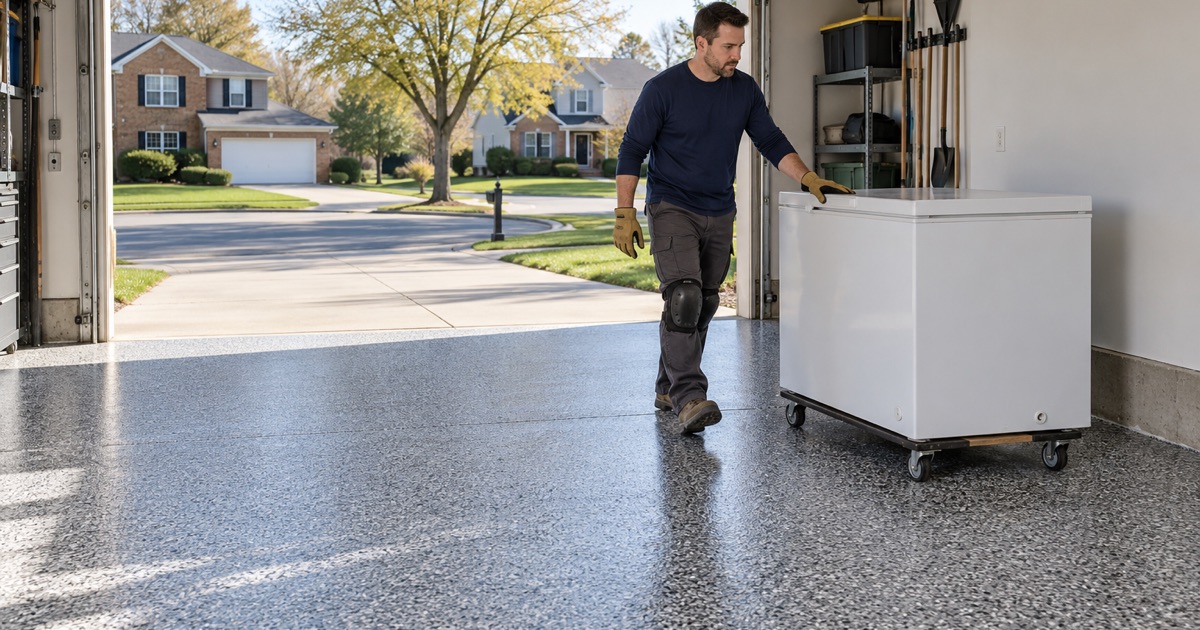
Flake blends mix several colors of vinyl chip, often grays, tans, blacks and whites, with occasional accent colors. Blends with a balanced mix of light and dark hide dust and stains best. Very light blends brighten a room but show tire marks, while very dark blends show dust and salt film.
We bring physical samples and recommend viewing them on your own floor in your own light. A blend that looks warm under a showroom light can read differently in a north-facing garage or a basement with fluorescent fixtures.
Chip Size
Flake chips come in several sizes. Larger chips make a bold, distinct pattern that suits a big garage or shop, where the floor is seen from a distance. Smaller chips give a tighter, more uniform look that suits a basement, laundry room or smaller space.
Chip size also affects texture. Larger chips can leave more relief under a single topcoat, which helps grip but makes the floor slightly harder to mop. We match size to the room and to how the floor will be cleaned.
Full or Partial Broadcast
With a full broadcast, chips are thrown until the base coat cannot hold any more, then the excess is swept and scraped off. No base color shows, the surface texture is even and the chip layer adds thickness and durability.
A partial broadcast scatters chips over a visible base color. It uses fewer chips and gives a lighter, speckled look, but leaves the base coat exposed between chips and offers less texture. We explain both and note the choice in the proposal.
The Layers Under the Flakes
Surface Preparation
Every flake floor starts with diamond grinding or shot blasting to the profile the base coat needs. Acid etching is not part of our process; it leaves an uneven surface and residue that weakens the bond. Grinding dust is collected at the machine rather than washed toward a drain.
During grinding, cracks, spalls and old patches appear. We fill and repair them so the floor finishes level, and where a slab has heaved or broken through, we tell you it needs repair or replacement first.
Base Coat Options
The base coat holds the chips and bonds to the concrete. A 100% solids epoxy builds thickness and has a longer working time, which helps on larger floors. A polyaspartic base cures faster and can shorten the job, at the cost of a shorter working window.
Where the slab’s moisture reading is high, a moisture-mitigation primer goes down first. It is priced as its own line, and the warranty discussion before signing covers what moisture-related failures are not covered.
Clear Topcoats
After the base cures, loose chips are scraped and vacuumed, and a clear topcoat is applied. We usually use polyaspartic or polyurea here, because they resist ultraviolet ambering and abrasion better than epoxy. One coat leaves more texture; two coats give a smoother, more cleanable surface.
The sheen can be gloss or satin. Satin hides tire marks, scratches and the film winter salt leaves better than gloss, which is why we often suggest it for garages that see daily driving.
Flake Floors Room by Room
Garages
Garages are where flake floors are most common, and for good reason. Rock salt, calcium chloride and brine ride in on tires through the winter, and a full-broadcast flake floor with a sealed topcoat keeps that brine on the surface, where it can be squeegeed out, instead of letting it soak into the concrete.
Many Buffalo Grove garage slabs were poured under the model code exception that skips the vapor retarder, so we test garage slabs for moisture before quoting. In townhome and condominium garages, we also confirm the association’s rules and plan around shared driveways before setting a date.
Basements and Laundry Rooms
In basements, a flake floor hides the uneven color of an older slab and makes spills easy to wipe up. We read the slab for past water first, because a coating does not stop seepage, and we leave sump pits and floor drains accessible with clean edges around each one.
Workshops, Locker Rooms and Commercial Spaces
Workshops, locker rooms, break rooms and some retail spaces use flake floors for their durability and easy cleaning. Commercial floors usually get a full broadcast and two topcoats for a smoother, more cleanable surface, and we phase the work around operating hours so the business keeps running.
In locker rooms and other wet areas, we add a fine aggregate to the topcoat and run a coved base up the wall where cleaning water needs to be kept off the joint between floor and wall.
- 20+ Years in Business
- Moisture Test in Every Scope
- Diamond-Ground, Never Acid-Etched