Buffalo Grove Epoxy Flooring approaches epoxy flooring in Fox Lake with more than 20 years of slab work behind us, and the first question we ask here is one many coating crews skip: what will people carry across this floor on the bottom of their feet? In a lake town the honest answer is often sand, and sand shapes the system, the matting and the cleaning plan more than any color choice does.
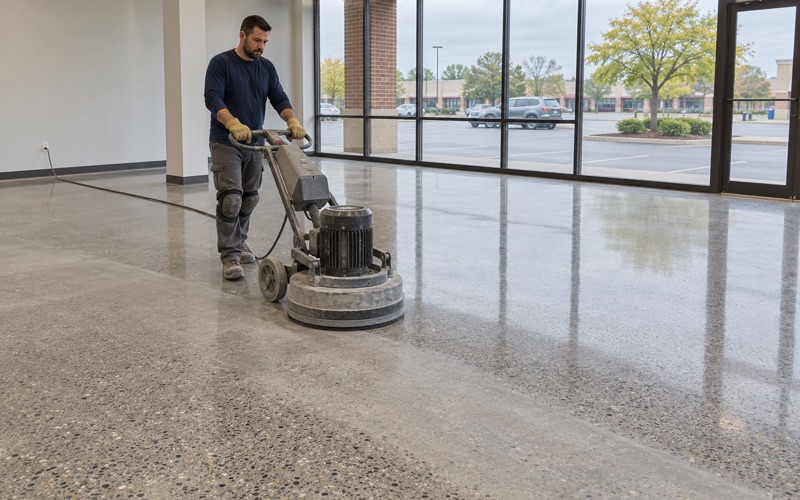
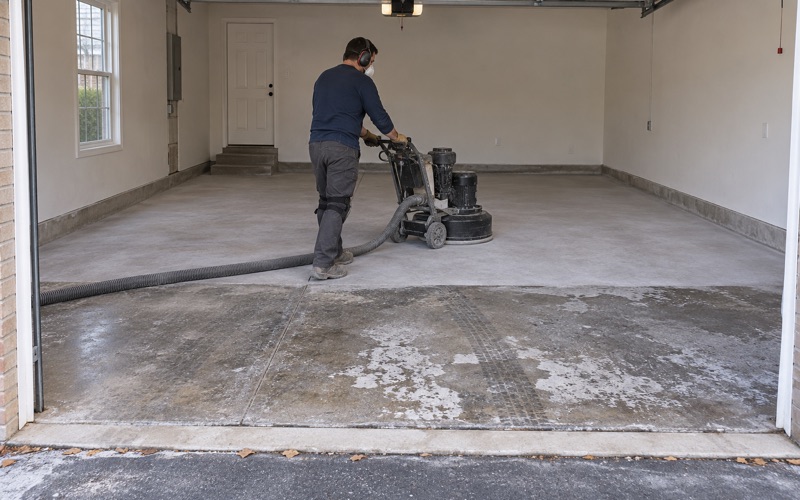
Every slab we coat is opened with a diamond grinder or a shot blaster rather than an acid etch, so the resin has a real profile to hold. A moisture test sits in the written scope before the price is final, and the proposal names the product line, the coat count and the finished thickness. That way a floor can be checked against the quote after we leave.
This page covers the part of the work that is specific to a beach town: how tracked-in sand wears a coating, where a resin floor earns its place in a building that shares a park with a beach, and how a lake house garage or mudroom should be built and cleaned so the gloss lasts past its first summer. We also explain what we will not coat, and why.
A Beach, a Splash Pad and a Recreation Building in One Park
Lakefront Park on Riverview Avenue is the clearest local example of the problem we plan for. Published listings describe a recently renovated park with a sand beach for sunbathing and swimming, a splash pad, a dance studio, modern meeting rooms and indoor and outdoor pickleball, and its Parks and Recreation office lists the same 10 Riverview Avenue address. The address sits in Grant Township, Lake County.
Sand Walks In on Wet Feet
When a beach and a splash pad share a park with an indoor building, sand rides in on wet sandals and damp towels all summer. We have not seen the building’s floors or its door layout, and the village is not our customer. The pattern, though, is common to lakeside facilities, and it is the right way to think about a lake-house entry too.
Wet sand is worse than dry sand because it clings to soles and gets carried farther before it drops. It ends up in the first stretch of corridor, at the restroom doors and under meeting-room chairs, which is exactly where foot traffic pivots and grinds it into the surface. Most of it settles within a few steps of the door, which is why entry design matters as much as the coating.
Where a Coating Belongs
In a beach-side building, a resin coat earns its place in entries, corridors, restrooms and meeting rooms. Those areas often sit on plain concrete slabs, they take the heaviest grit load, and they benefit from a seamless surface that sweeps clean. A fine broadcast texture helps wet feet without creating a profile that traps sand.
We specify slip resistance by the actual broadcast and topcoat, not by a slogan. A quartz aggregate broadcast locked under a polyaspartic topcoat gives grip that stays put, while an aggressive texture in a sandy entry becomes a grit pocket that is hard to clean. The goal is a texture a dust mop can still clear in one pass.
Reading the Slab Before Choosing a System
Before any of that, we map cracks, spalls and old coatings, and we say plainly when a slab needs repair or replacement first. An ASTM F2170 relative humidity probe or an ASTM F1869 calcium chloride test goes into the scope, because a dry-looking surface says little about what the slab below is holding. Moisture is also the first exclusion we name on any warranty.
Looking for epoxy-flooring closer to Forest Park? See Epoxy-Flooring Services in Forest Park.
Sand Is Sandpaper Underfoot
One resin maker is blunt about this. The Floorguard care guide for resinous floors tells owners to sweep, dust mop or vacuum daily to prevent scratches from micro abrasives, and to clean abrasive debris immediately. Beach sand is that micro abrasive in its purest form, and a floor near a beach can meet far more of it than a typical suburban garage.
How Grit Dulls a Topcoat
Under a shoe, a sand grain acts like a tiny cutting point. Each step drags it a fraction of an inch, and thousands of steps leave a haze of fine scratches that reads as a dull lane down the middle of a corridor. The coating underneath is usually intact; it is the topcoat that takes the wear.
That is good news, because a worn topcoat can be renewed without stripping the floor. The same guide calls for a quarterly look at high-traffic wear and puts a topcoat refresh at typically every 3 to 7 years, depending on use. A sandy entry lane will likely sit at the short end of that range.
Dry Removal Before Mopping
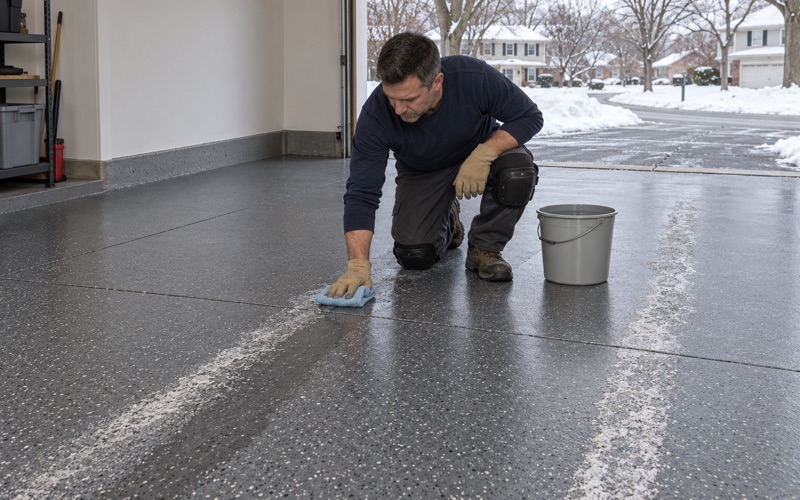
The order of cleaning matters more on a sandy floor than the product in the bucket. Mopping first turns loose sand into a slurry and drags it across the coat in long strokes. We tell owners to sweep, dust mop or vacuum first, then damp mop, and never to reach for a stiff bristle brush or harsh abrasive cleaner.
On a public floor in summer that can mean a dust mop pass more than once a day near the doors. On a home garage it means a push broom before the hose, not after. We put that routine in writing at handoff so it does not depend on memory.
Cure Time Before the Sand Arrives
A new floor is most vulnerable before it reaches full cure. That care guide lists light foot traffic at 24 hours, vehicles at 72 hours and cleaning chemicals only after about seven days, and we set ours by slab temperature and dew point rather than the calendar. Grit tracked onto a soft topcoat in that window leaves marks that do not polish out.
Walk-Off Matting and Harder Topcoats in the Traffic Lanes
The cheapest way to protect a coated floor from sand is to stop the sand at the door. The second cheapest is to put the toughest finish exactly where the remaining grit lands. We plan both together, because a matting sequence changes where the wear lanes form. Neither one works alone.
Scraper, Dryer and Finishing Mats
Cleaning-industry guidance on entrance matting names tracked-in grit as the largest source of finish damage and lays out a three-step sequence: an exterior scraper mat, a scraper and dryer mat, then an interior finishing mat. That guidance was written for floor finishes in general, not resin specifically, but the logic carries straight over to a coated entry.
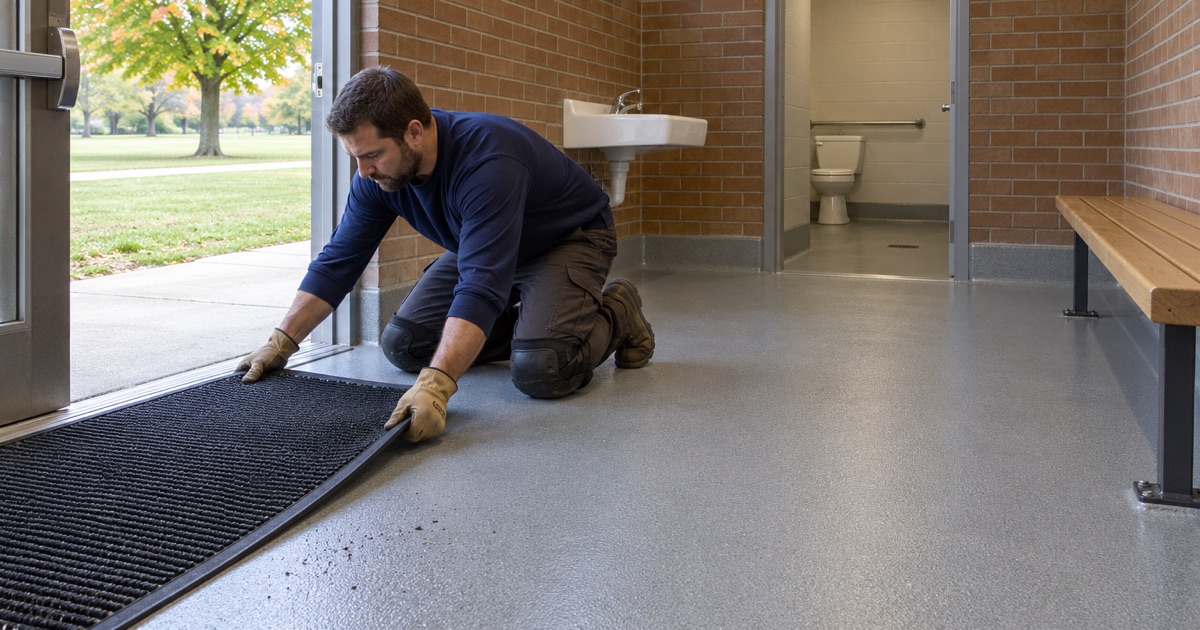
For a beach-side door the dryer stage matters most, since wet sand only lets go once the sole is blotted. Mats also stop working once they are full, so they need emptying on a schedule. We plan the coating edge around where the mats will sit, so a mat border never rides on a chipped lip.
Wear-Rated Topcoats in Entry and Corridor Lanes
Past the mats, the traffic lane is where the remaining sand does its work. In those lanes we favor a harder, wear-rated polyaspartic or urethane topcoat over the base coat, sometimes with an extra topcoat pass where a corridor narrows or turns. Low-traffic rooms off the lane can carry a standard finish without losing anything.
Because each area’s coat count is written down, an owner can later see exactly where the harder topcoat went. When the lane dulls before the rest of the floor, that is the system working as planned: the lane gets a scuff-and-recoat, and the base layers stay untouched. Grinding back to bare concrete is usually not needed.
Sports and Studio Floors Are Left Alone
A recreation building of this kind also holds surfaces we would not touch. A gym’s sport floor, indoor pickleball courts and a dance studio floor are specialty systems chosen for play and movement, and a garage-style epoxy has no place on them. In any building like that, our scope stops at the doors of those rooms.
Lake Sand at Home: Mudrooms, Garages and Boat Gear
The same sand comes home. The village center borders Pistakee, Nippersink and Fox lakes, and a lot of households here spend summer weekends on the water and come back through the garage or a side door carrying wet gear. Those entries take the beach-side building’s problem at a smaller scale. The fixes are the same ones, sized down.
Mudrooms and Side Entries
A mudroom floor sees wet feet, dripping life jackets and sand-caked sandals in a space of a few dozen square feet. We favor a fine quartz broadcast under a polyaspartic topcoat there, a short run of washable matting inside the door, and a cove or tight edge at the wall so sand cannot pack into the joint.
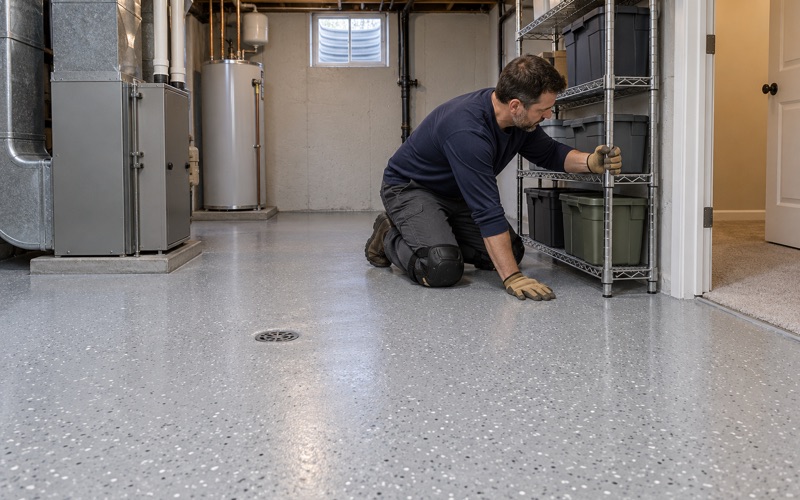
If the mudroom is a basement walkout, we read the slab for past water first. A coating does not stop seepage, and it is never a fix for a wet floor; the moisture test decides whether the slab can hold a coating at all. Sometimes the answer is a moisture-mitigation primer, and sometimes it is to wait.
Garages Full of Lake Gear
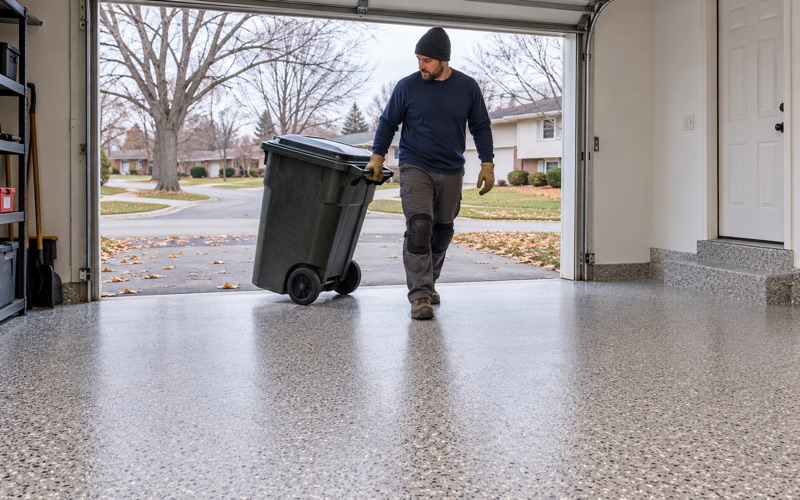
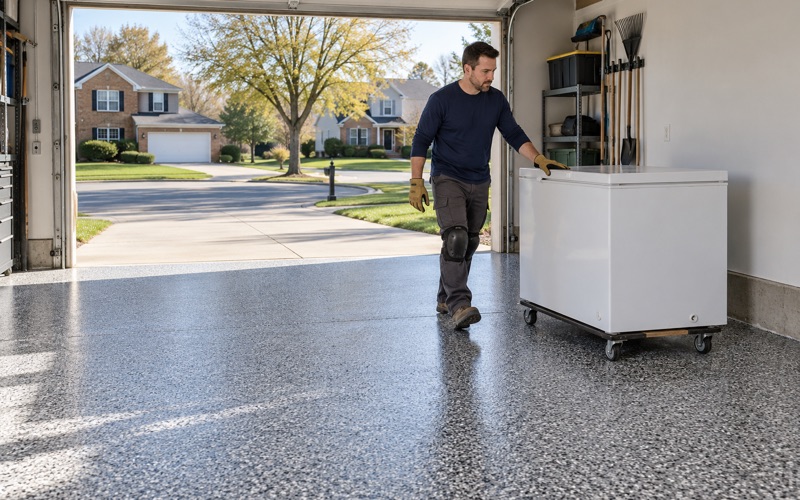
A lake house garage often doubles as gear storage: kayaks, coolers, fishing tackle, wet ropes and a beach cart that dumps sand every time it rolls in. A full-chip vinyl flake broadcast with a polyaspartic topcoat hides that grit visually, which is exactly why the cleaning routine matters; the scratches build up long before the sand shows.
Garages that also park a car need a topcoat rated against hot tire pickup, and the base coat thickness should match the load. Every garage slab is ground or shot blasted to an ICRI CSP profile the primer can grip, and the moisture test belongs in the garage scope just as it does in a basement.
Seasonal Homes, Townhomes and Scheduling
Census counts put 349 Fox Lake housing units in seasonal or occasional use. Owners who are only here part of the year often want the work done while they are away, so we plan cure time, access and the first cleaning around their absence. Nobody should be walking beach sand onto a topcoat that is still curing.
More than 1,100 owner households live in attached single-family homes, and their garage or basement work may run through an association. We sort out association rules and shared driveways before a date is set, and we confirm with the Village of Fox Lake Community Development Department whether a given job needs a permit; the village also asks every contractor for an original $10,000 surety bond.
- 20+ Years in Business
- Moisture Test in Every Scope
- Diamond-Ground, Never Acid-Etched