
Buffalo Grove Epoxy Flooring installs epoxy garage floor systems in Buffalo Grove, IL, serving surrounding cities including Prospect Heights, Deerfield, Lake Zurich, Lake Forest and Barrington. With more than 20 years in the business, we build garage floors in layers on concrete that has been ground, repaired and tested, rather than rolling a coat of paint over whatever the slab happens to be.
A garage floor works harder than most rooms in the house. It takes hot tires in summer, salt-soaked slush in winter, dropped tools, oil drips and the weight of a car turning in place. The coating has to bond to the concrete, flex with its small movements and shed the brine that rides in on every car through the winter months.
Before we quote, we walk the slab, map its cracks and any old coating, and run a moisture test. The written proposal then names the product line, how many coats go down and how thick the finished floor will be, so you can measure the floor we install against the floor we promised.
What Goes Into an Epoxy Garage Floor
Grinding the Slab to a Real Profile
The most important layer of a garage floor is the one you never see: the profile cut into the concrete. We open the slab with a diamond grinder, or a shot blaster where the surface allows, to the concrete surface profile the coating maker specifies, typically measured on the ICRI CSP scale.
Acid etching is the shortcut we skip. It leaves a shallow, uneven profile and residue that has to be rinsed away, and it barely touches concrete that has been sealed or painted. Grinding removes that weak top layer and leaves fresh concrete with enough texture for the base coat to grip mechanically.
The Base Coat and the Broadcast
On most garages, the base is a 100% solids epoxy, which builds real thickness in a single coat and carries no solvent that has to evaporate out. While it is still wet, we broadcast vinyl flake to the coverage you choose, which hides dust and wear and adds a fine texture underfoot.
A full broadcast means flake is thrown until the base coat cannot take any more, then the excess is swept and scraped off. The result is a uniform, textured surface. A partial broadcast shows more of the base color and reads lighter, but it leaves less texture for the topcoat to lock around.
The Topcoat That Takes the Wear
The topcoat is what your tires actually touch. We usually finish garages with a polyaspartic or polyurea coat, which resists ultraviolet ambering from an open door, stands up to abrasion and cures faster than a second epoxy coat would.
The topcoat also sets how the floor feels and cleans. A satin sheen hides tire marks and salt film better than high gloss, and a fine aggregate can be added to that final coat where you want more grip. The proposal states which topcoat goes down and how many coats it gets.
Garage Slabs in Buffalo Grove: Moisture, Salt and Age
Why Many Garage Slabs Have No Vapor Retarder
Buffalo Grove builds to the 2018 International Residential Code under Ordinance 2018-055 and has not amended R506.2.3, so the model exception that lets garages skip the under-slab vapor retarder still applies. The village’s detached-garage handout lists a four-inch slab over four inches of compacted stone, with no sheeting named.
Without that sheeting, ground moisture can travel up through the concrete and push against anything sealed on top of it. That is why a moisture test is part of every garage scope we write. Depending on the slab, it may be a plastic sheet test under ASTM D4263, a calcium chloride test under ASTM F1869, or in-slab humidity probes.
Rock Salt, Brine and Calcium Chloride
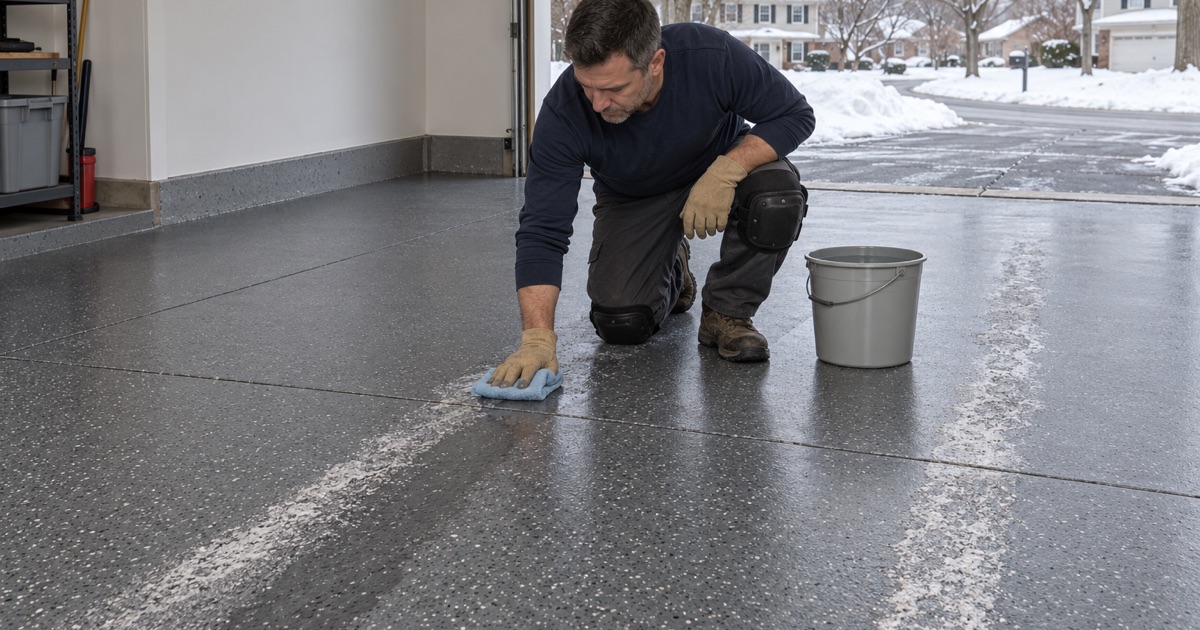
Winter road treatment comes home on every tire. Rock salt, calcium chloride and liquid brine soak into bare concrete, and repeated freezing and thawing of that salty water flakes the surface away a little more each year. Uncoated garage slabs often show it first near the overhead door.
We choose garage systems that hold up to that salt load and leave a surface you can squeegee. Brine that stays on a coating can be rinsed out the door in spring; brine that soaks into bare concrete stays there. Pitting that has already started is filled before coating so the floor finishes level.
Slabs From the 1970s and 1980s
Most homes in the village went up in the 1970s and 1980s, which means many garage slabs have forty or more winters behind them. Expect shrinkage cracks, settled sections near the apron and patches from earlier repairs. We map all of it in the estimate and price each repair as its own line.
Some slabs are past saving. When a section has heaved, broken through or dropped enough to hold water, a coating will only outline the problem. In that case we tell you the slab should be repaired or replaced first, and we would rather lose the job than coat a floor that is already failing.
Our Step-by-Step Epoxy Garage Floor Process
Step 1: Slab Walk and Moisture Test
We look at every crack, stain and old coating, note how the garage drains toward the door, and test the slab for moisture. If the reading is high, the proposal says so and offers a moisture-mitigation primer or a different approach before any price is final.
Step 2: Written Proposal and Paperwork
You receive a proposal naming the product line, coat count and finished thickness, plus each repair line. On home jobs over $1,000, Illinois law calls for a written contract and the Attorney General’s consumer-rights pamphlet, and both are handled before we start grinding.
Step 3: Grinding, Dust Capture and Repairs
On day one we grind the slab with a vacuum attached at the machine, so dust is captured rather than rinsed out the door. Cracks are routed and filled, spalls rebuilt, and the joints decided: honored with a sealant or filled flush, depending on how they move.
Step 4: Base Coat and Broadcast
The 100% solids epoxy base goes down and the flake or aggregate is broadcast into it. We check the slab temperature and the dew point spread at the surface before mixing, because resin applied to a cold or damp slab can cure soft or form amine blush.
Step 5: Topcoat and Return to Service
Once the base has cured enough to scrape, loose flake is removed and the topcoat is rolled on. We give you separate dates for walking on the floor, moving items back and parking, and they follow the cure we observe rather than a fixed promise.
Attached Garages, Townhomes and Winter Scheduling
Attached Garages Next to Living Space
On the Cook County side of the village, most houses have an attached garage, often a two-car one. That puts the work a door away from the kitchen or mudroom, so we seal the house entry, keep the vacuum running during grinding and ventilate through the overhead door.
Townhome and Condominium Garages
Many homes here are townhouses or condominium units with garages that share a driveway or a wall. We check the association’s rules on contractors and working hours, and plan where the trailer and equipment will sit, before a date is set so the neighbors are not blocked in.
Coating Season and Unheated Garages
Nearby weather stations record well over a hundred nights a year at or below freezing, and an unheated garage slab stays cold long after the air warms. If the slab will not hold the temperature the resin needs, we move your date to spring rather than install a floor that cures poorly.
- 20+ Years in Business
- Moisture Test in Every Scope
- Diamond-Ground, Never Acid-Etched