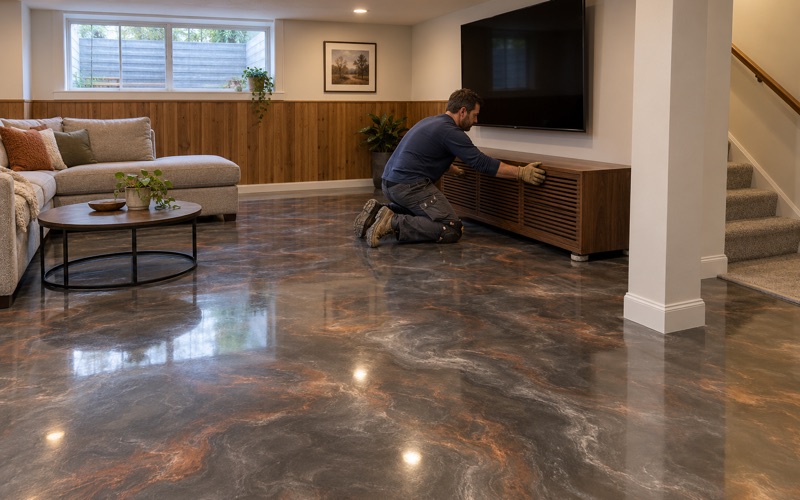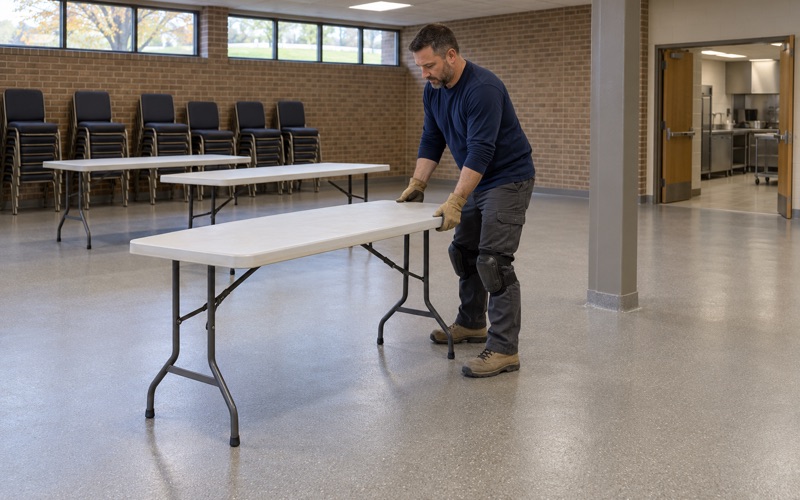
Buffalo Grove Epoxy Flooring takes on epoxy-flooring in Hinsdale with more than 20 years behind us, and the floors we think hardest about are the ones that take daily chemical abuse, from medical office suites to garages and basements. We start by reading the slab and the chemicals that will land on it, because a coating chosen without either is a guess. Then we write down exactly what goes on the floor.
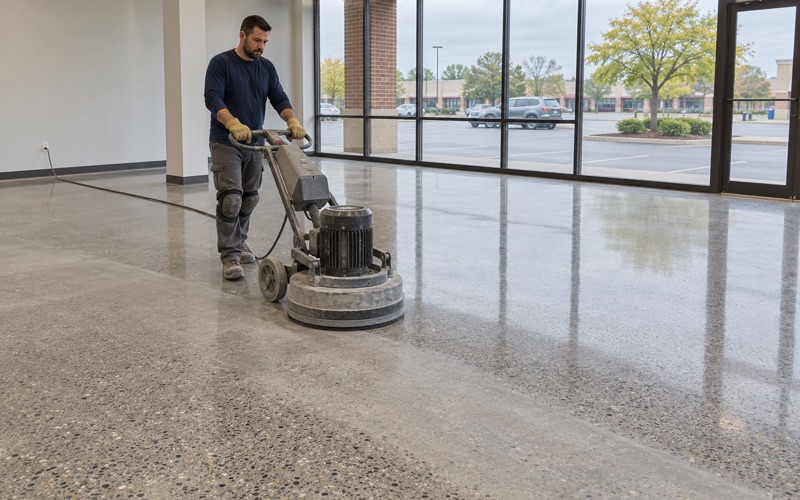
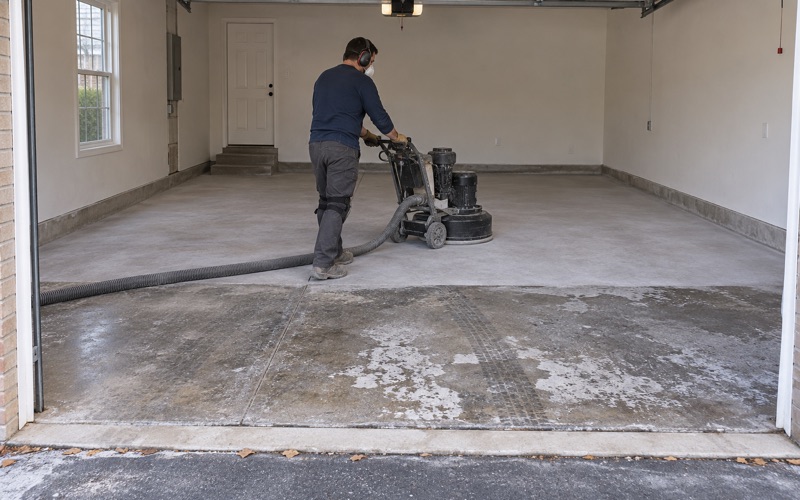
Every proposal we hand over names the product line, how many coats go down and the finished thickness, so the floor can be measured against the paper once it cures. Slabs are opened with a diamond grinder or a shot blaster rather than acid, which gives the resin a real profile to bite into. The grinding dust goes into a vacuum at the machine, not down a drain.
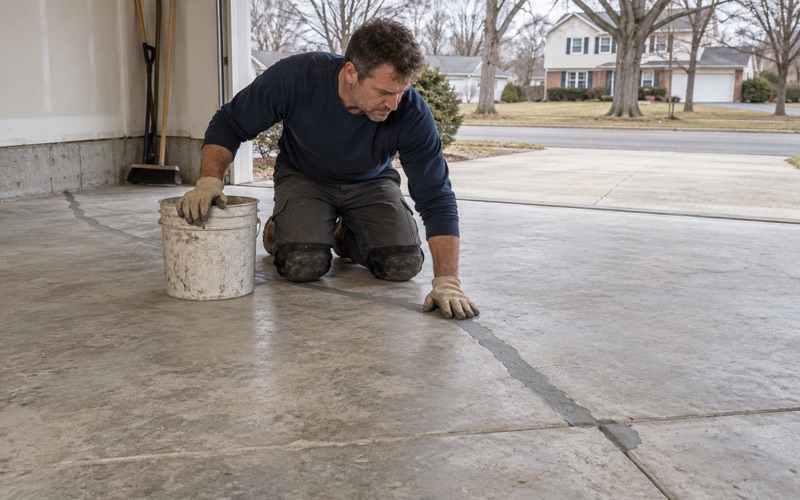
For a clinic, a lab or a shop that cannot close, we phase the work around operating hours and use overnight and weekend windows. Before any price is final, the slab gets a moisture test written into the scope, and we tell you plainly when cracks, spalls or an old coating mean the concrete needs repair first.
In-Office Scope Procedures and the Chemical Soak
On Salt Creek Lane, in the York Township part of Hinsdale, UChicago Medicine Hinsdale lists cystourethroscopy, colposcopy and biopsies among the procedures done at 11 Salt Creek Lane, Suite 300. The suite runs Monday through Friday, 7:30 a.m. to 5:00 p.m. We have not seen its floors or its reprocessing setup, and it is not our customer, but the procedure list says a lot about the kind of room a practice like that needs.
What an office scope procedure leaves behind
A cystourethroscopy uses a flexible scope that goes from one patient to the next during a working day. Between patients, that scope cannot simply be wiped and set aside. It is cleaned and then put through high-level disinfection, which infection-control researchers Rutala and Weber called an essential part of reprocessing reusable devices such as scopes.
In a practice that reprocesses on site, that soak happens in a corner of the suite with a sink, trays or a reprocessor, and staff in gloves and gowns. Every cycle moves liquid from basin to tray to rinse, so drips reach the floor many times a day. The floor in that corner is working, not just being walked on.
The handling rules point at the floor
Rutala and Weber note that ortho-phthalaldehyde, one common high-level disinfectant, must be handled with gloves, eye protection and fluid-resistant gowns around contaminated instruments. Clothing and skin get protection because the chemical marks them. The floor under the tray gets nothing unless someone plans for it, which is where our work starts.
Hours that leave little room for a closure
A suite open five days a week, with lab draws until 4:30 p.m., cannot hand a contractor a two-week shutdown. For an outpatient suite like that, we plan grinding and coating for evenings and weekends, sized so the room is back in service when the first patient arrives. A reprocessing corner is often a small enough area to finish inside one weekend window.
Looking for epoxy-flooring closer to Western Springs? See Epoxy-Flooring Services in Western Springs.
A Disinfectant Whose Label Warns About Floors
One ortho-phthalaldehyde product, ASP’s CIDEX OPA Solution, carries a plain warning in its instructions. Contact may discolor skin or stain clothing, and the solution ‘may also stain environmental surfaces such as countertops, walls and floors.’ That sentence is the reason we treat a reprocessing corner differently from the exam room beside it.
Gray stains from a protein reaction
Rutala and Weber describe the drawback directly: OPA stains proteins gray, unprotected skin included. On a floor, a drip that wicks into a seam, a grout line or porous concrete is out of reach of a mop, and a stain there cannot be counted on to come out. We do not promise a floor that can never mark, because the label itself warns that floors may stain.
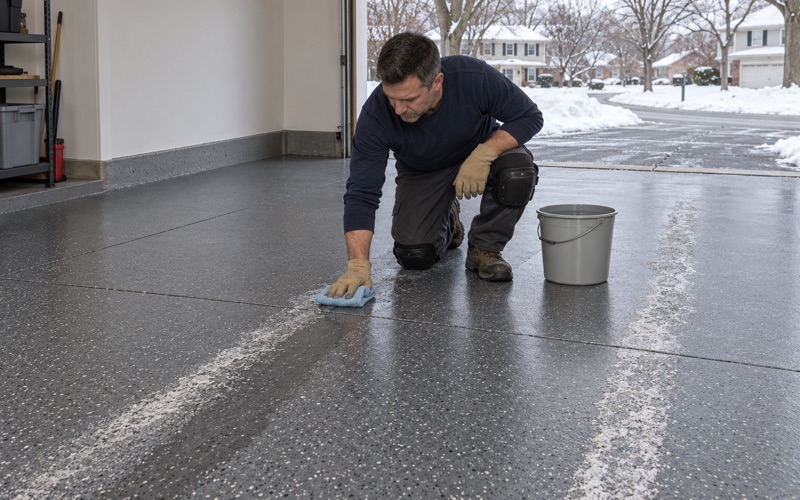
What a seamless floor does change is the odds. A continuous resin surface with no joints gives a drip nowhere to hide, so it stays on top where staff can wipe it, and the topcoat we choose is the layer that drip actually touches. That is a narrower promise, and it is one we can keep.
Reuse life, test strips and disposal
The same instructions set a soak of 12 minutes at 20 degrees Celsius, a reuse life of no more than 14 days, and a test strip before each use. That means fresh solution is poured, tested and changed out on a routine schedule, and each changeover is another chance for a splash.
Spent solution can go down hospital and office drains where local rules allow, sometimes after a glycine neutralizer. A floor near that sink sees the working solution, the neutralized waste and the rinse water, so we plan the cove and the wall run around where the pouring actually happens.
Laying Out the Reprocessing Corner as a Wet Zone
Many medical office suites are built out with carpet in the halls and vinyl tile or sheet goods in the clinical rooms, which is fine where the work is dry. A reprocessing corner is wet chemistry throughout the day. We lay it out as its own zone, with a floor that is one continuous surface from the sink wall to the doorway.
An integral cove behind the sink and trays
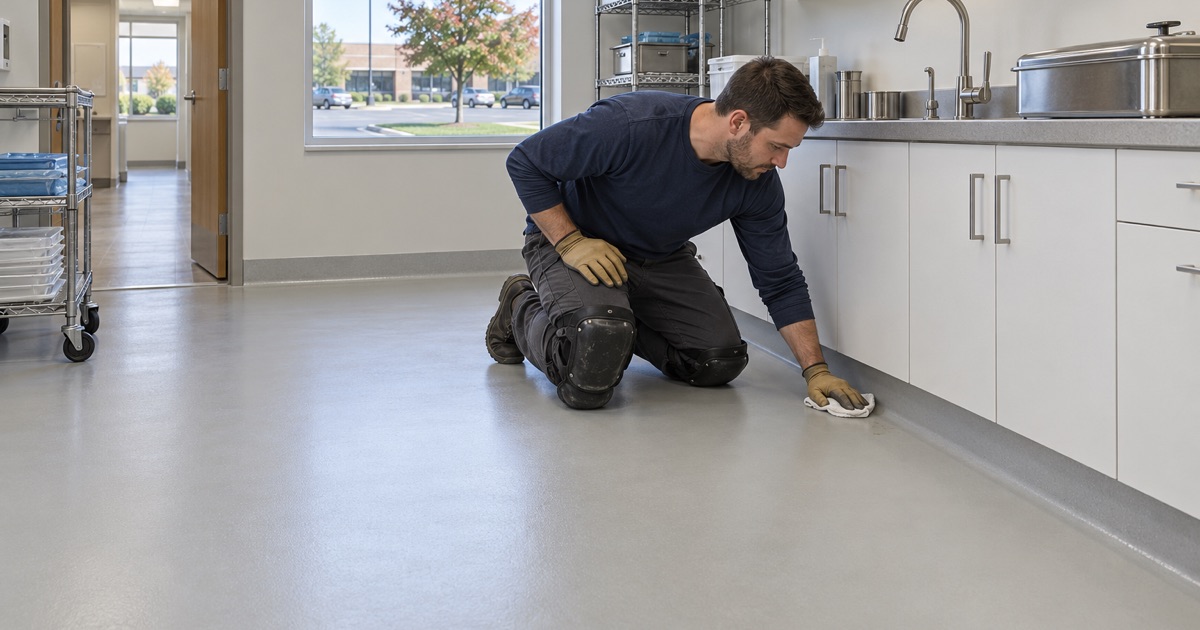
The joint between floor and wall is where a spill goes first and where a mop never quite reaches. We trowel an integral cove, a curved resin transition that runs the floor coating up the wall behind the sink, the soak trays and any reprocessor, so there is no corner seam for liquid to wick into.
Cove height is set in the proposal, along with where it stops and how it meets cabinet bases. The same detail, a coved floor and wall junction, is what food codes ask of commercial kitchens, and for the same reason: a surface that cleans as one piece.
Joints, penetrations and the slab underneath
Before any resin goes down, we map cracks, control joints and spalls in that corner and decide which get filled and which must be honored. Pipe penetrations and floor sinks are sealed into the system rather than caulked around afterward. If the slab beneath an office floor shows moisture or an active crack, we say so before quoting a coating over it.
Moisture gets measured, not assumed. On a slab-on-grade suite we run in-situ relative humidity probes or a calcium chloride test, whichever the slab and the flooring maker call for, and the reading goes into the written scope before the price is set. A suite on an upper floor of an office building sits on a suspended deck, which changes the test but not the rule.
A light, uniform color that shows a drip
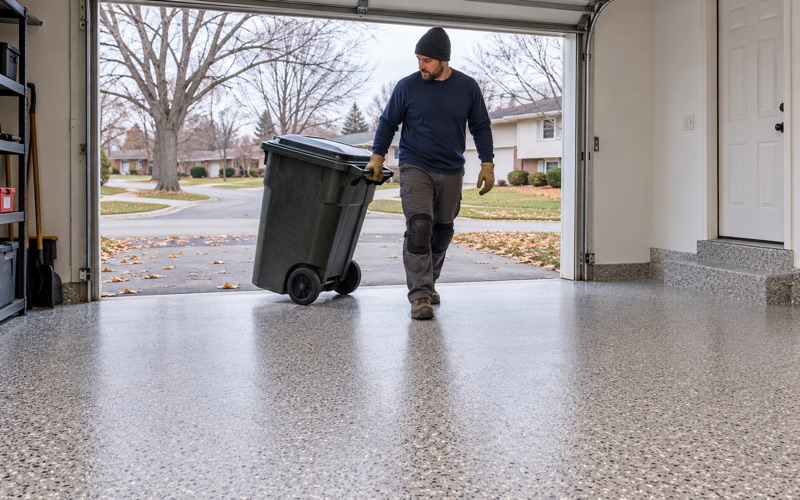
Flake blends and busy patterns are popular in garages because they hide dirt. In a reprocessing corner that is exactly the wrong goal. We recommend a light, solid color so a fresh drip of disinfectant stands out while it is still wet and can be wiped before it has time to mark the floor.
Texture matters too, because a wet floor near a sink is a slip risk for staff carrying trays. We specify slip resistance by the broadcast and topcoat, keeping the grit fine enough that the surface still wipes clean in one pass. A coarse quartz texture that suits a shop floor would hold residue here.
Choosing a Topcoat Against the Practice’s Own Chemicals
No single topcoat is the right answer for every disinfectant, and a chart from one coating maker is not a substitute for testing against what a practice actually pours. We start from the practice’s chemical list and work backward to the system, then put that choice in writing.
What we ask a practice before quoting
We have not read which disinfectant the Salt Creek Lane clinic chooses, and we would not guess. For any practice, we ask for the product names and safety data sheets of the high-level disinfectant, the enzymatic detergent and the surface cleaner before a topcoat is named in the proposal. A floor chosen for someone else’s chemical list is a floor chosen for someone else.
Where a practice can spare a small sample area or an offcut panel, we coat it in the chosen system and let staff run their own disinfectant on it through a normal week. What they see on that panel is better evidence than any brochure.
Building the system layer by layer
For a wet-chemistry corner we generally recommend a 100% solids epoxy base, which builds thickness without solvents, under a chemical-resistant topcoat chosen for that list. Everything in that stack is written into the proposal by product and coat, so facilities staff can hold the finished floor to it. Primer, base and topcoat come from one product line, so the layers are designed to bond to each other.
Cure times follow slab temperature and dew point, not a fixed promise. In a climate-controlled suite that usually means a predictable schedule, and we tell the practice when the room can take foot traffic, carts and its first chemical spill. Wheeled carts and stools roll through that corner all day, so the topcoat is also chosen for abrasion, not only for chemistry.
Warranty language and upkeep
Before the job is sold, we explain what a coating warranty leaves out. Moisture vapor coming up through the slab is the first exclusion we name, and on a disinfectant floor we also say plainly that cosmetic staining from the practice’s own chemicals is not something we warrant against.
Upkeep is simple to describe and easy to skip. Wipe drips as they happen, use the cleaner the topcoat was chosen for, and call us when a cove edge or a joint shows wear, because a small repair in a wet zone is easier than chasing a stain that has reached the concrete.
- 20+ Years in Business
- Moisture Test in Every Scope
- Diamond-Ground, Never Acid-Etched