Buffalo Grove Epoxy Flooring brings more than 20 years of experience to epoxy flooring in La Grange Park, and school buildings raise a question most homeowners never face. The question is not only how a coating wears under foot traffic. It is what the custodial staff may legally clean it with every day, and whether the floor sends them back to the strongest chemicals in the closet.
Illinois answers the first half of that by rule. Schools are expected to use hard-floor cleaners that carry a Green Seal or EcoLogo mark for routine work, yet the products that strip, polish and wax a floor sit outside that category entirely. A floor built around wax therefore keeps a stripping cycle alive no matter how green the daily mop bucket is.
This page walks through what that rule covers, why a resin floor can be specified so the neutral cleaner is the only product it ever needs, and where a coating stops being the answer. Our experience is that the cleaning plan belongs in the proposal, not in a binder handed over after the crew leaves.
What Illinois Requires Schools to Clean Floors With
The Routine Cleaner Category
The rule is Part 2800 of Title 23 of the Illinois Administrative Code, the green cleaning guidelines for elementary and secondary schools. Section 2800.10 says the requirements must be used in all school buildings unless an exemption is obtained, and that they apply to in-house and contracted cleaning services alike. A floor contractor is not a cleaning service, but whoever mops the finished floor afterward is.
Section 2800.20 defines general purpose and hard floor surface cleaners as products for routine cleaning of hard surfaces, including impervious flooring such as concrete or tile. Under 2800.30(b), a school may be deemed in compliance if it solely uses products that Green Seal or the EcoLogo program has approved. That is the bottle on the custodial cart every morning.
That definition names concrete outright. A sealed concrete or resin floor is squarely the kind of impervious surface the category describes, which is why the floor and the cleaner can be planned as one decision.
Why Strippers and Waxes Sit Outside It
The same definition closes with a carve-out: the category does not include products intended primarily to strip, polish or wax floors. That sentence matters more to a flooring decision than anything else in Part 2800. The green rule governs the daily cleaner, and it leaves out the chemistry used to tear a finish off and lay a new one down.
Floor strippers are built to dissolve cured polish, which is why they tend to be the harshest products in a custodial closet. A building can follow the green rule perfectly on Monday and still run a stripping crew over the same floor during a break. The rule does not create that contradiction; the wax layer does.
Which Schools the Rule Reaches
The guidelines are written for school buildings, and secondary summaries of the Green Cleaning Schools Act say it covers public schools and non-public schools with 50 or more students. We have not read the statute text itself, so we treat a private school’s coverage as a question for its own administration rather than something we assume.
Either way, the practical effect for a floor is the same. If the people cleaning a building are bound to labeled hard-floor cleaners, the floor should be chosen so those cleaners are enough on their own. A contractor who designs the floor first and asks about cleaning later has the order backward.
Looking for epoxy-flooring closer to Brookfield? See Epoxy-Flooring in Brookfield.
A School Floor With No Wax to Strip
LADSE North on Harrison Avenue
A concrete example in the village is LADSE North at 1125 Harrison Avenue. The LaGrange Area Department of Special Education, a cooperative of 15 member districts, uses the building for its emotional-disabilities K-8 classrooms and for LRB Academy, which serves grades 9 through 12.
The site was St. Louise de Marillac School until that parish school closed in 2020, and its mapped point falls inside La Grange Park. We have not seen its floors or its cleaning products, and we have no relationship with the cooperative. It is useful here because it is exactly the kind of building the rule was written for: a former parish school now serving public classrooms.
How the Tile Cycle Keeps Harsh Products in Use
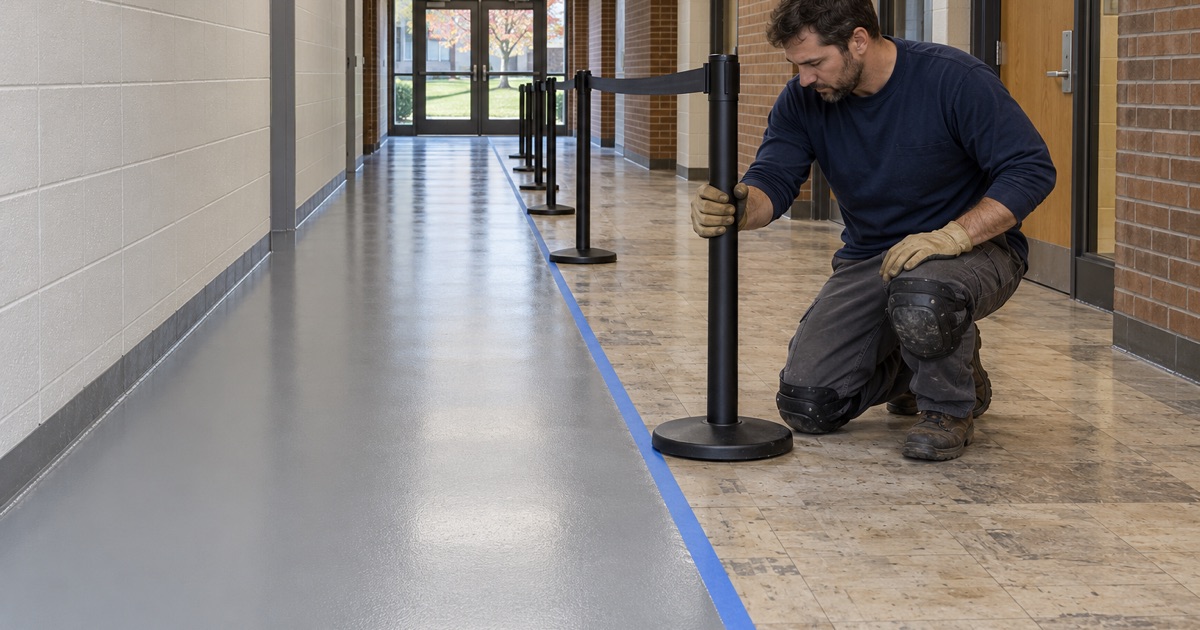
Many older school buildings carry resilient tile under a sacrificial polish. The polish takes the scuffs, dulls, and eventually has to come off with stripper before fresh coats go down, which means the building’s greenest daily routine still ends in a strip-and-refinish job.
That cycle also costs classroom time. In any occupied school, a hallway closed for stripping, recoating and drying is a space the schedule has to route around, and the smell of stripper rarely stays in that hallway. A resin floor that never needs that closure gives the schedule those days back.
What a Resin Floor Does Instead
A seamless epoxy floor with a nonporous topcoat has no wax layer, so there is nothing to strip. Soil sits on the surface and comes off with the same neutral hard-floor cleaner the rule already points to, and the gloss comes from the topcoat itself rather than from a polish that wears through.
When a resin floor does wear, the fix is a scuff-sand and a fresh topcoat on a planned interval, not a chemical strip. We write that interval into the maintenance sheet so the facilities office knows what the floor needs before it needs it, and so nobody reaches for a stripper out of habit.
Seams matter too. Tile joints collect soil and hold cleaning solution, while a seamless resin floor can be run up the wall as an integral cove base, so the mop meets one continuous surface from the middle of the room to the wall.
Choosing a Topcoat Around the Cleaner the Building Buys
Start With the Cleaner, Not the Color
Asking which Green Seal or EcoLogo hard-floor cleaner a building already buys is part of choosing the topcoat. We read that product’s dilution and pH guidance and match it against the topcoat’s chemical resistance data before we recommend a system, because a floor that dulls under the approved cleaner pushes staff back toward polish.
In practice that usually points to a polyaspartic or polyurethane topcoat over a 100% solids epoxy body coat. The maintenance sheet we hand over names cleaning in terms of the building’s labeled products, with dilution, pad and frequency, and leaves stripper off the list entirely.
Color and finish follow from there. A mid-tone flake or a solid color with a satin topcoat hides the light scuffing a busy hallway produces between recoats, while a high-gloss solid shows every mark and invites a crew to buff it with something it should not use.
Texture Fine Enough to Mop
A classroom or corridor needs grip without a surface that traps soil a flat mop cannot lift. We specify slip resistance by the broadcast and topcoat used, typically a fine quartz aggregate locked under the final coat, rather than promising it as a slogan.
Coarse texture belongs at an entrance or a wet area, not across a whole classroom. A heavy broadcast holds grime in its valleys, and grime that will not lift with a neutral cleaner is exactly what tempts a crew toward something stronger.
Preparation Under the Topcoat
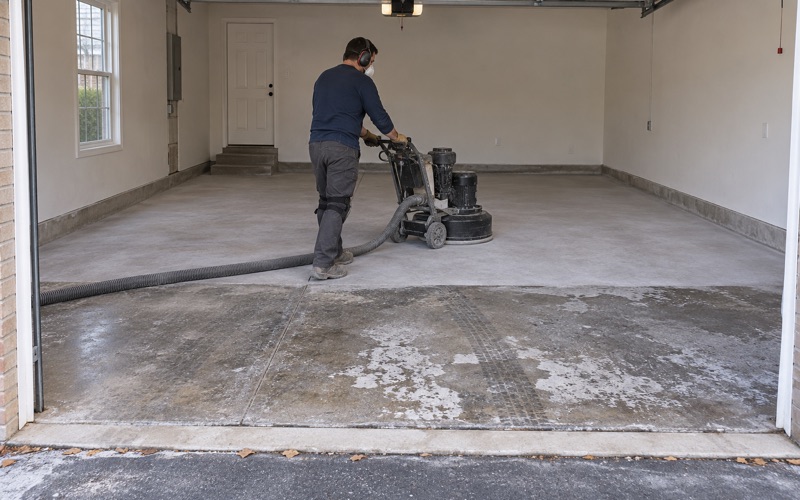
A topcoat only behaves as designed if the system under it stays bonded. We open every slab with a diamond grinder or shot blaster to a measured ICRI concrete surface profile, never an acid etch, and capture the dust at the machine with a vacuum instead of washing it toward a floor drain.
Moisture comes next. An ASTM F2170 relative humidity probe or an ASTM F1869 calcium chloride test is part of the written scope before the price is final, and the proposal names the product line, the number of coats and the finished thickness so the facilities office can check the floor against the quote.
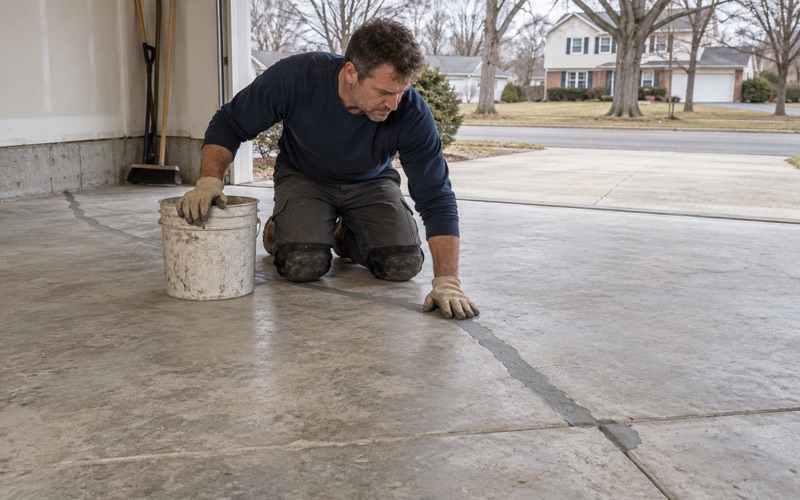
Cracks, spalls and old coatings are mapped before the proposal is written. When a slab needs repair or replacement before it should be coated, we say so, because a topcoat chosen around the cleaner still fails if the concrete under it is moving.
Exemptions, Schedules and What a Coating Cannot Do
The One-Year Exemption
Part 2800 is not absolute. Under 2800.50, a school may claim a one-year exemption for a product category, renewed annually, by showing on the Appendix B form that three comparable green products cost more after dilution. A building using an exempted product is still inside the rule; it has simply documented why.
An exemption is the building’s decision and its paperwork, not ours. What we can do is avoid designing a floor that only looks right under a product that would need one, so the exemption question never has to come up because of the floor.
What a Coating Cannot Make Compliant
Part 2800 is about cleaning products, not floors. No coating carries a green cleaning label in that sense, and no coating makes a cleaner compliant that was not compliant already. A resin floor only removes the reason to keep a stripper and a wax in the closet.
The coating’s own chemistry answers to different rules. We pick products inside the Illinois VOC limits for floor coatings under 35 Ill. Adm. Code Part 223, which bind the person applying them, and we keep that limit separate from any claim about cleaning.
What a coating warranty leaves out is explained before the job is sold, and moisture vapor transmission is the first exclusion we name. A school slab poured without an under-slab vapor retarder can push enough moisture to lift a coating no matter how carefully it is cleaned.
Scheduling an Occupied Building
A school cannot close for a week of cure time on short notice. We phase classroom and corridor work around operating hours, using overnight and weekend windows, and we set cure schedules by slab temperature and dew point rather than the calendar.
Permit questions get asked before a date is set. La Grange Park’s Building and Inspectional Services department runs plan review through an outside code consultant, and the village lists painting or surface coating among work exempt from permit, so we confirm with the department what a given scope needs before we quote a schedule.
Phasing also matters for the cleaning plan itself. Custodial staff should see the maintenance sheet before the first room reopens, so the first wet mop after full cure is the neutral cleaner the sheet names.
- 20+ Years in Business
- Moisture Test in Every Scope
- Diamond-Ground, Never Acid-Etched