Buffalo Grove Epoxy Flooring has spent more than 20 years installing epoxy flooring in Lake Zurich garages, shops and commercial spaces, and the floors that ask the most of us are the ones where somebody strikes an arc. A resin coating is an organic film. Put it under a welding table and it becomes part of the fire plan, not just the finish.
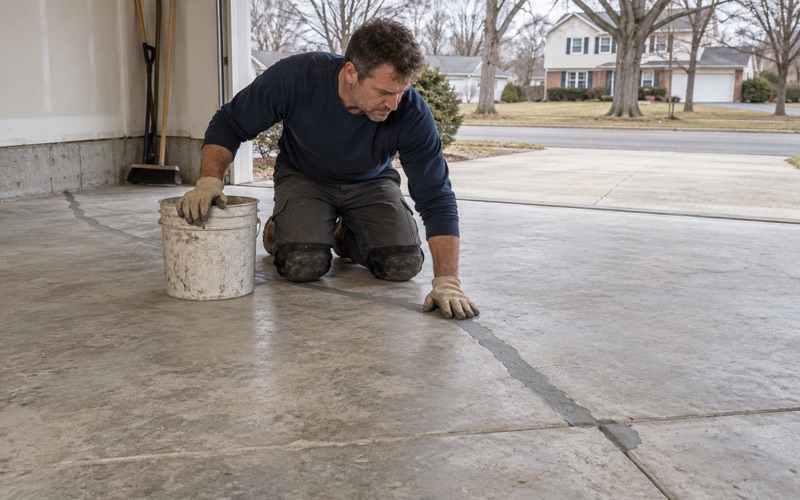
That changes how we quote a shop floor. A moisture test is written into the scope before the price is final, and we map cracks, spalls and old coatings so a slab that needs repair is named before anyone coats it. Then we ask where the hot work happens, how often, and whether it can stop while the coating goes down and cures.
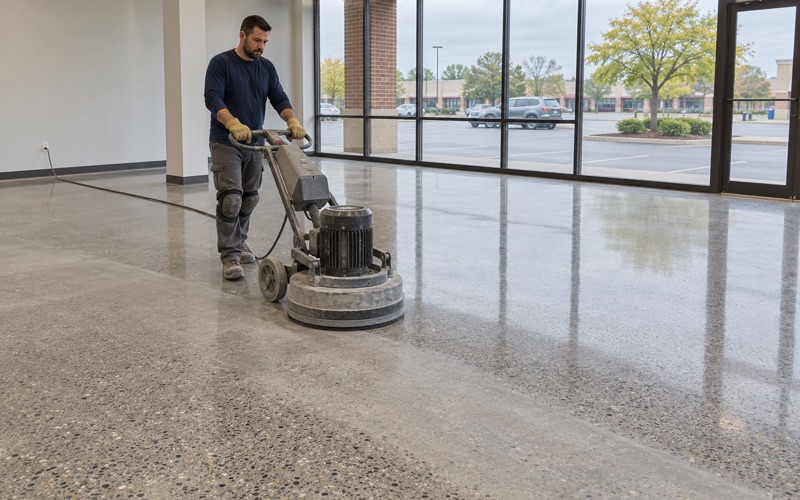
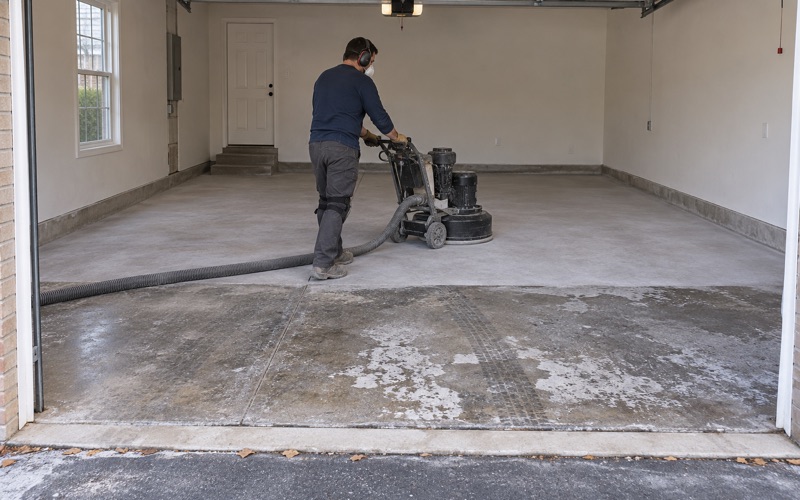
The answers shape everything else: where the weld station sits, what goes under it, which primer we can open in the building, and how the crew and the welders share the calendar. Grinding for the profile is done with a diamond grinder or shot blaster, never an acid etch.
A Weld Shop on Oakwood Road and the Rule Under It
Ack-Temp Mechanical Services works out of 805 Oakwood Road, Suite B, inside the village. Its listings describe an HVAC-R mechanical contractor handling plumbing, piping and heating, and they name welding and fabrication alongside that work. A shop like that welds and fabricates its own pipe and duct, which puts a federal fire-prevention rule on the floor itself.
What we know about this shop, and what we don’t
We have no relationship with Ack-Temp and have not seen its shop, its floor or its hot-work practice, so nothing on this page describes them. What the listings do show is the combination that matters for a floor: a mechanical contractor that also welds and fabricates. Any shop with that mix faces the same rule, and a home garage with a welder in it faces the same physics.
Swept clean for 35 feet
OSHA’s welding, cutting and brazing standard, 29 CFR 1910.252, has a paragraph on floors. Where combustible materials such as paper clippings, wood shavings or textile fibers are on the floor, it says the floor shall be swept clean for a radius of 35 feet. On a coated shop floor, we read that radius as including grinding dust, cardboard and packaging, not just sawdust.
The same section says that, where practicable, combustibles are relocated at least 35 feet from the work, and that a fire watch is required where appreciable combustible material sits closer than 35 feet to the point of operation. A smooth, sealed floor makes that sweep faster and more complete, which is one honest benefit a coating brings to a weld shop.
Wet, damp sand or a fire-resistant shield
The next sentence is the one that matters to us: combustible floors shall be kept wet, covered with damp sand, or protected by fire-resistant shields. We treat a resin floor as a surface that sparks can burn, so in a shop that welds, the practical answer is a shield or welding blanket at the station rather than a hose.
Wetting has its own catch. OSHA notes that where floors have been wet down, anyone running arc welding or cutting equipment has to be protected from possible shock. We do not supervise hot work and hold no welding or fire-safety credential, so the shop’s own safety lead decides its practice; our job is a floor that fits it.
Looking for epoxy-flooring closer to Lake Forest? See Epoxy-Flooring in Lake Forest.
Spatter, Slag and Plasma on a Resin Finish
Hot metal and resin do not get along, and no floor system we install changes that. Epoxy, polyaspartic and urethane cement are all organic, and the reports from shops that weld over them point the same way. The useful question is not whether sparks will mark the floor but where they land, how hot they are when they arrive, and what is underneath.
Weld spatter near floor level
Experienced users of coated garage floors report that epoxy tolerates weld spatter from work done at about waist height. Spatter from work near the floor is another matter, and they report it burning and marring the finish. A welding-blanket patent for pipeline work says the same of coatings generally: spatter that reaches past the protected zone melts into the coating and damages it.
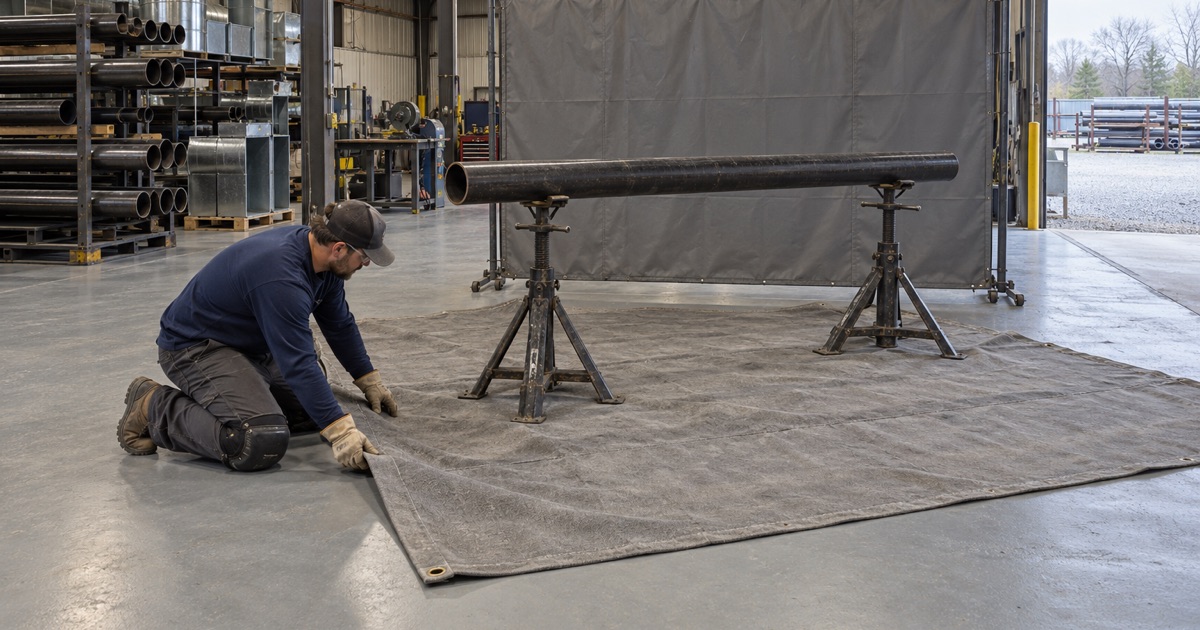
Those are field reports and patent copy, not lab measurements, and we present them that way. They still point to a rule we use when laying out a shop: low welding, such as pipe on stands or fittings on the floor, is where the shield goes down first, because that is where the floor takes the heat.
Slag that gets walked in
Slag is the quieter problem. Chipped off a bead and left on the floor, it gets stepped on and dragged, and the same users report it scratching and dulling the coating. A coated floor in a weld shop needs a cleanup habit: slag and grinding debris picked up at the station, not tracked across the bay toward the office door.
A broadcast system helps here. A quartz aggregate broadcast locked under a polyaspartic or polyurea topcoat gives the surface more body than a thin roll-on film, and a scratch reads less in a textured floor. The slip resistance comes from the broadcast and topcoat we specify.
Plasma cutting at bench height
Plasma cutting is harder on a resin floor than welding. The same garage-floor reports describe plasma cuts burning through coatings even when the work sat at bench height, and a cut sends its sparks out the underside of the plate. Where a shop plasma-cuts, we plan the table’s footprint as a shielded zone from the start.
That shielded zone is not a bare patch. The coating runs under it like everywhere else, ground to the same profile and built to the same thickness, and the shield sits on top as a working surface the shop can replace when it wears through.
A Shielded Weld Station on a Coated Floor
Most of the planning for a weld shop happens on paper before we grind. We walk the space with whoever runs the shop, mark where welding and cutting actually happen, and draw the 35-foot circle around each station. That circle tells us where the floor has to be easiest to sweep and where nothing combustible should be stored.
Shields and blankets at the station
At the station itself, the floor carries a fire-resistant shield or a welding blanket rather than bare coating. Plate steel, a purpose-made welding mat or a heavy blanket all serve; what does not serve is cardboard or carpet, which the pipeline patent notes quickly burn. Placement matters as much as material: the shield has to extend past where low spatter actually lands.
When the station moves, the shield moves with it. A shop that welds a fitting in the middle of the floor for an afternoon puts a blanket down there too, and the sweep follows the work rather than staying fixed at the bench. We say this plainly at the walk-through, because a floor quote that ignores how the shop works is a quote for a floor that will fail early.
Picking the system for a hot-work bay
For the coating itself, the system depends on the shop. A 100% solids epoxy body coat gives build; urethane cement suits a bay that also sees hot water or heavy washdown. None of these is chosen for spark resistance. They are chosen for bond, thickness and cleanability, and the shield handles the heat.
Bond starts with profile, ground to the ICRI concrete surface profile the system calls for. A weld shop slab may also carry oil and cutting fluid soaked in over years, and that contamination has to come out before any primer goes down, or the coating lifts no matter how well the station is shielded.
A welder in a Lake Zurich home garage
The same physics applies at home. Lake Zurich’s housing stock peaked in the 1980s, and 69.2 percent of its housing units date from 1970 through 1999, so a typical garage slab here is old enough to have been sealed, painted or coated before. A homeowner who welds or runs an angle grinder in that garage is asking the floor to take sparks.
Our advice there is the shop advice scaled down: a welding blanket on the floor whenever the work is low, cutting done over a blanket or outside, slag swept up before the car comes back in. Garage systems are also chosen for the brine and rock salt Lake County winters carry in on tires, which is a separate test the floor has to pass.
No Torches While the Coating Cures
The hot-work rule cuts the other way during installation. Solvent-borne primers, coatings and cleaners give off vapor while they are open and curing, and a working torch, a plasma arc or a grinder throwing sparks has no place in the same building at that time. On a shop job, the schedule is a safety document as much as a calendar.
Shutting hot work down for the install
We agree the shutdown in writing before we mobilize: no welding, cutting or spark-throwing grinding anywhere in the building while solvent-borne products are open or curing. Our own grinding uses diamond tooling with a vacuum at the machine, which captures the dust instead of washing it toward a floor drain, and it runs before any solvent is opened.
Office, lab and kitchen floors get phased around operating hours, and a shop gets the same treatment. Where a business cannot stop welding for days, we use overnight and weekend windows and sequence the system so the solvent-borne steps land while the shop is dark.
Low-odor systems and the Illinois VOC limits
When a shop cannot shut hot work down long enough, the answer is a low-odor or water-based system rather than a gamble. Many 100% solids epoxies carry little solvent, and water-based primers and topcoats are made for occupied buildings. We still keep torches off the floor until the coating has cured hard enough to walk and take a shield.
Every product we use sits inside the Illinois VOC limits for floor and industrial coatings under 35 Ill. Adm. Code Part 223, and those limits bind the person applying the coating, not only the manufacturer. Low odor is a side benefit; compliance is the requirement.
Cure by the slab, not the calendar
How long the shutdown lasts depends on the slab. We set cure schedules by slab temperature and the dew point spread at the surface, not by a number of days printed on a can, and an unheated shop bay in deep winter is told to wait. A cold, damp slab also invites amine blush on epoxy, which spoils the bond of the next coat.
The written proposal names the product line, the number of coats, the finished thickness and the hot-work shutdown window, so the shop can plan its jobs around ours and check the floor against the quote. It also spells out what the warranty leaves out, starting with moisture, before anyone signs.
- 20+ Years in Business
- Moisture Test in Every Scope
- Diamond-Ground, Never Acid-Etched