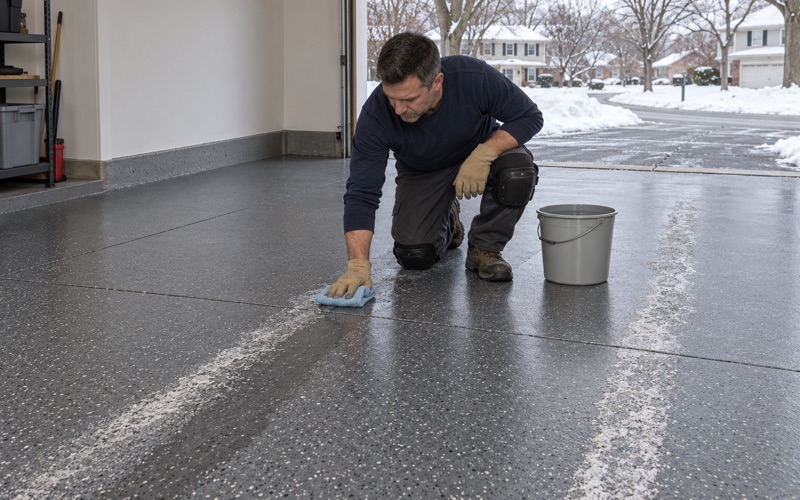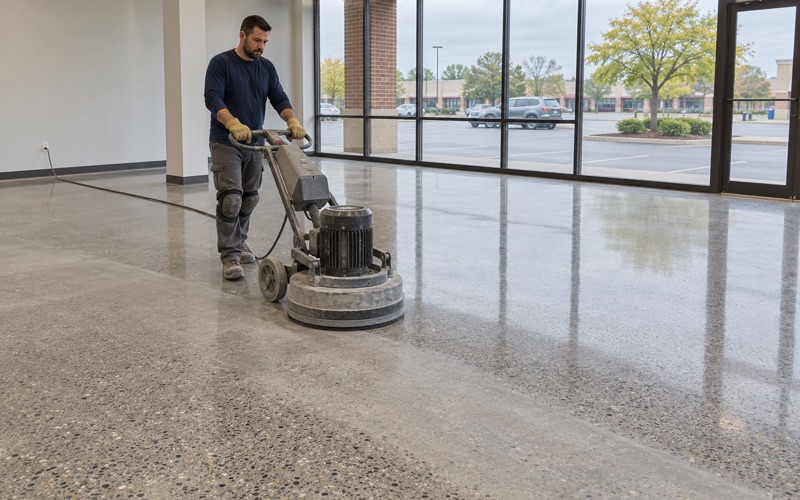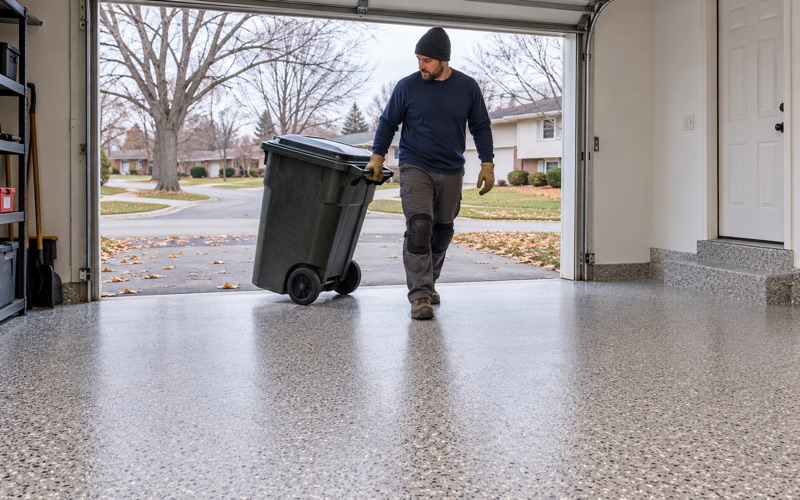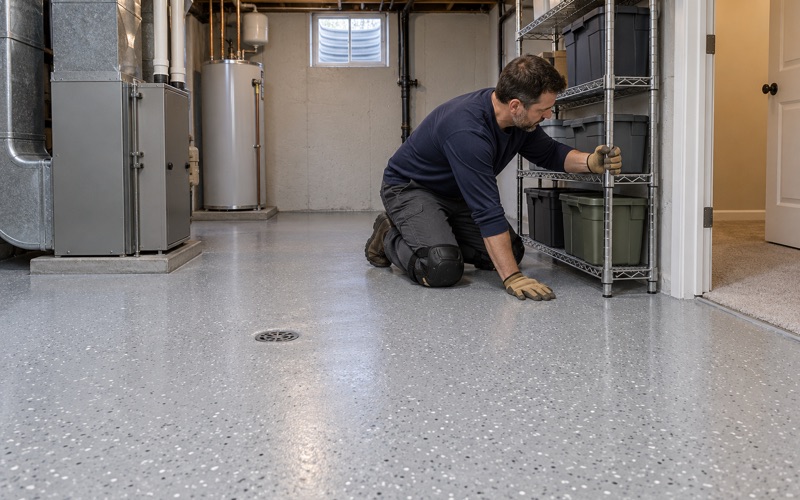
Buffalo Grove Epoxy Flooring brings more than 20 years to epoxy flooring in Lincolnwood, and our work here keeps returning to one question: what will be spilled, splashed and scrubbed on this slab every week? Draft bars answer that with two opposite chemistries, which is why this page centers on a bar floor rather than a generic showroom finish. A floor that survives one and dissolves under the other is not finished.
Beer left standing goes sour, and the cleaner that keeps draft lines honest is hot caustic followed, when minerals build up, by an acid. A bare concrete slab, an open control joint or a worn coating holds both. We specify a seamless, coved system chosen for acid and caustic resistance, so the night crew can rinse a spill before it turns into a smell.
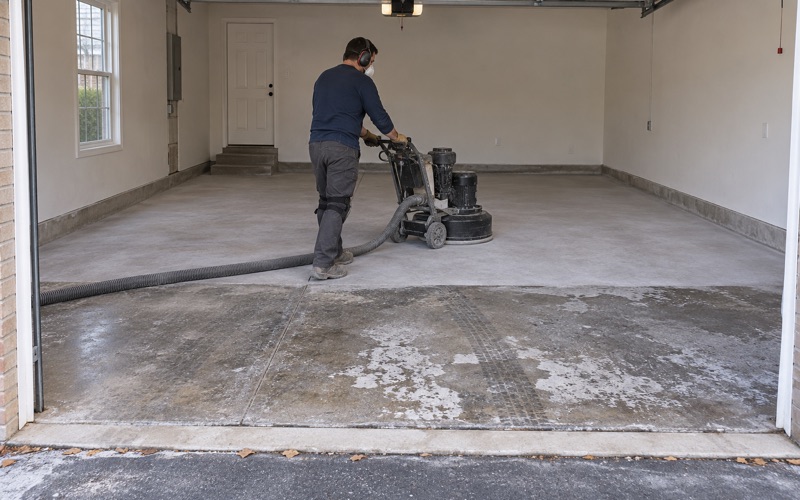
Every job starts the same way here: the slab is opened with a diamond grinder or a shot blaster rather than an acid etch, moisture is tested before the price is final, and the written proposal names the product line, the coat count and the finished thickness. That way a bar owner can hold the installed floor against the quote, line by line.
A Lincoln Avenue Bar Built Around Its Keg Cooler
Fatpour Tap Works opened its third location at 7244 N Lincoln Ave in Niles Township, in a space a trade report described as almost 10,000 square feet of combined indoor and outdoor industrial room. The same April 2024 report said the keg cooler is a focal point of the restaurant, built in the center of the bar from floor to ceiling. We have not seen its floor, and it is not our customer.
Why a Center-Bar Cooler Matters to the Floor
A cooler set in the middle of a bar means bartenders, barbacks and keg changes all cross the same few square feet of slab every shift. Whatever leaks from a coupler, a tower drip tray or a wet hand truck lands right there, and it lands next to a cooler wall rather than in a back room nobody sees.
That is the general shape of any center-bar draft system, not a reading of one business. Fatpour’s own page lists bar hours to 1:00 a.m. on Fridays and Saturdays and more than 200 beers. In our experience it puts the hardest-working, wettest part of the floor exactly where customers can see it, so the finish has to look clean at closing as well as at opening.
Who Inspects a Bar Floor in Lincolnwood
The village contracts with the Cook County Department of Public Health for food establishment inspections, and the Lincolnwood Fire Department, staffed largely under contract by Paramedic Services of Illinois, provides fire inspection services. A coating does not pass an inspection on anyone’s behalf. What it can do is give an inspector a floor that is visibly sealed, cleanable and tight to the wall.
The FDA Food Code addresses that wall joint directly, in section 6-201.13 on coved and sealed floor and wall junctures. We confirm the current local requirement with the owner and the designer before we quote a cove height, rather than assuming one detail fits every bar on Lincoln Avenue. The answer decides whether the cove is troweled as a separate step.
Phasing Work Around a Late-Closing Bar
A bar that serves until 1:00 a.m. on weekends rarely closes for a week. We phase floor work around operating hours, splitting the room so part of it stays in service. Village construction hours run Monday through Friday from 7:00 a.m. to 6:00 p.m. and Saturday until noon, with Sunday prohibited, so any overnight window is cleared with the village before we promise it.
Cure schedules follow slab temperature and the dew point spread at the surface, not the clock on the wall. A fast-return polyaspartic topcoat can shorten the gap between coats, but we still tell an owner plainly when a cold slab or humid night means the room cannot reopen on the planned shift. Grinding dust is captured at the machine with a vacuum, so a working bar is not dusted over.
Looking for epoxy-flooring closer to Franklin Park? See Franklin Park Epoxy-Flooring.
Every 14 Days: What Draft Line Cleaning Puts on the Floor
Brewers Association guidance on draft system cleaning sets the frequency at a minimum of every 14 days. A brewing-trainer workshop at the 2022 Craft Brewers Conference quoted the trade’s draft quality manual the same way, recommending a maximum two-week chemical cleaning cycle on all draft systems. That cadence is the part a floor contractor should plan around, because it never stops.
Hot Caustic at the Tower and in the Cooler
The same guidance calls for a 2 to 3 percent sodium or potassium hydroxide solution at 80 to 110 degrees F, recirculated for 15 minutes or more or left to soak for 20 minutes or more. Its diagrams put the cleaning pump on the bar side with a water bucket and a waste bucket under the tower, and the keg couplers in the walk-in cooler.
Read as a floor plan, that is hot alkaline solution in open buckets at both ends of the system, carried between the taps and the keg cooler on a cart or by hand. The presentation warns cleaners to wear eye and skin protection. A splash strong enough to burn skin deserves a floor chosen with that chemistry in mind, not one picked from a color card.
The Acid Rinse for Mineral Build-Up
Caustic removes organic residue; the guidance names acid as the cleaner for inorganic build-up, and it is emphatic that the two are never mixed. We have not seen a published acid interval for any Lincolnwood bar, so we do not guess one. What matters for the floor is simply that both chemistries reach it, on different days, from the same buckets.
Many floor systems handle one end of the pH scale well and the other poorly. A standard epoxy can tolerate a caustic wash yet stain or soften under repeated acid, which is why the topcoat and the resin matter as much as the color. We pick the system from the manufacturer’s chemical-resistance data for both exposures, and we put that product line in writing.
Where the Cleaning Cart Rolls
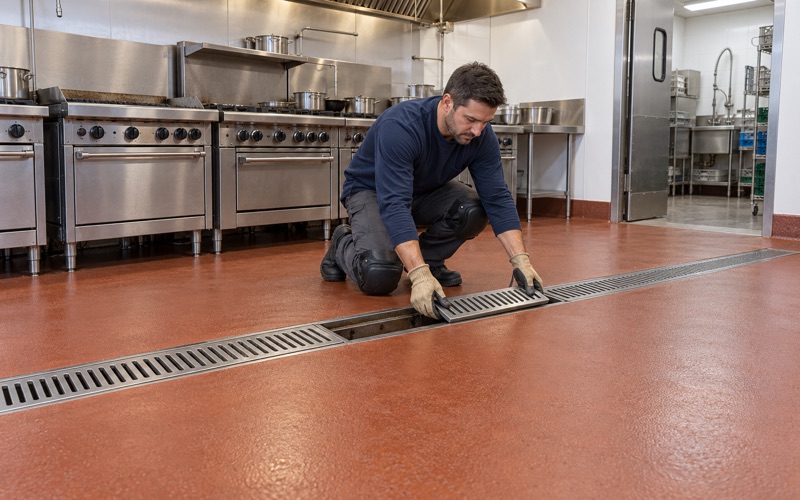
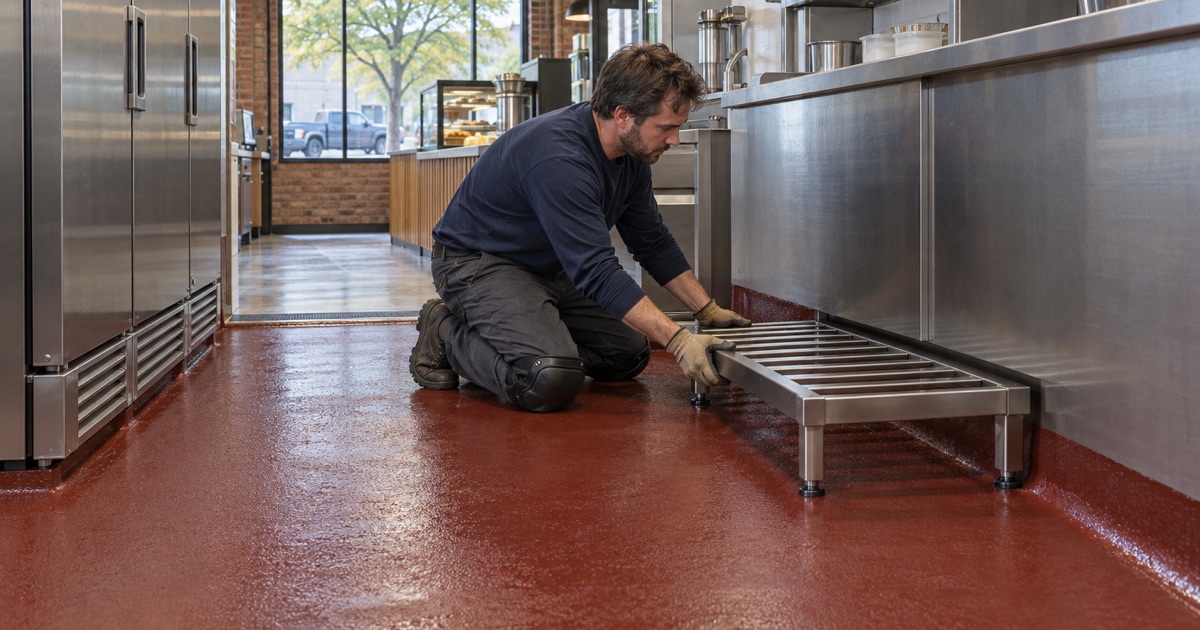
One photograph in the line-cleaning presentation shows a cleaning cart parked on a red resin floor beside a waste bucket. It is a small detail, but it shows where the cart, the hoses and the drips actually sit: on the path between the tower and the cooler door, the same stretch that sees keg traffic.
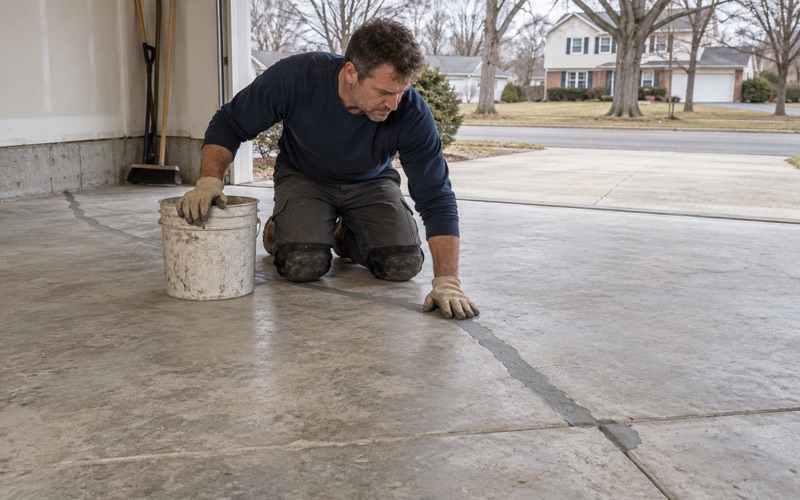
That path gets our heaviest attention at layout. Cracks, spalls and old coatings are mapped first, and every joint along the cart route gets a sealed detail rather than being left as a groove that collects solution. Where a slab needs repair before it should be coated, the proposal says so and names the repair.
Beer That Sits Sours, So the Floor Has to Rinse Clean
The same 2022 workshop listed acetobacter among the microbial problems in draft beer: an aerobic contamination that produces acetic acid and a vinegar, sour off-flavor. Its slide says the problem starts in spill trays and floor drains, and that it is prevented and resolved with proper equipment cleaning. We read that as a reason to keep the floor around those trays as rinseable as the trays themselves.
Spills That Settle Into Bare Concrete
Bare or worn concrete is porous, and beer that soaks into it stays there after the mop has passed. Open saw cuts, chipped edges and the seam where a slab meets a cooler wall do the same thing on a smaller scale. That is where a sour smell tends to linger in an older bar, long after the visible spill is gone.
A sealed resin floor changes the arithmetic. Beer stays on the surface, where a squeegee and a hose can reach it on the same shift, instead of working into the slab night after night. Nothing about a coating replaces the line cleaning itself; it simply removes one place for spilled beer to hide.
Seamless and Coved at the Cooler and Bar Base
The detail that does the most work is the cove: resin carried up the cooler wall and the bar base so the floor and wall meet in a curve instead of a crack. We profile the slab to the ICRI concrete surface profile the resin maker calls for, so the cove and the field bond as one piece.
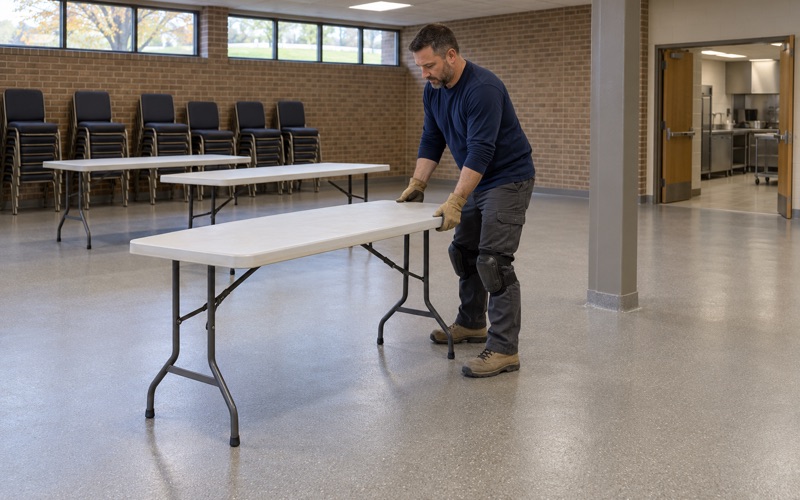
For the field, a bar floor usually wants a chemical-resistant body coat, a quartz aggregate broadcast for grip and a topcoat chosen for both caustic and acid exposure. The slip-resistant texture comes from the broadcast and topcoat we name in the proposal, not from a promise. Too much texture fights the squeegee, so we balance grip against how easily the floor rinses.
Rinsing on the Same Shift
A floor chosen for both chemistries only earns its keep if it is rinsed. Our advice to any bar owner is plain: rinse line-cleaning splashes and spilled beer with water the same shift, never leave solution or beer standing overnight, and keep cleaner buckets on the cart rather than on the floor.
What a coating warranty leaves out gets explained before the job is sold, and moisture is the first exclusion we name. On a bar floor we also point out that chemical exposure outside the product’s published resistance, or splashes left to dwell, can fall outside coverage. Reading that page together is cheaper than arguing about it later.
Home Bars, Kegerators and Basement Taps in Lincolnwood
The same chemistry shows up at home on a smaller scale. A kegerator or a basement tap system still needs its lines cleaned, still drips at the coupler and still invites a spilled pitcher. Lincolnwood’s housing leans old: about half the housing units were built between 1940 and 1959, and close to 40 percent in the 1950s alone.
Reading a 1950s Basement Slab First
Slabs of that age predate under-slab vapor retarder practice and have often carried decades of paint or sealer. We read the floor for past water before anything else, then test moisture with ASTM F2170 in-situ relative humidity probes or ASTM F1869 calcium chloride tests as part of the written scope. A coating does not stop seepage or a sump that cannot keep up.
Old paint and sealer have to come off completely before a primer can bond, and that removal is often the longest day of a basement job. Where readings run high, a moisture-mitigation primer goes under the system, and we say so in the price rather than finding out after the first blister.
A Floor Around the Kegerator
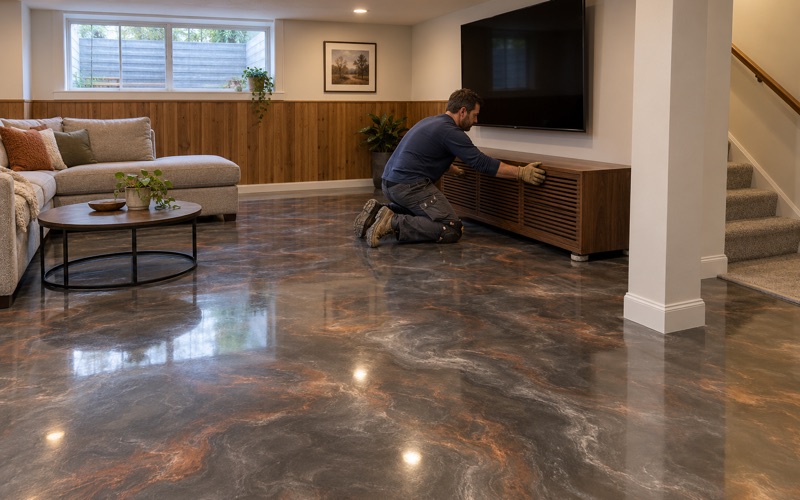
A home bar rarely sees a commercial cleaning cart, but line cleaning still happens, often on the floor right beside the kegerator. A 100% solids epoxy body coat with a polyaspartic topcoat, carried a few inches up the bar base, handles beer, cleaner splashes and mop water in a basement that may also hold a laundry or a sump pit.
What to Ask Before a Basement Bar Floor
Ask how the floor will meet the bar base and the kegerator, and whether the cove is included in the price. Home jobs over the state threshold get a written contract under the Illinois Home Repair and Remodeling Act, along with the Home Repair: Know Your Consumer Rights pamphlet, before any grinding starts. Permit questions are checked with the village before the job is scheduled.
- 20+ Years in Business
- Moisture Test in Every Scope
- Diamond-Ground, Never Acid-Etched