Buffalo Grove Epoxy Flooring approaches epoxy flooring in Norridge with more than 20 years behind us, and some of the floors that ask the most of a coating are also the smallest. A dessert counter that drips fruit, lime and salt from opening to close puts more chemistry on a small footprint than many larger rooms ever see. This page is about that kind of floor and how we would build one.
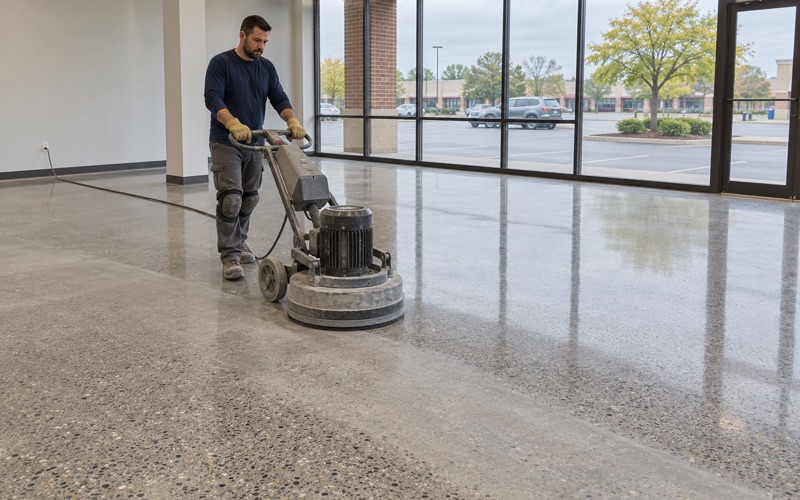
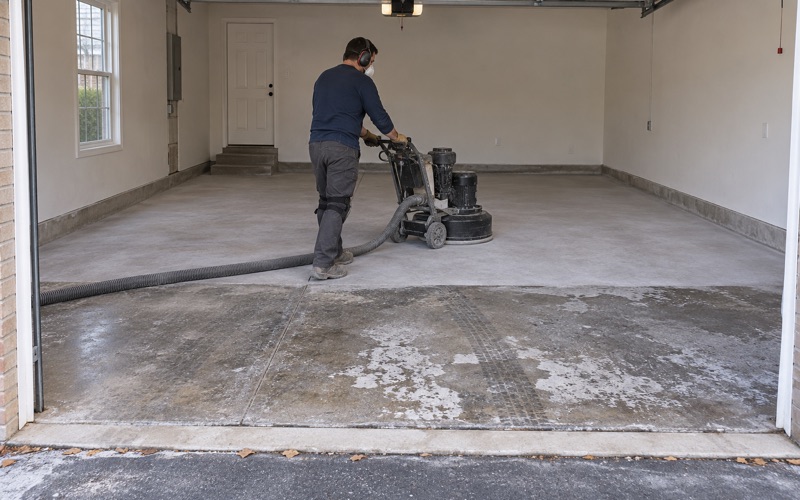
The work starts the same way on every slab. We open the concrete with a diamond grinder or a shot blaster rather than an acid etch, map every crack, spall and old coating, and run a moisture test before the price is final. If a slab needs repair or replacement before it should be coated, we say so in writing.
Below we walk through a frozen-dessert counter in a mall food court: what fruit acid and syrup do to concrete, why the answer is a sealed, seamless resin wiped the same day, and why the tenant’s floor and the landlord’s floor are two separate decisions. The same reasoning applies to any food counter that handles acidic fruit all day.
A Fruit-Ice Counter in the Harlem Irving Plaza Food Court
Harlem Irving Plaza at 4104 N. Harlem Avenue sits inside the Village of Norridge, in Norwood Park Township. It opened in 1956 as a strip mall on a former livestock farm and now covers 725,000 square feet with more than 100 stores and a food court. It is the food court, not the stores, that this page is about.
Bella’s Comes to the Food Court
Bella’s Helado de Coco and Italian Ice started on Fullerton Avenue in Chicago in 2021, and the mall’s directory now lists its new location as open in the food court. The directory describes an Italian ice shop with flavors made from real fruit, including coconut, and the brand is known for Helado de Coco served in a shell.
The menu reaches past ice. The mangonada, described in the 2025 coverage as mango, sorbet and chamoy with chili powder, is fruit acid, salt and sugar in one cup. We have no relationship with Bella’s and have not seen its floor; it is simply the clearest example of a counter whose floor takes acid all day.
A Kiosk on Harlem Avenue, Inspected by the Village
A food counter in Norridge answers to the Village of Norridge Health Department, not the Cook County health department. The village inspects roughly 80 establishments on a regular basis, and since January 1, 2025 its food code is the 2022 FDA Food Code as adopted by the State of Illinois. That code expects food-area floors to be smooth, durable and easily cleanable.
A coating does not carry the department’s approval on its own; the inspector reads the finished room, not a product label. Our part is to build a floor that gives the operator and the inspector the same easy answer: no open joints, no worn patches, no gap at the wall base.
What the Floor Behind the Counter Lives With
Behind a fruit-ice counter the floor takes melt from frozen product, drips from scoops and cups, and whatever slides off a spoon of chamoy. Staff stand and turn in the same few steps of floor for an entire shift, so wear concentrates where the drips land. A mall food court also keeps long hours, so the floor rarely gets a quiet day to dry out.
Looking for epoxy-flooring closer to Lincolnwood? See Epoxy-Flooring Services in Lincolnwood.
Mango, Lime and Chamoy: The Acid Under a Dessert Counter
What Lands on the Floor
Fruit ices are made from fruit, and much of that fruit is acidic. Chamoy adds more: one widely sold brand lists chili peppers, sea salt, citric acid, dehydrated lime juice and acetic acid among its ingredients, and its chili-lime seasoning lists citric acid and dehydrated lime juice again. We have not read which chamoy or seasoning Bella’s uses.
So the drips are not just sugar water. They carry fruit acid, lime and salt, they keep arriving through every shift, and they are walked on before anyone can wipe them. That combination is what a coating behind this counter has to be chosen for.
What Citric Acid Does to Bare Cement Paste
Concrete holds together because of its cement paste, which is alkaline, and acids dissolve that paste. In a 2023 laboratory study, Ninan and colleagues soaked ordinary portland cement mortar in 10 percent solutions of lactic, acetic, citric and propionic acid. They found citric and lactic acid more aggressive than acetic and propionic, and wrote that citric acid’s degradation was consistent and of higher magnitude.
That was immersion in a lab, not a reading taken on a real Norridge counter, and we do not put a number on what a counter’s drips would do to a real slab. The direction is the useful part: an acid that ranks near the top in a controlled test is the acid that lands behind a fruit-ice counter, so bare paste is the wrong surface to leave there.
Why Grout Lines and Worn Sealer Fail First
Many counter areas are finished with tile set in cement-based grout, or with concrete under a thin sealer. Grout is cement paste by another name, so it is the first place fruit acid finds, and a worn sealer leaves paste exposed exactly where traffic is heaviest. Once the surface opens, the next drip soaks in instead of sitting on top.
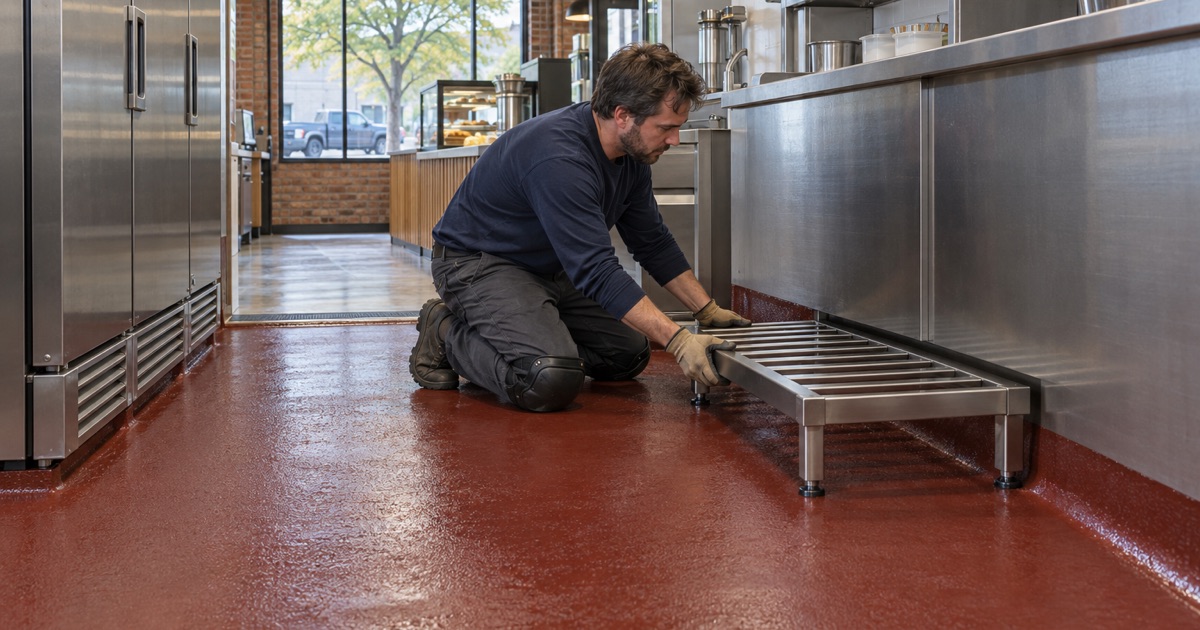
A sealed resin floor changes the question from how fast the paste wears to whether the coating stays intact. We prepare the slab by diamond grinding or shot blasting to a measured concrete surface profile on the ICRI CSP scale, then build a 100% solids epoxy system with a chemical-resistant topcoat, so the acid meets resin instead of cement.
Sticky Syrup, Grit and a Floor Wiped the Same Day
Why Syrup Turns Into Sandpaper
Acid is only half of it. Sugar syrup dries into a tacky film, and that film holds whatever grit comes in on shoes from the mall corridor. Left overnight, a sticky floor becomes an abrasive one, and the grit grinds at the surface with every step behind the counter.
That is why the finish has to be wiped the same day it is soiled. A seamless resin surface gives a mop and a squeegee nothing to catch on, so the syrup lifts instead of settling into joints and texture that a closing crew cannot reach. The Food Code’s own cleaning rule points the same way: clean as often as necessary, and apart from spills, clean when the least food is exposed, such as after closing.
Seamless, Coved and Sealed at the Edges
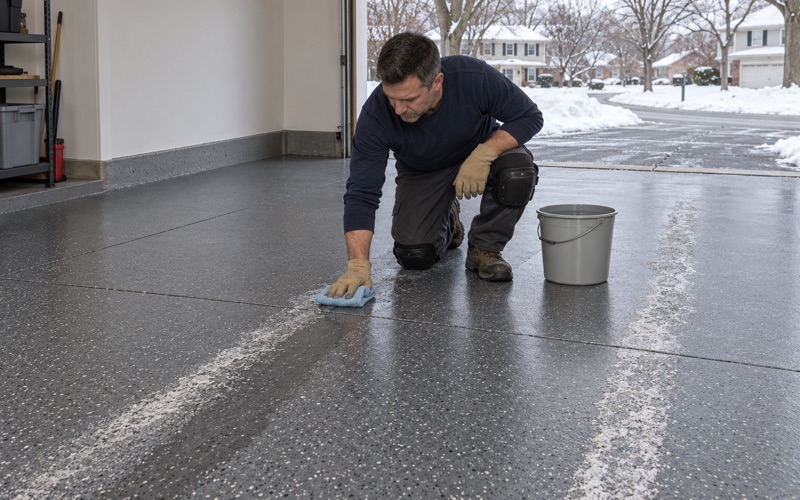
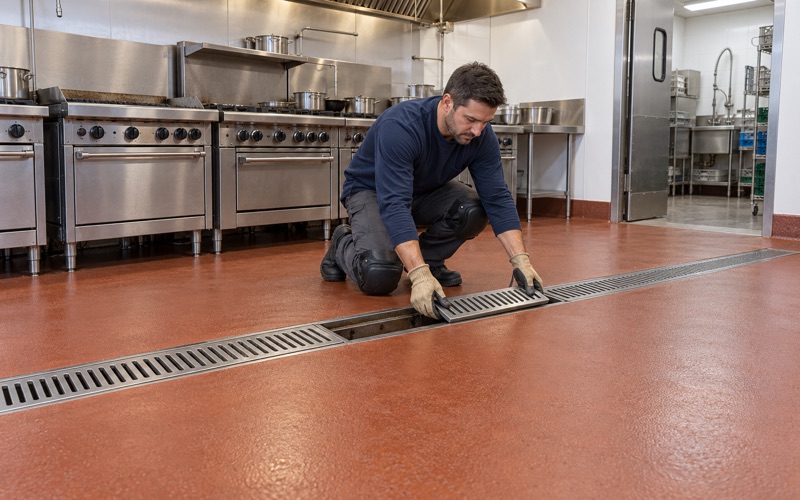
The weak points on a counter floor are the edges. We carry the resin up the wall as an integral cove, the detail Food Code section 6-201.13 describes for floor and wall junctures, and we close the joint where the floor meets the counter base so drips cannot run underneath.
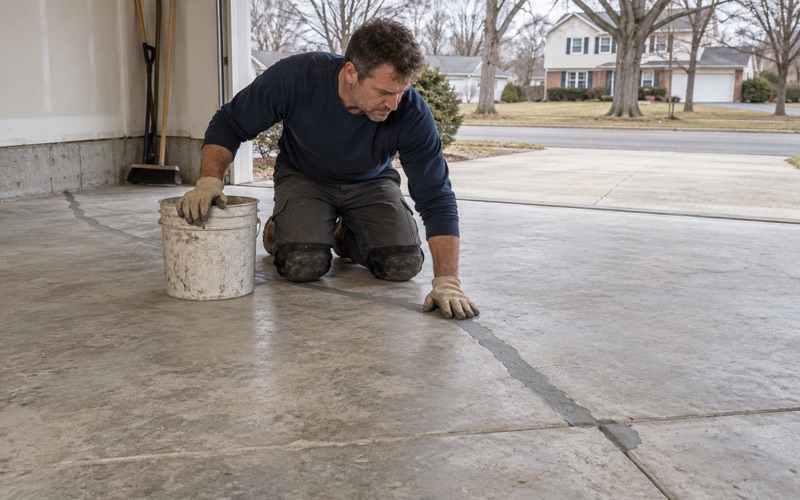
Joints in the slab need the same honesty. A control or isolation joint that moves should be treated with a flexible joint filler rather than bridged rigidly for a seamless look, because a resin floor cannot restrain movement in the concrete below it, and a rigid bridge over a moving joint tends to crack or lift.
Texture That Comes From the Broadcast
A wet, sugary floor behind a counter is a slip risk, and texture is the answer only when it is specified. We name the broadcast, such as a fine quartz aggregate, and the topcoat that locks it in, so the finished grip is something the proposal states rather than a promise.
There is a balance to strike. Too coarse a texture holds syrup and grit and fights the same-day wipe, while too smooth a finish is slick once it is wet. Behind a dessert counter we lean toward a fine, even texture under a chemical-resistant topcoat, which grips a wet shoe and still lets a mop glide.
Kiosk Floor or Common Floor: Who Owns Which Surface
The Tenant’s Floor and the Landlord’s Floor
In a mall food court, the floor behind a counter and the floor under the shared seating are usually two different surfaces with two different owners. The tenant typically builds out and maintains its own space, while the landlord keeps the common area, and the lease decides where one ends and the other begins.
We ask to see that boundary before quoting. A resin system behind the counter has to end cleanly at the line where the landlord’s finish starts, with a flush transition that a cart wheel and a mop both cross without catching. We have not read any Harlem Irving Plaza lease, so we confirm that line with the tenant and the property manager on site.
Working Around Mall Hours
A food-court counter cannot close for a week. We phase the work into overnight windows after the mall shuts, capture grinding dust at the machine with a vacuum, and pick a system whose cure fits the time before the counter reopens. Cure schedules follow the slab temperature and the dew point spread at the surface, not the calendar.
Fast-curing polyaspartic topcoats can shorten the return to service, but speed is not the only test. Over an acid-exposed counter floor, chemical resistance and full cure come first, and we tell an operator plainly when a system needs a second night rather than opening on a coating that has not finished curing.
Permits, Moisture and a Scope in Writing
Commercial work in Norridge runs through the village Building Department at 4000 North Olcott Avenue, and we confirm registration and permit requirements there before a date goes on the calendar. Inspection appointments are made at least 24 hours ahead, which we build into an overnight schedule.
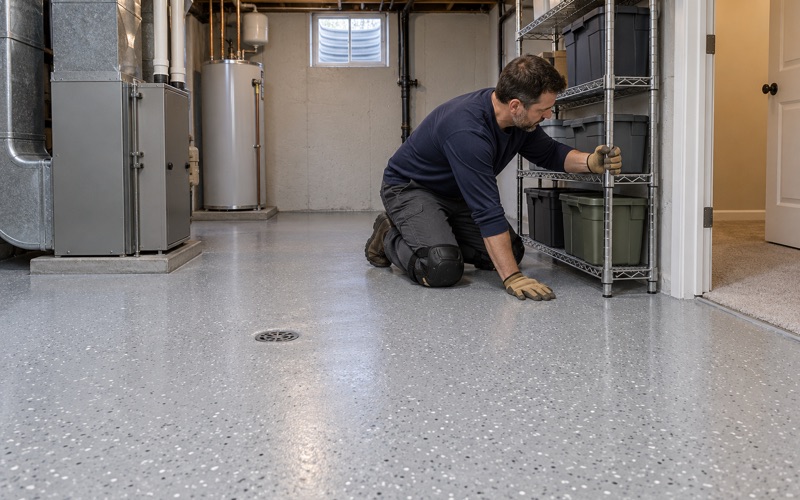
On the slab itself we choose between ASTM F1869 calcium chloride tests and ASTM F2170 relative humidity probes, because a ground-floor slab can push vapor into a coating from below. The written proposal names the product line, the number of coats and the finished thickness, so the operator can hold the floor against the quote. Moisture is also the first exclusion we explain in any coating warranty, before the job is sold.
- 20+ Years in Business
- Moisture Test in Every Scope
- Diamond-Ground, Never Acid-Etched