Buffalo Grove Epoxy Flooring has handled epoxy flooring in Northlake for owners who need a slab to stay out of the way of the work, drawing on more than 20 years of grinding, priming and coating concrete. Our focus on this page is industrial floors where the surface itself can end up in the product. A bare slab that sheds dust is more than a housekeeping problem when what sits on it is sold by quality.
Every job we take starts the same way: the slab is opened with a diamond grinder or a shot blaster, never an acid etch. Cracks, spalls and old coatings are mapped before we quote. The proposal then names the product line, the number of coats and the finished thickness, so a plant manager can hold the finished floor up against the quote.
We also say plainly what a coating will not do. A sealed floor keeps concrete dust and grit out of what is stacked on it and makes the floor quick to sweep, but it does nothing about water rising through a wet slab, and moisture is the first exclusion we name in any warranty discussion. What follows is how that plays out on a paper sorting floor.
A Paper Plant on Lake Street, Where Grade Means Clean
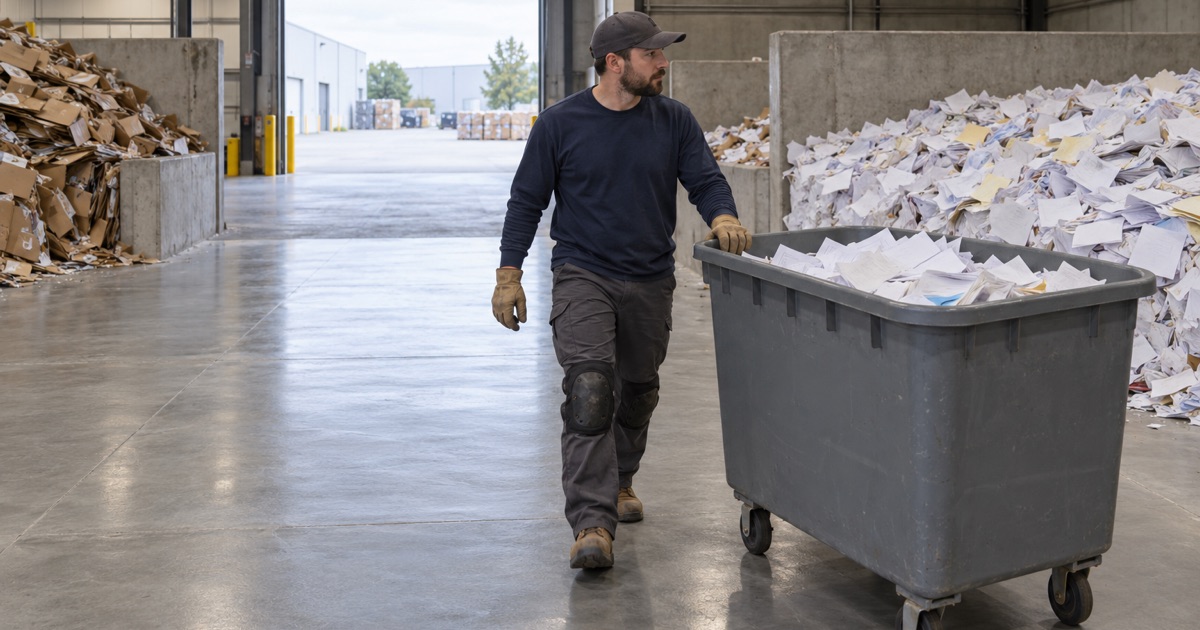
Loop Paper Recycling at 301 W Lake St
Loop Paper Recycling lists a facility at 301 W Lake St, an address that geocodes inside Northlake city on the Proviso Township side, Cook County. The company describes it as one of four Chicagoland materials recovery facilities, alongside Chicago, Riverdale and Joliet, and Commtrex also lists it as a transload facility in Northlake. Which services run at this particular site is not something the operator states.
Northlake counted 12,840 people at the 2020 census and is split between Leyden and Proviso townships. The city takes its name from North Avenue and Lake Street, which intersect on its western border, so the paper plant sits on one of the two roads Northlake is named for. The operator’s trade, as its own pages describe it, is buying recovered paper by grade.
Paper Grades and the Premium Rate
Loop buys Sorted Office Paper, Sorted White Ledger, mixed paper, newsprint and magazines, and it tells suppliers it will help them sort and segregate so they are paid the premium rate their paper deserves. The spread between those paper grades is the point. Sorting is how a supplier gets paid for the better grade rather than the cheaper one.
The same operator gives a plain instruction: keep paper clean and dry. It also notes that baling improves storage, shipping efficiency and the rebate tier. Put those together and the floor under a sorting line matters more than it first appears, because sorted office paper is valued for being clean, and anything that settles onto it between the tip and the baler travels with it.
Self-Haul Drop-Off and Transload Traffic
Loop says self-haul drop-off is available at all four of its facilities, so a receiving floor at a plant like this can see small loads wheeled in by hand alongside larger deliveries. A transload listing points to material changing from one carrier to another. Every set of wheels carries some road grit in, and on an unsealed slab that grit joins whatever the concrete is already shedding.
None of this says anything about the floors inside 301 W Lake St, which we have not seen, and we have no relationship with the operator. What it does describe is the kind of building where a floor can either stay out of the product or quietly become part of it, and that is the decision a plant owner in Northlake is really making when coating comes up.
Looking for epoxy-flooring closer to River Grove? See River Grove Epoxy-Flooring.
What a Dusting Bare Slab Puts Into a Bale
Cement Dust and Grit in White Grades
Bare concrete wears at the surface. Forklift tires, pallet runners and push brooms slowly break the weak top layer of paste loose, and the result is a fine gray powder that comes back no matter how often the floor is swept. On a sorting floor that powder lands on white and office grades, which show it, and gets pressed into the bale along with the paper.
Grit is the coarser cousin of that dust: sand-sized bits from spalled joints, broken edges and worn patches. It rides on the paper the same way, and a buyer paying for a clean grade is not paying for it. A sealed, non-dusting surface takes the floor itself out of that equation, so whatever reaches the bale came in with the paper rather than off the slab.
Damp Patches and the Clean and Dry Rule
Clean and dry are two separate demands, and a floor coating answers only the first. A sealed floor sheds dust and sweeps clean, but it is not a fix for water. Where a slab sits wet from below, from a leaking door or from a low spot that holds water after washdown, paper set down there picks up moisture whatever finish is on the concrete.
That is why we treat damp patches as a finding rather than something to paint over. Ponding is a slope and drainage question, a wet door line is a building question, and moisture rising through the slab is something a coating can fail over. We name those separately in the proposal so nobody expects the floor to keep paper dry on its own.
Testing the Slab Before We Price It
A moisture test is written into the scope before the price is final. Depending on the slab, that may be an ASTM F2170 in-situ relative humidity probe, ASTM F1869 calcium chloride testing, or a quick ASTM D4263 plastic sheet check to flag a problem area. Where readings come back high, a moisture-mitigation primer goes into the quote instead of being discovered later as a failure.
The walk-through also marks where the work happens: the tip floor where loads land, the lanes the sorters stand in, the bale line and the storage rows. Those areas wear differently, and a slab section that has crumbled past saving is flagged for repair or replacement before anyone talks about coating it. Coating over failed concrete only seals the failure in.
Sealed Floors for Tipping, Sorting and Baling
A Profile the Coating Can Grip
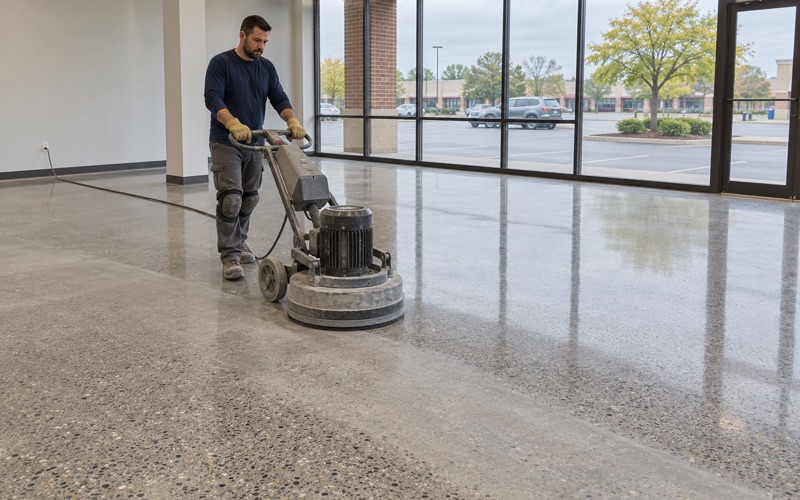
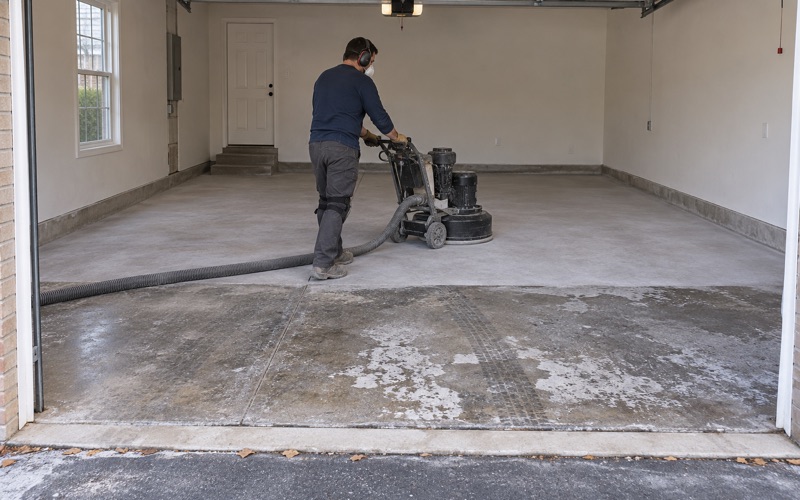
Coating a dusting slab without opening it first only glues a new layer onto the weakest part of the concrete. We grind with diamonds or shot blast to cut through the loose paste down to sound material and leave a profile in the ICRI CSP range the chosen system calls for. Prep dust is captured by a vacuum at the machine, so it does not settle onto stock or wash toward a floor drain.
Where the plant cannot be emptied, prep moves zone by zone. Bales and loose stock are cleared from one bay, the bay is ground and coated, and it returns to service once the system has cured enough to carry traffic. Cure timing follows slab temperature and the dew point spread at the surface, not the calendar, so an unheated bay in deep winter may have to wait.
Choosing the System by Zone
The tip floor takes the heaviest abuse: loose loads dropped onto it, forklift traffic, and piles pushed along toward the sort line. There we lean toward a thick 100% solids epoxy or a urethane cement, built for impact and abrasion rather than looks. That zone is priced as its own line rather than averaged into the rest of the floor.
Sort lanes and bale storage need less build and more cleanability. A smooth epoxy system with a polyaspartic or polyurea topcoat sweeps fast, and where sorters stand a light quartz aggregate broadcast gives traction the broom can still clear. In a low-traffic storage corner, a lithium silicate densifier can be enough to stop dusting at a lower cost.
Joints, Cracks and Edges
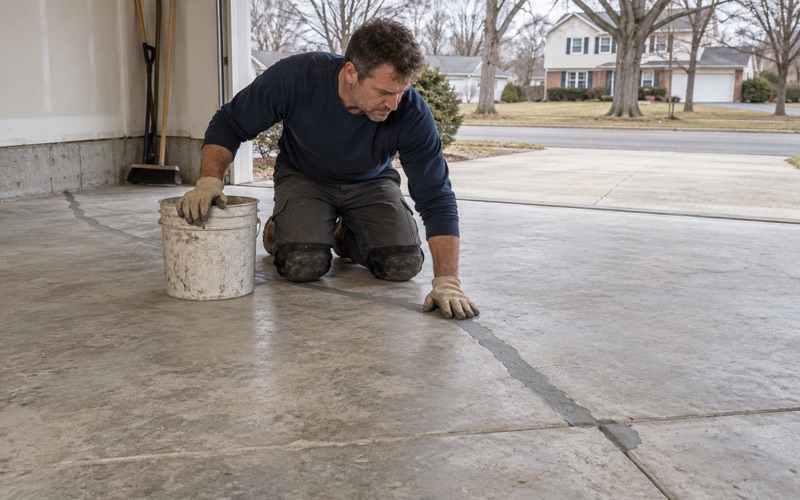
Open joints and cracks are where grit is born. Every time a pallet wheel or forklift tire crosses one, the edges chip a little more, and those chips end up in the sweepings and sometimes in the paper. We clean out damaged joints and fill them flush with a semi-rigid filler, and cracks are routed and filled before any coating goes down.
Edges matter as much as joints. A coating feathered thin to nothing at a door or column lifts first, so we stop it in a saw-cut key-in termination where the resin fills the cut and the edge is captured. Along walls, a short cove keeps sweepings from packing into the corner where a broom cannot reach.
Sweeping Clean Between Grades
Dry Cleaning Without Washdown
A sorting line that switches from mixed paper to white ledger needs the floor clear of the previous grade first. On a sealed surface that is a sweep or a pass with a ride-on scrubber, and the dust comes up instead of being ground back into the pores. Bare concrete holds fine material in its surface, so every pass leaves some behind for the next grade.
Dry cleaning fits the clean and dry rule better than hosing, which puts water exactly where paper is about to land. A smooth sealed floor makes a dry sweep effective enough that washdown becomes occasional rather than routine. When a wet clean is needed, the coating lets the floor surface dry quickly instead of the slab soaking up the water.
Traction That Still Sweeps
Slip resistance on a paper floor is a balance. Loose sheets underfoot are slippery on any surface, and a heavily textured floor traps fragments that a broom then drags across the next grade. We specify texture through the broadcast and topcoat chosen, and we state which in writing rather than promising a slip-resistant floor as a slogan.
In practice that often means a finer aggregate in walking lanes and a smoother finish under bale storage, where nobody walks and sweeping speed counts most. Decorative vinyl flake belongs in a garage, not under a baler, and we say so if it comes up. A floor that looks plain and sweeps fast is the better tool for a plant that sells by grade.
Registration, Fire Questions and Scheduling
Before any work in the city, we register with the City of Northlake Building Department, which asks every contractor and subcontractor for a $100 registration that runs one year from issuance, a $10,000 bond and a certificate of insurance naming the city. That paperwork is settled before a date goes on the calendar, not on the morning crews arrive.
Fire protection here is a separate district rather than a city department, so a commercial fire-code question goes to the Northlake Fire Protection District, not City Hall. Work on a running plant is phased around operating hours, with overnight and weekend windows where a sort line cannot stop, and products are chosen inside the Illinois VOC limits for floor coatings.
- 20+ Years in Business
- Moisture Test in Every Scope
- Diamond-Ground, Never Acid-Etched