Buffalo Grove Epoxy Flooring has spent more than 20 years on epoxy flooring in Pingree Grove and across the northwest suburbs, and the work here starts with a question many contractors skip: which fluids will land on this floor? A garage that parks a diesel pickup and a shop that services heavy trucks both see more than oil. The coating, the texture and the cleanup plan should all answer that list.
Most floor advice is written for one fluid family: motor oil, fuel and grease. Modern diesel engines add a second one that behaves nothing like the first, and it changes what a safe floor looks like. We plan for both before we price a job, and we put the product line, coat count and finished thickness in writing so the floor can be checked against the proposal.
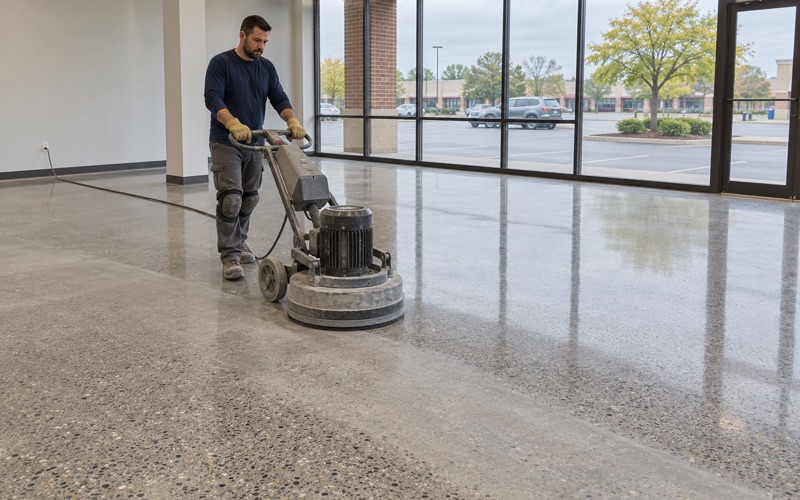
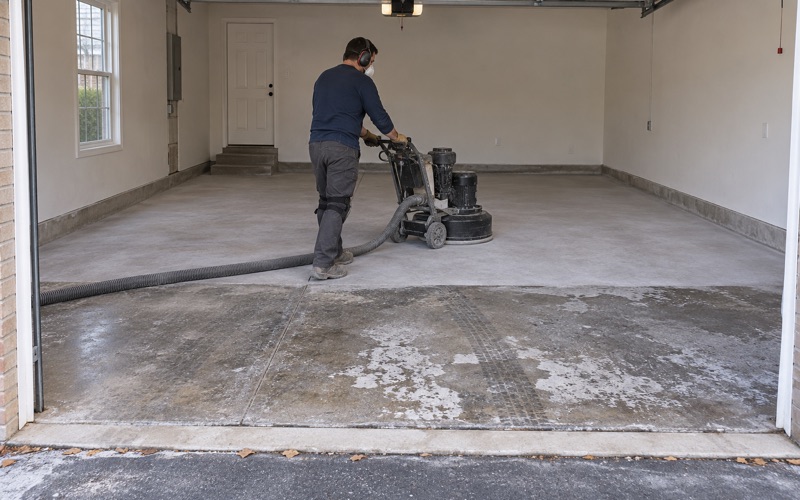
Every slab we coat is opened with a diamond grinder or a shot blaster rather than an acid etch, and the grinding dust goes into a vacuum at the machine instead of toward a drain. The rough profile it leaves is what lets a coating hold where trucks and boots work all day. Those habits matter most on floors where water-based spills are routine.
A 30-Bay Truck Campus on Bell Court and the Fluid It Brings
What Is Planned at 1360 S Bell Court
In June 2025, REBusinessOnline reported that Freight Union Inc. would build a 61,858-square-foot maintenance facility in Pingree Grove with 30 repair bays, two docks and 238 trailer positions. The company’s published address is 1360 S Bell Court, and Hampshire Truck Center has posted that it is coming soon to the same address for fleets and owner-operators.
We have no relationship with either business, we have not seen their floors, and we have not confirmed whether the shop is finished or running. What the plan does show is the scale of heavy-truck maintenance planned for a village that had 124 residents in 2000 and 10,365 by 2020. A floor serving that kind of work faces a problem homeowners rarely hear about.
New commercial construction here also answers to the Pingree Grove & Countryside Fire Protection District, which may adopt its own ordinances and sets its own submittal, inspection and occupancy requirements. When a commercial floor is part of that work, we ask the owner what the district has reviewed before we schedule.
Diesel Exhaust Fluid Is Mostly Water
Diesel exhaust fluid, sold as DEF, is what modern diesel trucks inject into the exhaust to cut nitrogen oxides. The safety data sheet we read lists it as 67.5 percent water and 32.5 percent urea, colorless, with a faint ammonia odor and a pH of about 9.8 to 10. It is fully water-soluble and is not classified as hazardous.
That last point deserves care. Nothing on that sheet suggests harm to concrete, and we will not sell a coating on fear. The issue is behavior, not toxicity: a water-based fluid spreads thin across a smooth surface, and the SDS itself tells users to clean it up immediately and keep it out of sewers.
The SDS also lists ammonia and nitrogen oxides as decomposition products and says DEF is incompatible with strong acids, bases and oxidizers. That is a storage note for the shop, not a flooring problem, but it is one more reason to keep the DEF area tidy and easy to rinse.
Two Fluid Families on One Floor
A heavy-truck repair bay sees oil, fuel and grease on one side of the ledger and DEF on the other. The first family beads and smears; the second sheets out like water and evaporates. A floor plan that only answers oil leaves the other family unaddressed, which is why we ask about DEF before choosing a broadcast or topcoat.
We ask where DEF is stored, where it is dispensed and where trucks are topped off, because those spots see the most drips. Those answers mark the wet zones on the floor plan, and the rest of the specification follows from them.
Looking for epoxy-flooring closer to La Grange? See La Grange Epoxy-Flooring.
Why Oil-Only Pads and Smooth Floors Fail on DEF
The Absorbent Problem
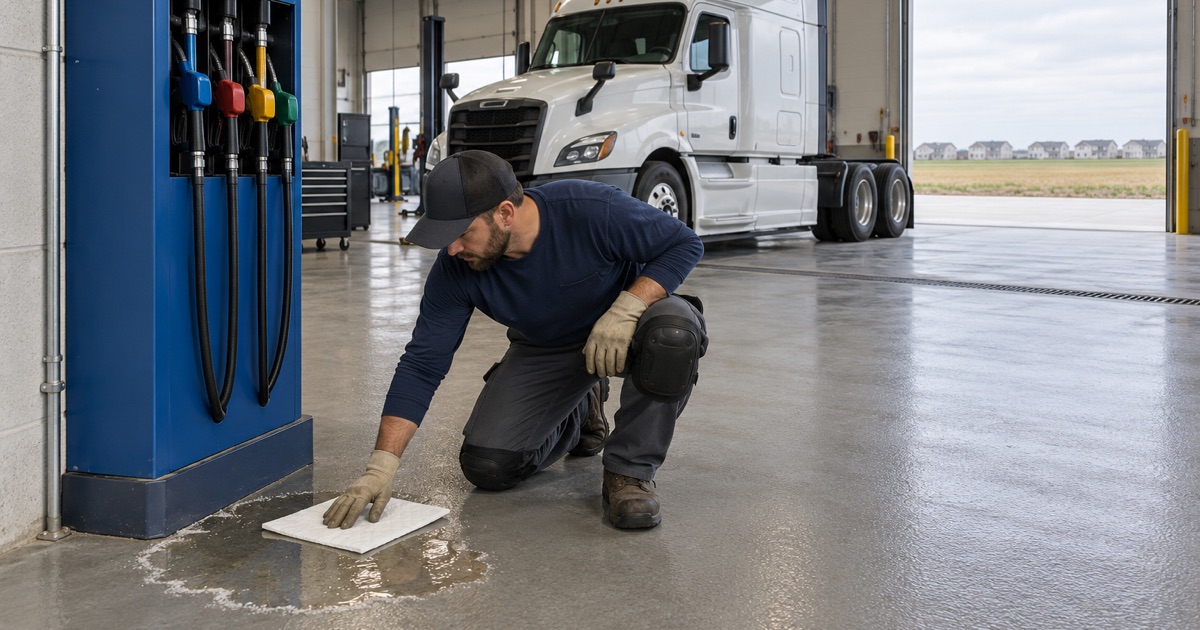
Spill kits stocked for oil are built from hydrophobic material, and one spill-kit maker states plainly that oil and fuel kits reject water-based chemicals such as DEF. A pad that drinks motor oil can sit on a DEF puddle and push it around. The DEF SDS calls for inert absorbents instead, such as sand or vermiculite.
So the right absorbent belongs beside the DEF dispenser, not across the shop in the oil station. That is a housekeeping decision rather than a coating one, but it shapes the floor plan: where the dispenser sits is where texture, sealing and cleanup access matter most.
Slick Film on a Smooth Surface
Several DEF and urea data sheets warn about slip hazard, and one notes the product can be slippery on floors, especially when wet. A glossy epoxy with no broadcast reads fine under a dry boot and very differently under a thin water film. In a bay where technicians walk around trucks all shift, that difference is the one that counts.
Oil on a smooth floor is a familiar hazard that crews watch for. A clear, faint-smelling film is easier to miss, which is why we treat DEF areas as wet-service zones when we specify texture rather than as an afterthought.
White Crystals Left Behind
When DEF dries, the water leaves and the urea stays as a white crystal crust. On bare or porous concrete those crystals can lodge in the open pores instead of wiping away. The spill-kit guidance we read says DEF should not be left to dry or washed toward a storm drain, because residue remains.
A sealed coating changes that cleanup. Crystals sitting on a nonporous topcoat wipe up with water and a mop. That is a good reason to coat, but a floor coating does not hold a spill back from a drain, and we never describe one as if it did.
Texture, Sealing and Rinse-Off for Both Fluids
Choosing a Broadcast That Grips Under Water
Slip resistance comes from the broadcast and the topcoat, so we specify it that way rather than promising it. Quartz aggregate broadcast into a 100% solids epoxy and locked in by a polyaspartic topcoat gives a profile that still grips when a water film covers it. Grit size and topcoat thickness decide how aggressive the finish feels.
Too coarse and the floor fights mops and squeegees, which matters when DEF should be rinsed up quickly. We match texture to how each area is cleaned, often with a heavier broadcast at dispensers and walkways and a lighter one across open bay floor.
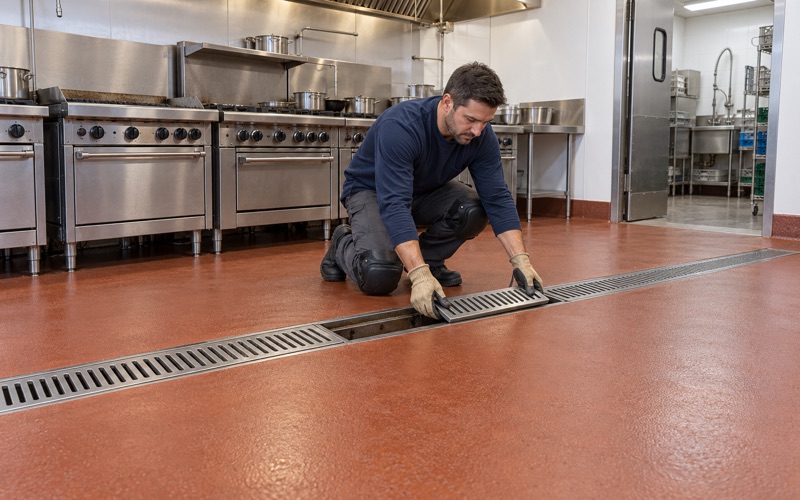
Edges and the area right around a floor drain get the same attention, since rinse water runs there. Where a drain leads and what may go into it is the owner’s call under the shop’s own permits, and we do not guess at it.
Sealing the Surface So Residue Rinses Off
Surface prep leaves an ICRI concrete surface profile the primer can grip. Coat count and finished thickness then build a continuous film over the pores where urea would otherwise settle. Urethane cement is another option where hot rinse water or steam cleaning is routine.
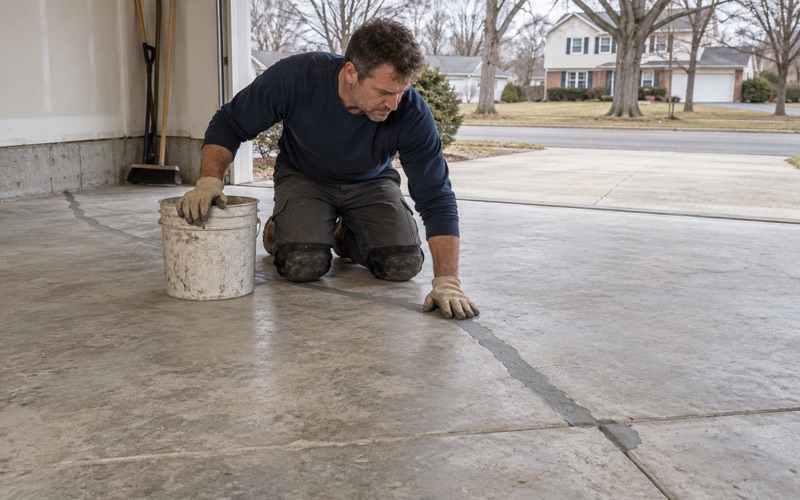
Cracks, spalls and old coatings are mapped before any of that, and we say so when a slab needs repair first. A crack left unfilled becomes a channel where DEF and rinse water collect, which undoes the point of sealing.
Cure Timing for a Busy Shop
Shops rarely close for long, so we phase the work around operating hours and use overnight or weekend windows where a bay cannot sit empty. Cure schedules follow slab temperature and dew point at the surface rather than the calendar. A coat put down too close to the dew point can form amine blush that weakens adhesion.
Products are chosen inside the Illinois VOC limits for floor and industrial coatings under 35 Ill. Adm. Code Part 223, which bind the applicator. In practice that narrows the product list before the texture conversation even begins.
DEF Jugs and Diesel Pickups in a Pingree Grove Garage
The Same Chemistry at Home Scale
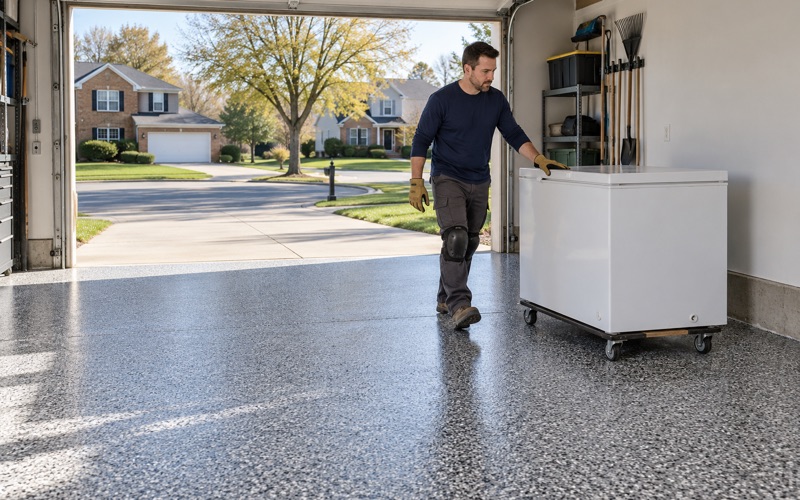
Plenty of diesel pickups park in residential garages, and a 2.5-gallon DEF jug on a shelf is a common sight. A tipped jug or a sloppy refill leaves the same thin film and the same white crystals a truck bay sees, only on a smaller floor. Keep a bag of sand or another inert absorbent near the jug rather than relying on oil pads.
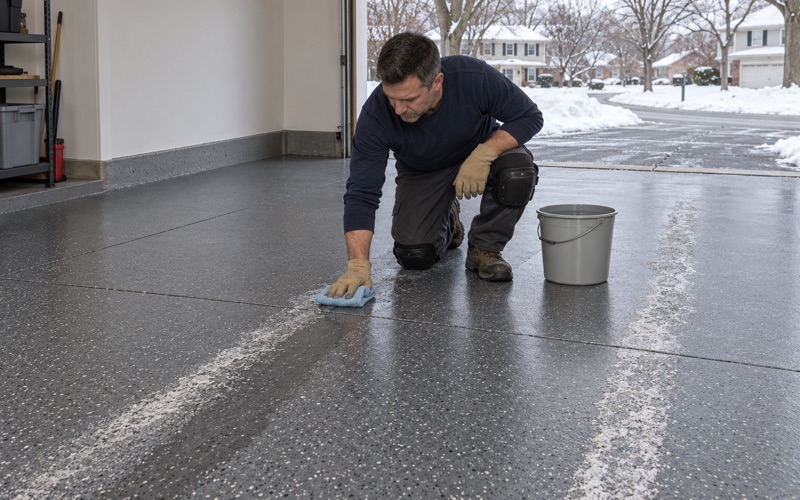
On a coated garage floor with a light broadcast, a DEF spill is a wipe-and-rinse job. On bare concrete the residue can linger as a white stain. Either way, mop up the rinse water rather than hosing it down the driveway toward the street drain.
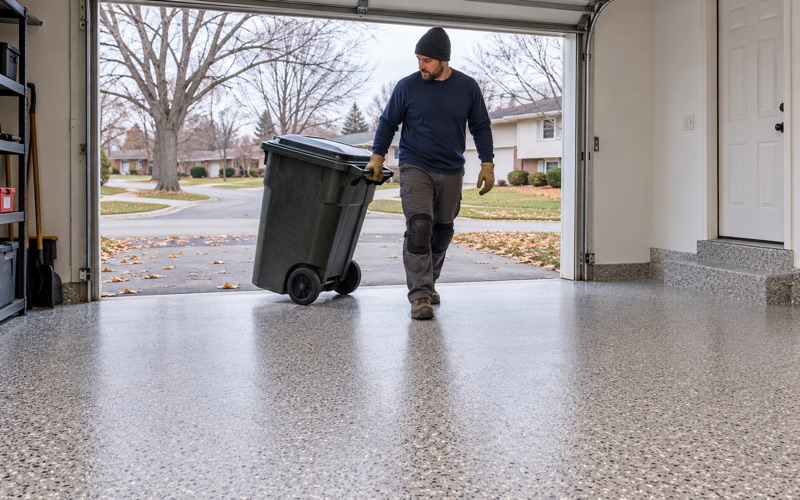
For a garage that parks a diesel pickup, we usually talk through a vinyl flake broadcast under a polyaspartic topcoat, which hides small marks and leaves a little texture underfoot. We show owners a sample wet and dry so they can feel the texture before choosing.
A First Coating on a Newer Slab
Nine of every ten homes in the village were built in 2000 or later, and about four in ten in the 2010s, so many jobs here are likely first coatings on builder-finished slabs. Newer does not mean tested. The model residential code exempts garage slabs from the under-slab vapor retarder rule, in the IRC R506.2.3 exception.
That is why our written scope includes a moisture test on every garage, using an ASTM F2170 relative humidity probe or a calcium chloride test to ASTM F1869. We also explain what the coating warranty leaves out before the job is sold, and moisture is the first exclusion we name.
Attached Homes, Permits and Paperwork
In Pingree Grove, 1,486 owner-occupied homes are single-family attached, where the garage may share a wall, apron or driveway with a neighbor. Exterior items usually fall under association rules, so we read the documents and schedule around shared driveways before setting a date.
Building questions go to the Village of Pingree Grove, which sets permit fees in Title 10, Chapter 4 of its code, and the village sits in Kane County across Rutland and Plato Townships. Home jobs over the state threshold get a written contract and the Illinois Home Repair: Know Your Consumer Rights pamphlet before grinding starts.
Renters are rare here, with 53 renter households in the count, so the person asking for a quote is nearly always the owner who will live with the floor. That owner also signs the contract, which keeps the scope, the moisture result and the warranty terms in one set of hands.
- 20+ Years in Business
- Moisture Test in Every Scope
- Diamond-Ground, Never Acid-Etched