Buffalo Grove Epoxy Flooring applies polyaspartic floor coating systems in Buffalo Grove, IL, serving surrounding cities including Prospect Heights, Deerfield, Lake Zurich, Lake Forest and Barrington. After more than 20 years of putting resin on concrete, we use polyaspartic where its strengths count: quick cures, color that holds up in sunlight and a tough surface for tires and foot traffic.
Polyaspartic is not a shortcut around preparation. Its fast cure gives an installer little time to correct mistakes, which makes a well-ground, dry and clean slab even more important. Every floor we coat is opened with a diamond grinder or shot blaster and tested for moisture before the price is final.
Our written proposals say exactly where polyaspartic goes in the system, whether as a full-build floor, a topcoat over an epoxy base or a clear coat over flake. They name the product line, the number of coats and the finished thickness, so you know what you paid for and can check it later.
Why Polyaspartic Works on Floors Here
Fast Cure and Short Downtime
Polyaspartic cures in hours rather than the day or more many epoxies need between coats. For a homeowner that can mean a garage back in use sooner, and for a business it can mean a room coated overnight and reopened in the morning.
That speed has a cost. The working time in the bucket is short, so the crew has to mix in smaller batches and move steadily. We plan the layout of each pour around that, so lap lines and missed spots do not appear in the finished floor.
Holding Color Under Sunlight
Many epoxies amber under ultraviolet light, turning yellow near open doors and windows. Aliphatic polyaspartic is formulated to resist that change, which is why it is our usual top layer for garages that face the street and retail floors with large front windows.
Where color matters most, such as light gray floors or clear coats over a bright flake blend, the topcoat choice is the difference between a floor that looks the same in five years and one with a yellow band inside the door.
Flexibility and Temperature Range
Polyaspartic stays somewhat more flexible than a rigid epoxy, which helps it ride through the small movements of a slab that heats and cools. It also cures at lower temperatures than most epoxies, widening the season for coating work.
That does not make every winter day a coating day. The slab must still sit safely above the dew point and within the product’s limits, and we measure both before mixing rather than trusting the forecast.
Residential Polyaspartic Floor Coating
Garage Floors Through Salt Season
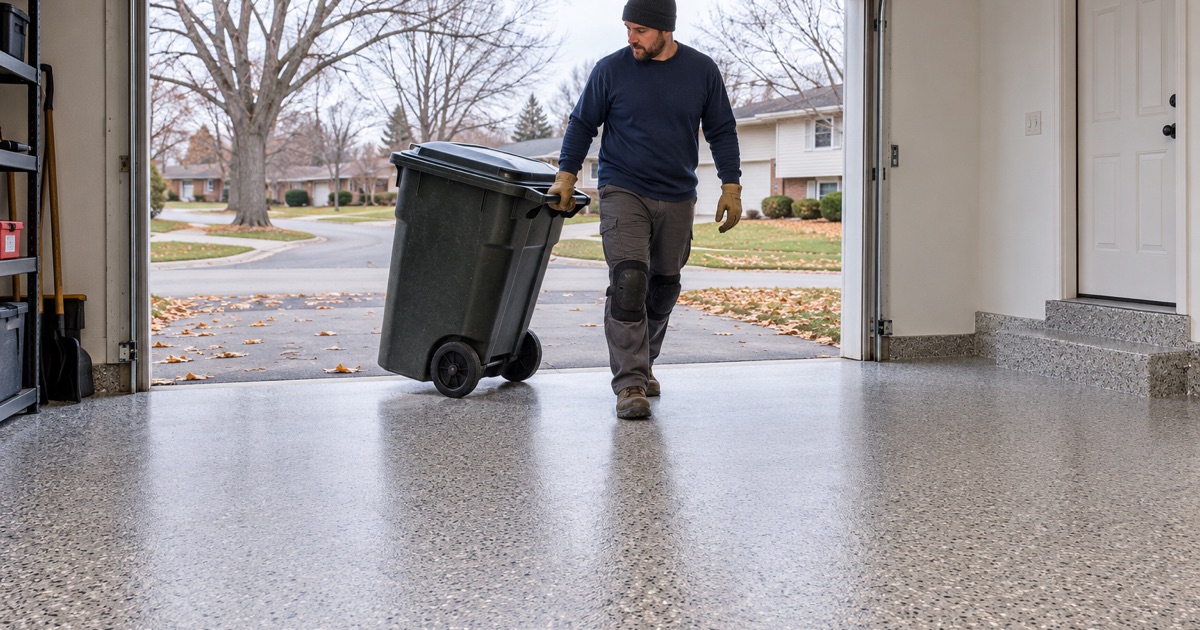
Rock salt, calcium chloride and brine arrive on every tire from late fall to spring. A polyaspartic topcoat over a full flake broadcast keeps that salt water on the surface, where it can be squeegeed out the door, instead of letting it soak into concrete and scale it.
We set the texture by the broadcast and the topcoat, so a wet floor still offers grip. A satin sheen also hides the gray film that dried salt leaves behind better than a high gloss does.
Basements and Lower Levels
On the Cook side of the village, most homes have a full or partial basement, and polyaspartic can finish those slabs quickly with less disruption to the household. Before we coat one, we read it for past water and test it, because a coating does not stop seepage and moisture under the floor can lift it.
Where a basement reading runs high, a moisture-mitigation primer goes down first and the polyaspartic system is built on top. That primer is priced as its own line so you can see what it adds.
Townhome Garages and Shared Driveways
Many homes here are townhouses or condominium units with garages along a shared drive. A faster cure helps there, because neighbors are inconvenienced for less time. We still confirm the association’s contractor rules and working hours before we set the date.
We also plan where the trailer, mixing station and vacuum will sit so a neighbor’s garage door stays clear, and we tell the association when vehicles can return. Garages that share a wall get the same dust capture and ventilation as any attached garage, so odor and powder do not reach the unit next door.
Clear Coats Over Decorative Flake
A clear polyaspartic coat is what makes a flake floor look finished. It locks the chips in, smooths their sharp edges to a texture you choose and protects the color of the blend from sunlight. One coat leaves more grip, while a second fills the texture for a smoother, easier-to-mop surface.
Commercial Polyaspartic Floor Coating
Retail and Showroom Floors
Stores and showrooms along Lake Cook Road and Route 83 often cannot close for days. A polyaspartic system can go down after hours in phases, with sections reopened the next morning, and it keeps its color under display lighting and front windows.
We plan those jobs area by area, mark which aisles reopen when, and keep a vacuum on every grinder so dust stays out of merchandise and air handlers. Store managers get the sequence in writing ahead of time, so staff know which sections to rope off each night.
Office Break Rooms, Corridors and Restrooms
Offices in Buffalo Grove’s corporate parks have break rooms, restrooms and corridors that take steady traffic and frequent cleaning. Polyaspartic over a flake or quartz broadcast gives a seamless, cleanable floor that can be installed over a weekend.
Restroom floors get a coved base where the coating turns up the wall, so mop water cannot sit in a seam at the corner. In corridors that link office space to warehouse bays, we pick a texture and sheen that handle both street shoes and the occasional pallet jack.
Auto Service Bays and Fleet Garages
Service bays deal with hot tires, oil and brake fluid. A polyaspartic topcoat over a thicker epoxy base gives abrasion and chemical resistance where it matters, and we leave lift anchors, trench drains and floor plates accessible rather than coating over them.
Those bays also see heavy salt in winter as vehicles come in off the road, so a slip texture is set by the broadcast and the topcoat rather than left to chance.
Our Step-by-Step Polyaspartic Floor Coating Process
Step 1: Test, Map and Write the Scope
We test the slab for moisture, map its cracks, spalls and any old coating, and write a proposal naming the product line, coat count and finished thickness. Warranty exclusions, starting with moisture vapor and hydrostatic pressure, are explained before you sign.
For home jobs over $1,000, Illinois’ Home Repair and Remodeling Act calls for a written contract and the Attorney General’s consumer-rights pamphlet before work starts, and we handle both at this step. In Buffalo Grove we also confirm our annual contractor registration and ask the village about any permit for the specific job.
Step 2: Grind and Repair
The slab is diamond ground to the surface profile the product requires, with dust captured at the machine. Cracks are routed and filled, spalls rebuilt and joints treated so the floor finishes flat and the coating has sound concrete to bond to.
Because polyaspartic cures so quickly, any defect left in the slab is locked in almost at once. We vacuum the ground surface thoroughly and wipe the edges, since leftover dust under a fast-curing coat shows up as rough patches and weak bond.
Step 3: Prime or Base Coat
Depending on the system, a polyaspartic or epoxy base coat goes down, with flake or quartz broadcast into it while wet. We check the slab temperature and the dew point spread at the surface first, since applying to a damp or cold slab risks poor adhesion.
When the base is epoxy, we also watch for amine blush, a waxy film some epoxies form in cool, humid conditions. A topcoat laid over blush can peel, so we check for it and wash it off before the polyaspartic goes down.
Step 4: Topcoat and Inspection
After the base has cured enough to scrape and vacuum, the polyaspartic topcoat is applied at the stated coverage. We walk the finished floor with you, check for thin spots and missed areas, and give written dates for foot traffic, furniture and vehicles.
We also leave you with care instructions: a neutral cleaner, a soft squeegee for winter brine, and felt pads under heavy furniture or equipment. A coated floor that is rinsed of salt each spring and kept free of grit will keep its sheen far longer.
- 20+ Years in Business
- Moisture Test in Every Scope
- Diamond-Ground, Never Acid-Etched