Buffalo Grove Epoxy Flooring brings more than 20 years of epoxy flooring in River Forest and the wider area to a problem that is easy to overlook: the small, hard-used floor. A restroom is the clearest case. It takes more abuse per square foot than almost any other room in a building, and it is where bare concrete gives up first.
Broom-finished concrete looks clean the day it is poured, but it is a sponge with a hard surface. Urine and mop water find the open pores and the seam where the floor meets the wall, and the smell returns after every cleaning. A seamless resin floor, carried up the wall as an integral cove, keeps that liquid on top where a mop can reach it.
This page walks through how we approach that kind of room: the state’s own wording for restroom floors, why the odor keeps coming back on concrete, how the cove is built, and the limits of what any coating can do. The same thinking applies to a shop washroom, an office restroom or a basement half bath.
The State’s One-Sentence Rule for Restroom Floors
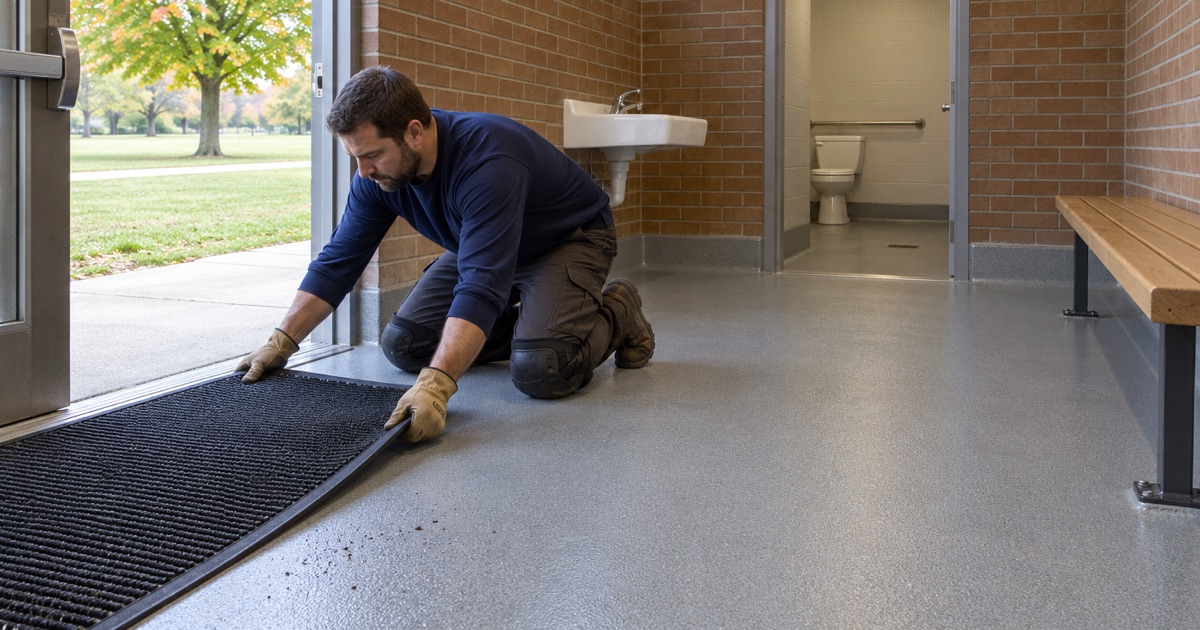
Illinois puts its expectation for restroom floors into a single line. The Public Area Sanitary Practice Code, at Section 895.50(c) of Title 77 of the Illinois Administrative Code, says that floors shall be constructed of impervious, easily cleanable material. We quote it as the state’s own description of a good restroom floor, not as a ruling on any particular building.
What Impervious Asks of a Floor
Impervious means liquid stays on the surface instead of moving into the material. Plain concrete fails that test by nature, because cement paste is full of capillary pores that wick moisture in. A cured 100% solids epoxy has no such pore network, and a nonporous topcoat over it closes the surface further, so a spill sits where it landed until someone wipes it up.
Sealers sit somewhere in between. A penetrating sealer or a lithium silicate densifier hardens concrete and slows absorption, but it does not form a continuous film, and the joints and edges stay open. For a room that sees urine every day, we treat a densifier as a step toward a sealed floor, not as the finished answer.
What Easily Cleanable Asks
Easily cleanable is about the shape of the surface as much as the material. A floor with grout lines, open cracks or a rough broom texture traps soil in thousands of small valleys that a mop skims over. A seamless resin floor with a fine broadcast gives the mop one continuous plane, and we set the texture by the aggregate and topcoat we specify rather than by promise.
There is a balance to strike. A restroom floor still needs grip when it is wet, so a light quartz aggregate broadcast is locked under the topcoat, enough to steady a shoe without leaving ridges that hold dirt. The proposal names that broadcast, the product line, the number of coats and the finished thickness, so the floor can be checked against the quote.
Constitution Park and the Shelter Restroom
River Forest has a fresh example of the building type. The River Forest Park District rebuilt Constitution Park at 7715 Greenfield Street with a 20-by-20-foot picnic shelter holding two single-stall restrooms, one men’s and one women’s. The $1.6 million project drew a $600,000 state OSLAD grant, the Village Board approved it on April 28, 2025, and the ribbon cutting was set for July 2026.
We have not seen those restrooms and do not know what their floors are made of, and we had no part in the project. We mention them because a park shelter restroom is exactly the room the state sentence describes: open to the public, used hard on busy days, and cleaned by staff who have a whole park to look after.
Looking for epoxy-flooring closer to Fox Lake? See Epoxy-Flooring in Fox Lake.
Why Urine Odor Outlasts Mopping on Bare Concrete
Anyone who has managed a busy restroom knows the pattern. The floor is mopped, it smells fine for an hour, and then the odor creeps back. That is not a sign of lazy cleaning. It is what happens when the source of the smell has moved below the surface, where a mop head never reaches.
Uric Acid in the Pores
A restroom-odor study reported in the cleaning trade press found uric acid to be the main source of the smell. Urine is absorbed into grout, the uric acid builds up, and the odor is released again. The same study found many of the products and tools in use were not removing it.
Broom-finished concrete behaves much like grout in this respect, with open pores across the whole floor rather than in thin lines. Each spill and each wet mop pushes a little more into the slab. Surface cleaning lifts what is on top, while the reservoir underneath keeps feeding the smell back into the room.
The Seam at the Wall
The worst spot is usually the joint where the floor meets the wall. A slab poured against a block or framed wall leaves a crack, sometimes hidden behind a rubber base, and liquid runs straight into it. Around a toilet and in the corners, that joint stays damp long after the floor has dried, and it is often where the smell is strongest.
Where an Enzymatic Cleaner Can Work
Cleaning guides point to enzymatic cleaners for this job, because the enzymes break down uric acid crystals that ordinary detergents leave behind. They work best when the urine is still on a surface they can reach. On a sealed resin floor, a daily mop followed by an enzymatic cleaner meets the residue at the top instead of chasing it into the slab.
The same guides add a warning that matters to anyone choosing a coating. A sealer that cracks or wears through opens a path for absorption again. That is why we put a durable, nonporous topcoat over the epoxy in a restroom and talk about recoat timing up front, rather than treating the floor as finished forever.
The Integral Cove, and a Single-Stall Room in a Day
An integral cove is the detail that turns a coated floor into a sealed room. Instead of stopping at the wall and relying on a separate base, the resin is carried up the wall in a smooth curve, usually several inches high, so the floor and the wall base are one continuous piece. There is no seam left for urine to find.
Building the Cove
The cove starts with a curved fillet, often troweled from an epoxy mortar, that fills the inside corner and gives the coating a radius to follow. The wall above is ground or abraded so the resin bonds to it, and the cove is coated in the same system as the floor. Where the cove ends, we finish it with a clean, sealed top edge.
Food code writers reached the same conclusion: FDA Food Code 6-201.13 calls for coved floor and wall junctures where floors are cleaned with water. A restroom cleaned daily with a wet mop has the same need. Around the toilet flange and any pipe penetrations, the resin is worked tight so no gap is left at the fixture.
Preparing a Small Room Properly
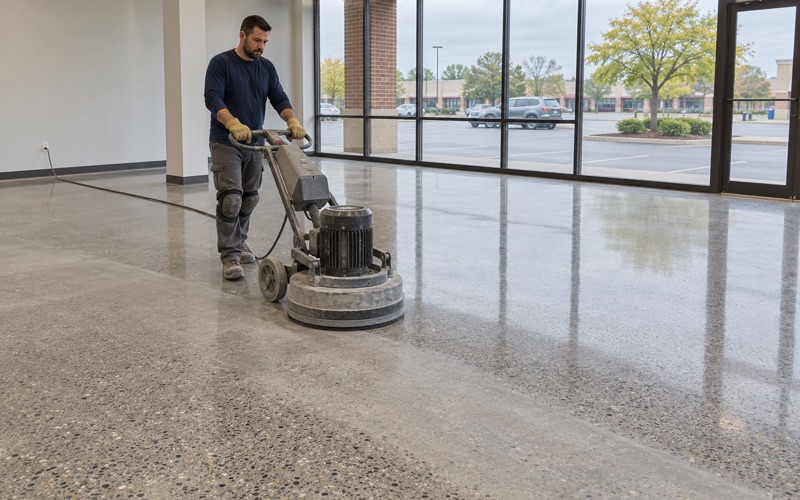
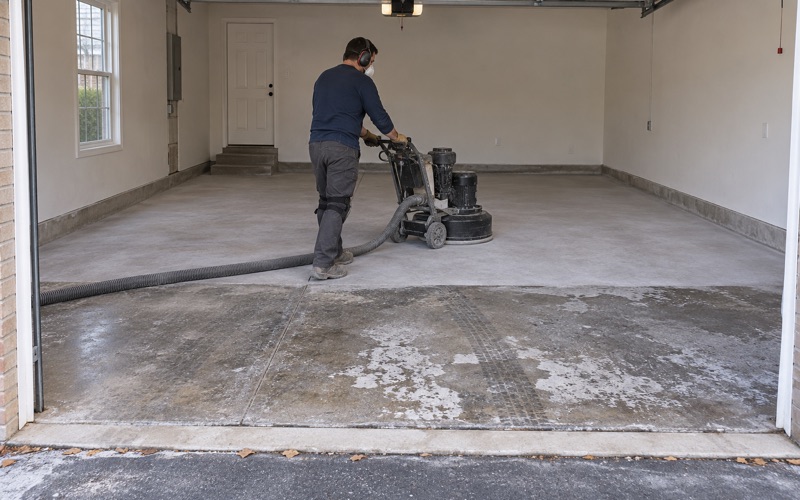
A small room still gets full surface preparation. We open the slab with a diamond grinder, never an acid etch, to reach the concrete surface profile the system calls for, and a vacuum at the machine captures the dust rather than letting it be rinsed toward a floor drain. Cracks, spalls and any old coating are mapped before the price is final.
Urine that has soaked in for years can also interfere with adhesion, so we look closely at stained areas around the fixture after grinding. If the concrete there is badly contaminated or broken, we say so and recommend repair before coating.
Coated Within a Day Off
A single-stall restroom is small enough that the floor and cove can usually be ground, coated and topcoated in one day of closure, depending on the system and conditions. Fast-curing topcoats such as polyaspartic shorten the wait between coats. The room then needs time to cure before it reopens, which is where scheduling matters most.
Cure follows slab temperature and the dew point, not the calendar. One epoxy manufacturer’s data lists a minimum substrate temperature of 50 degrees, with the slab at least 5 degrees above the dew point, and roughly 24 hours to foot traffic at that temperature. An unheated shelter in deep winter is a room we would tell an owner to wait on.
What a Coating Does Not Fix
A resin floor solves one problem well: it keeps liquid on a surface that can be cleaned. It does not change the rest of the room, and we would rather say that before a job is sold than after. Three limits come up in nearly every restroom conversation.
Drains and Ventilation Stay as Built
A coating does not move a floor drain, and it does not add air movement to a room that lacks it. The state section that asks for impervious floors also asks that restrooms be ventilated, and that is a mechanical question, not a flooring one. If a room smells even when the floor is dry and clean, the air deserves a look first.
Odor Control Is Ongoing
A sealed floor makes daily cleaning effective. It does not make cleaning optional, and it will not erase odor that lives in the walls, the fixtures or the room’s air. Expect a cleaner floor that responds to a mop, not a room that stays fresh without attention.
Moisture and the Warranty
Moisture is the first exclusion we name in any coating warranty, and we explain it before the job is sold. Vapor rising through a slab can lift even a well-applied floor, which is why we test with ASTM F2170 relative humidity probes or an ASTM F1869 calcium chloride test before committing to a system. A moisture-mitigation primer is an option where readings call for one.
Restroom Floors Across River Forest
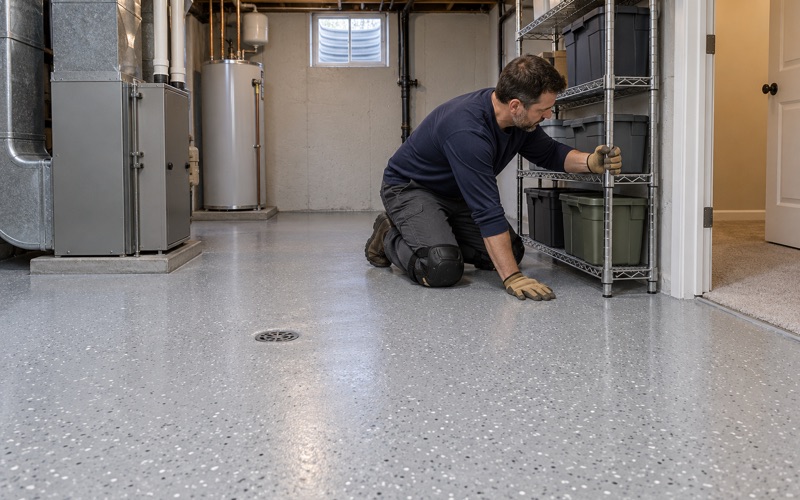
Restroom work in River Forest often sits inside a bigger renovation; the village reports about 6 to 10 renovations a year in its housing. Many homes predate 1940, so a basement half bath on an old slab raises the same questions as a public room. The same cove detail suits a small powder room just as well as a public one.
For businesses along Lake Street and North Avenue, a staff or customer restroom usually cannot close for long. We phase that work around operating hours and use overnight or weekend windows when a room has to reopen the next morning. In a home, we confirm any permit question with the Village of River Forest before a date goes on the calendar.
- 20+ Years in Business
- Moisture Test in Every Scope
- Diamond-Ground, Never Acid-Etched