Buffalo Grove Epoxy Flooring has spent more than 20 years on epoxy flooring in River Grove and across the region, and the floors we think about hardest are the ones that take a beating from feet that just left a playing field. Cleats, grit and loose granules ask more of a coating than a parked car does. This page covers how we build a floor that gives that debris up to a broom.
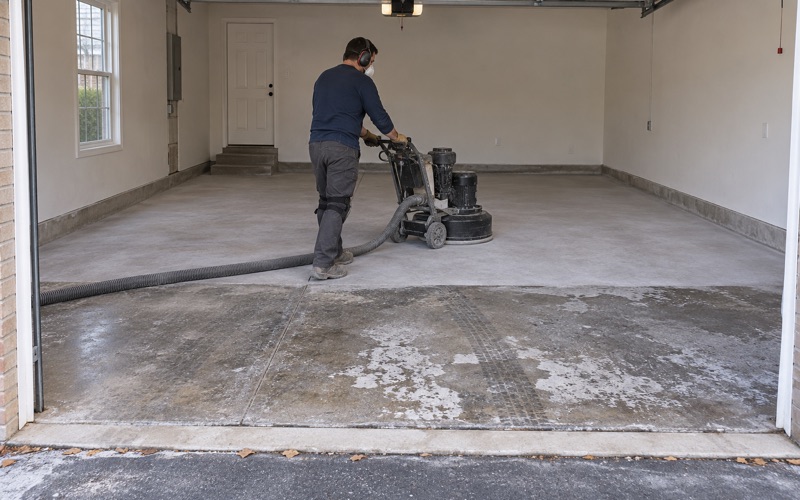
Every job starts the same way. We open the slab with a diamond grinder or a shot blaster rather than an acid etch, map the cracks, spalls and old coatings before pricing, and run a moisture test as part of the written scope. If a slab needs repair or replacement before it should be coated, we tell you that first.
The proposal names the product line, the number of coats and the finished thickness, so you can hold the finished floor against the quote. We also explain what a coating warranty leaves out before anything is signed, and moisture is the first exclusion we name. From there, the floor is shaped around what actually crosses it every day.
A Turf Field, Four Locker Rooms and Where the Infill Goes
On the east side of the Triton College campus, behind the R-Building, sits the Jorndt Athletic Complex Multi-Purpose Field. It was rebuilt in 2016, it is home to Triton soccer and track and field, and the college lists it as 100 percent synthetic turf. Beside the field are four heated locker rooms, an officials’ locker room and a concession stand.
Players Walk Straight Off the Infill
That layout is the reason we use it as an example. When a match or a practice ends, players can walk from the turf straight into a heated room still wearing cleats. Whatever the field shed into their studs, socks and bags comes along with them. We have not worked on those rooms, and Triton is a place here, not a client.
Infill Migrates by Design
Synthetic turf is held upright by infill, typically rubber pellets, sand or a mix, and we have not read which kind the Jorndt field uses. Stormwater guidance from the Marin County program, citing the Synthetic Turf Council, says rubber infill pellets migrate away from their initial position depending on how often and how intensely a field is used.
Heavy use means more granules on the move, and a busy field sends a steady trickle off the playing surface and toward its exits. The same guidance budgets about one hour of inspection and maintenance for every 10 hours of play. That ratio shows how much of owning turf is simply keeping the infill where it belongs.
Swept Up and Kept, Not Washed Away
The guidance is direct about where escaped pellets should end up. It asks fields to post signs telling anyone leaving to remove rubber pieces from their person and equipment, and it tells staff to sweep and remove pellets where they accumulate. Collection is the goal, and a hose that pushes granules toward a drain works against it.
That changes what a locker-room floor is for. Indoors, the floor becomes the last collection point, the place where whatever slipped past the exit gets gathered and carried to a bin. A floor that holds granules in its texture, or one that can only be cleaned by flooding it, turns a stormwater rule into a mopping problem.
Looking for epoxy-flooring closer to Beach Park? See Epoxy-Flooring in Beach Park.
Brush Mats at the Gate, a Sweepable Floor Inside
Containment works in two layers. The first is outside, where players knock most of the infill loose before they reach a door. The second is the floor they step onto, which should release what is left without a fight. We design for the second layer, but it only works well when the first one is doing its job.
What Brush Mats Catch
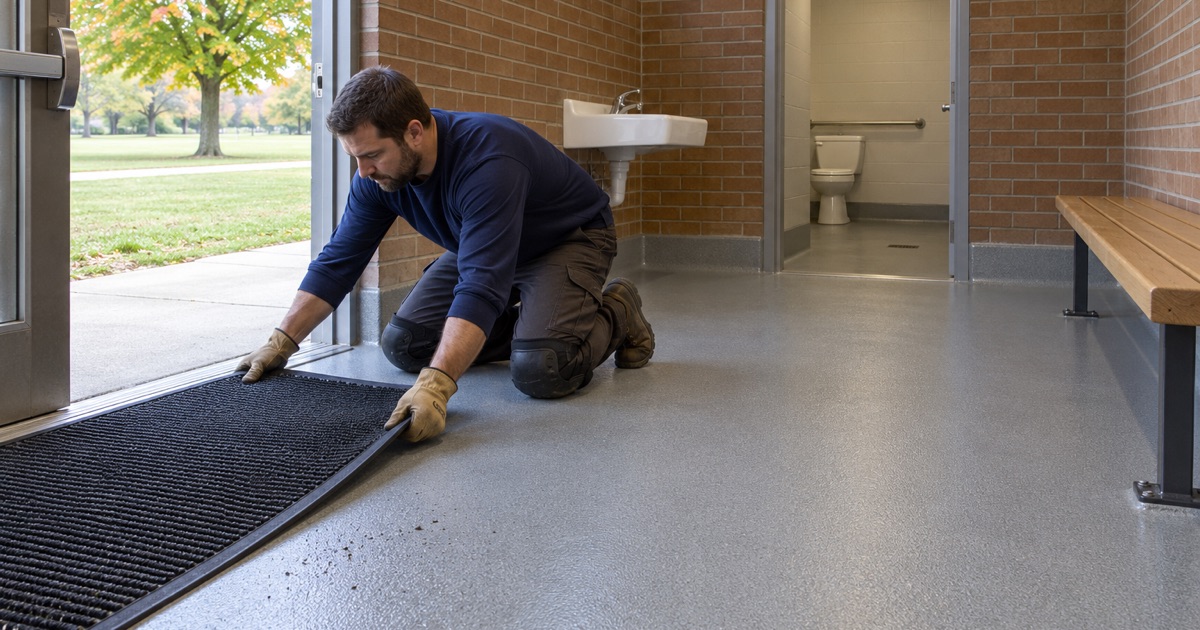
The Marin County guidance calls for brush mats at several field entrances and asks that players clean their shoes on the way out. Stiff bristles pull pellets and sand from between cleat studs in a way a flat doormat cannot. Whatever the brushes miss is usually the finest material, the grains small enough to ride in a sock fold or a bag seam.
A Surface That Gives Granules Up
Inside, the coating needs to be sealed and smooth enough that a broom or a vacuum lifts granules on the first pass. Rubber pellets roll underfoot and gather in corners, while sand behaves like loose grit. Neither should be able to lodge in pinholes, open pores or a coarse broadcast, because anything lodged there gets ground in with the next pair of cleats.
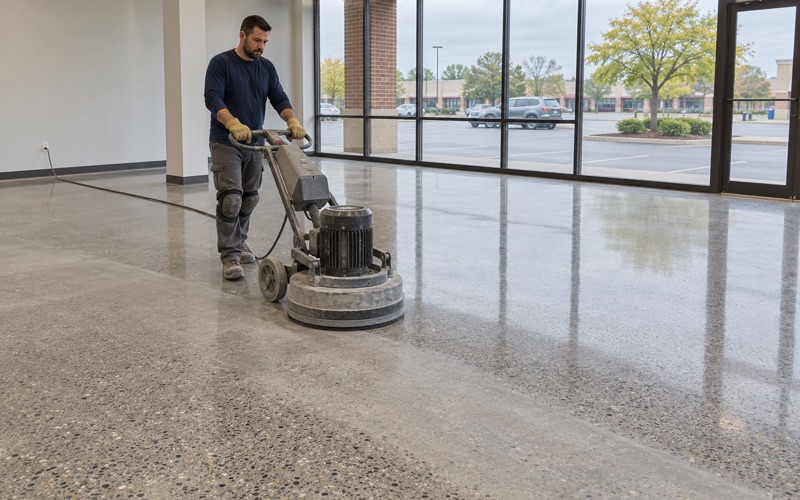
That is why surface preparation matters as much as the resin. We grind or shot blast to a measured ICRI concrete surface profile, fill bugholes and cracks, and lay down 100% solids epoxy at a build that leaves no open pores. A densified bare slab, even one treated with lithium silicate, still leaves an open surface that fine sand can settle into.
A Bin, Not a Floor Drain
Many locker rooms and mudrooms have a floor drain, and the habit is to hose the floor toward it. With turf infill, that sends exactly what the field guidance wants kept out of the water straight into the plumbing. We would rather build a floor that a dry broom and a dustpan can clear, so the routine ends at a trash bin.
We hold ourselves to the same rule during installation. Grinding dust is captured at the machine with a vacuum rather than rinsed toward a floor drain, a sump or a storm inlet. It would make little sense to coat a floor meant to keep debris out of the drains and then send our own dust down one on day one.
Cleats, Grit and the Topcoat They Wear
A cleat is a concentrated load. Molded studs press into a small area with every step, and a few grains of sand caught under them act like sandpaper on whatever the floor’s top layer is. The topcoat, not the base coat, takes that wear, so it is where most of the specification for an athletic floor lives.
Polyaspartic and Polyurea Topcoats
Over a 100% solids epoxy base, we usually recommend a polyaspartic or polyurea topcoat for any floor that sees cleats. These finishes resist abrasion and scuffing better than an epoxy top layer alone, and they tend to hold their color longer. On a high-wear floor we often specify a second topcoat rather than a thicker base.
Where a room also takes hot water, cleaning chemicals or heavy wet use, urethane cement becomes worth discussing. It tolerates thermal shock and constant moisture in ways a thin film cannot, though its surface is usually rougher. That tradeoff matters on a granule floor, and we talk it through before choosing rather than defaulting to the toughest-sounding system.
Texture Fine Enough to Sweep
A wet locker room needs grip, but grip and sweepability pull in opposite directions. A heavy quartz aggregate broadcast gives bare feet and shower sandals plenty of traction, and it also gives sand plenty of places to sit. We specify slip resistance by the broadcast and topcoat used, choosing a fine texture that a broom can still clear.
In practice that often means a light quartz or vinyl flake broadcast locked down under the topcoat rather than left proud of it. Wet areas near showers can take a slightly coarser grade than the dry aisle where players change. Splitting the texture by zone keeps traction where water sits and smoothness where granules land.
Heated Rooms and Cure Timing
Heated rooms help with one part of the job. Our cure schedules follow slab temperature and dew point spread at the surface, not a date on a calendar, and a conditioned space makes those readings easier to hold steady. Too little spread between the slab and the dew point invites amine blush, which leaves a greasy film that weakens the bond between coats.
Sports Bags and Cleats in River Grove Garages and Mudrooms
The same problem follows players home. River Grove has 4,196 occupied housing units, and 2,332 of them are owner-occupied, which puts a lot of households in charge of their own garage and back-entry floors. Wherever a family drops cleats and sports bags after practice, a share of the field comes in with them.
The Drop Zone by the Door
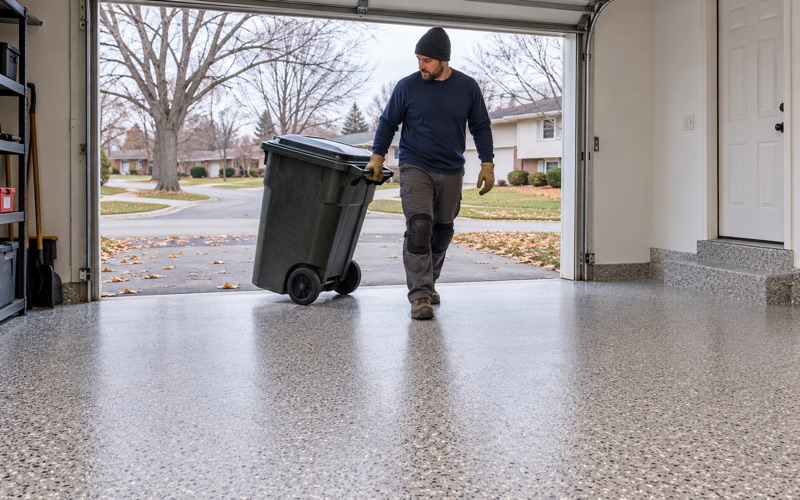
In many homes the drop zone is the garage step or a mudroom just inside it. Rubber pellets and sand shake out of bags and shoes there, and a bare or painted slab hangs onto them. A sealed epoxy floor with a light flake broadcast lets you sweep the corner in a minute instead of finding granules tracked through the kitchen.
Painted garage floors are where we see the most trouble, because a thin one-part coating over an etched slab has little profile to hold. Cleats scuff through it, and hot tire pickup lifts it where cars park. Opening the concrete mechanically and building a real film thickness is what keeps the drop zone from peeling.
Winter Salt on the Same Floor
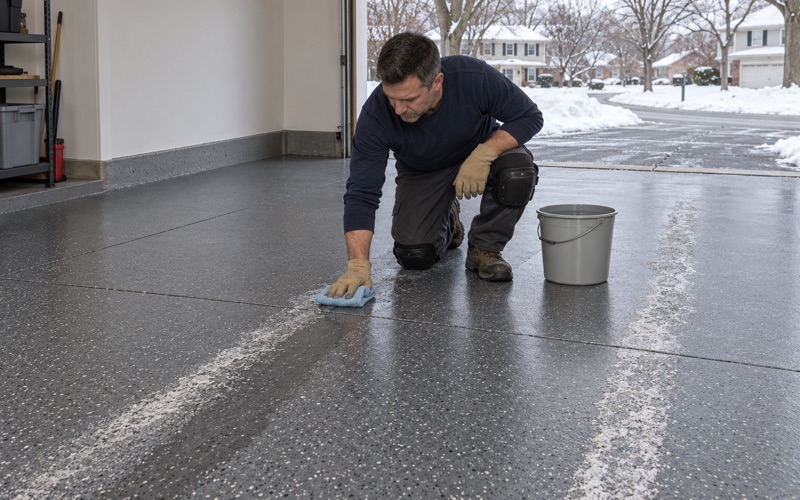
A garage that collects infill in the fall collects brine and rock salt from tires all winter. We choose garage systems that hold up to calcium chloride and rock salt deicers, and the same smooth, sealed topcoat that lets go of rubber pellets also keeps salt residue on the surface, where a squeegee can move it, rather than in the concrete.
Cold is the other winter issue. An unheated garage in deep winter is told to wait, because the slab may not reach a temperature the resin needs to cure properly. Scheduling the work for spring or early fall costs a few weeks and saves a floor that would otherwise soften, blush or peel.
Older Slabs, Moisture and Paperwork
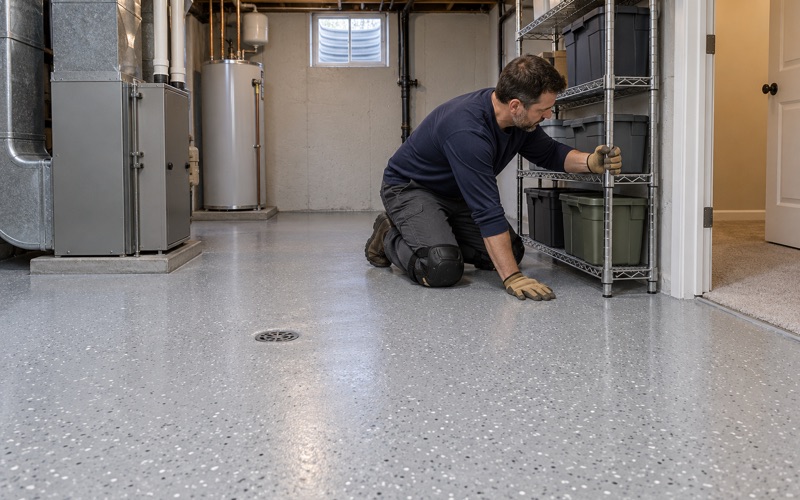
A lot of River Grove’s housing is older: 762 units were built in 1939 or earlier, and another 1,086 date to the 1960s. Older garage and basement slabs often lack a vapor retarder, so we confirm moisture with ASTM F1869 calcium chloride tests or ASTM F2170 relative humidity probes before the price is final, and use a moisture-mitigation primer when readings call for one.
Paperwork follows the village’s rules. River Grove requires a building permit for remodeling valued over $100, and contractor paperwork with the Building Department at 2621 N Thatcher Avenue runs on the calendar year, so we confirm both before a date is set. Home jobs over the state threshold also get a written contract and the Illinois consumer-rights pamphlet before any grinding starts.
- 20+ Years in Business
- Moisture Test in Every Scope
- Diamond-Ground, Never Acid-Etched