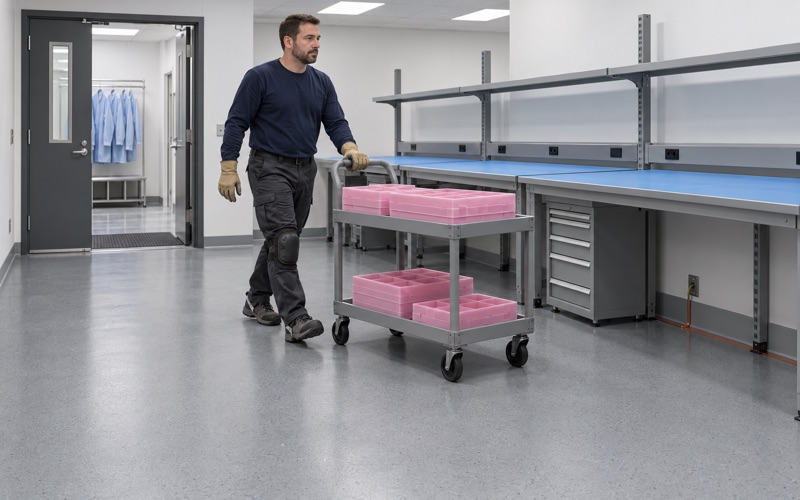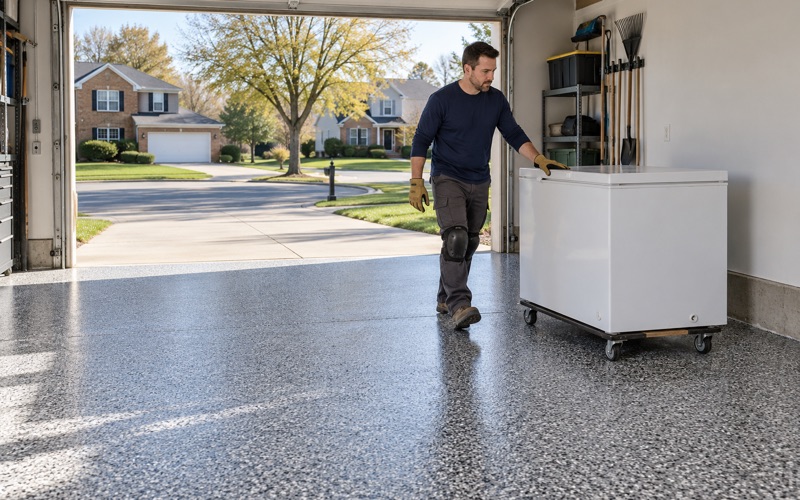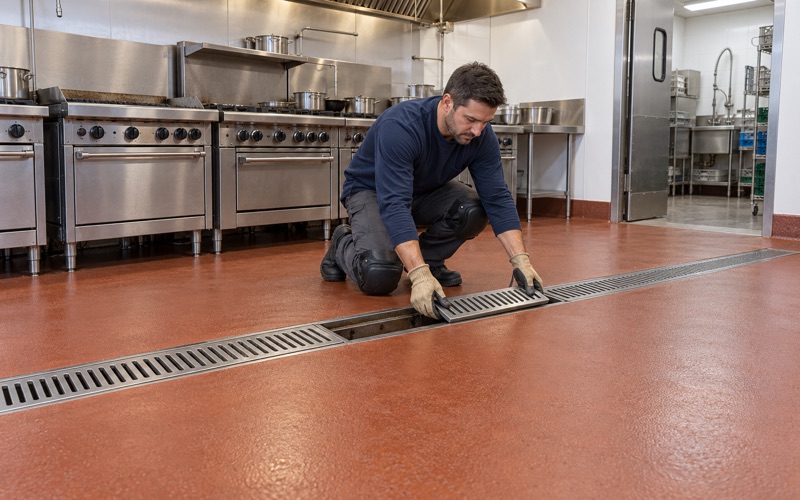
Buffalo Grove Epoxy Flooring has spent more than 20 years on epoxy flooring in Round Lake and across the northern suburbs, and the first thing we settle on any job is who owns the slab. A homeowner’s garage, a shop in an industrial building and a floor inside a public building are three different jobs, even when the coating system is the same. Ownership decides the paperwork, the wage and, in the end, the price.
That matters here more than in most places, because a public floor in Illinois is not quoted the way a private one is. When a public body owns the building, even a modest recoat falls under the state’s wage law, with records that run for years after the last payment on the project. We explain that difference up front so nobody is surprised by the number.
The coating work itself does not change with the owner. Every slab is ground or shot blasted to a measurable profile, moisture is tested before the price is final, and the written proposal names the product line, the coat count and the finished thickness. What changes is everything wrapped around that work, and on a public building that wrapper is substantial.
Why a Round Lake Village Floor Is Public Works
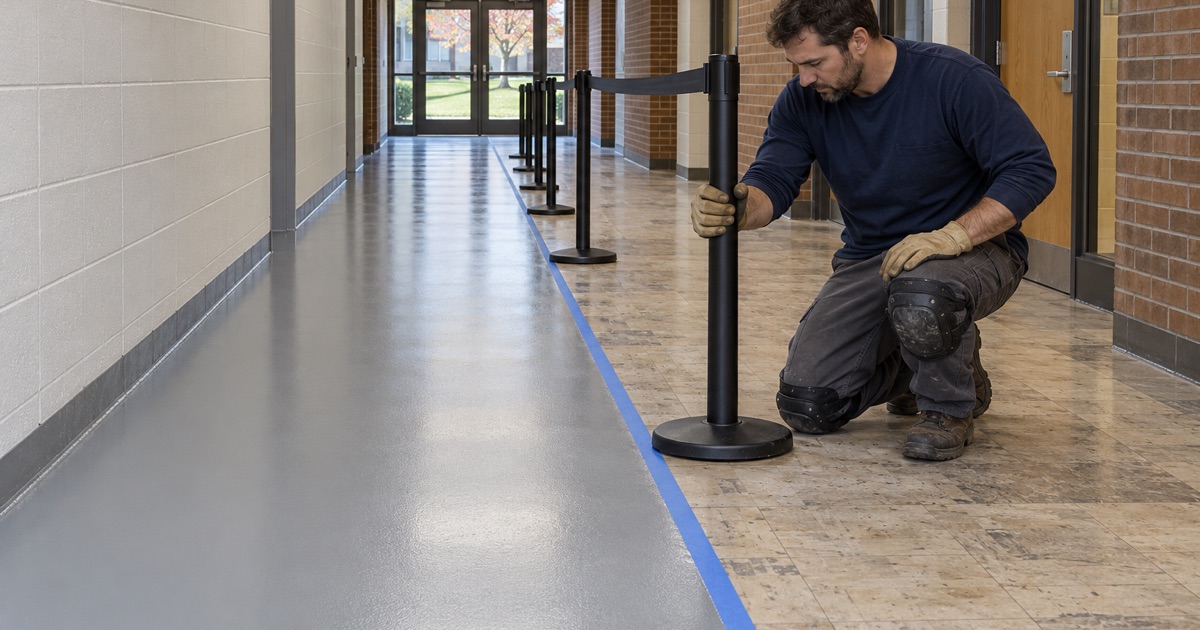
Round Lake is in the middle of rebuilding its own civic buildings. After several years of planning, the village moved its facility improvement project into construction in the fall of 2026, and Village Hall is operating out of the Annex at 442 N. Cedar Lake Road while work is underway. Any floor that goes down in one of those buildings is a floor on public works.
The $7.8 Million Village Hall and Police Building Project
A construction-lead listing published in October 2026 values the Village Hall and Police/Public Works addition and renovation at about $7.8 million, with a start date of September 18, 2026. Its scope runs from demolition, concrete and masonry through roofing, interior finishes, plumbing, HVAC and electrical work. The listing shows the award stage as subject to final approval.
The Police and Public Works building is 17 years old, and the village’s capital plan says it is beginning to show signs of wear inside. The village’s own update lists new roofs, AC and heat, carpet and updated technology for it. None of that is a floor coating, but it shows a public body actively reinvesting in an aging building.
Who Owns the Building Decides the Rules
The Illinois Department of Labor reads the Prevailing Wage Act broadly. It covers all fixed works constructed by any public body or paid for in whole or in part with public funds, and a project does not have to be for public use to be covered. A village-owned police station, public works building or office annex sits squarely inside that language.
Funding can pull a building in even when ownership does not, which is why we ask where the money comes from before we price a floor. If any public dollars touch the job, the safe reading is that the Act applies, and the public body in charge is the one to confirm it.
Why We Use the Village’s Project as the Example
We hold no contract or relationship with the Village of Round Lake, and nothing on this page describes work we are doing there. The village’s renovation is simply the clearest live example in town of a public floor decision. It is published, it has a dollar figure, and its bid packages are listed where anyone can read them.
Reading a public project this way is also how we would approach any civic floor in the area: start from the owner, then the funding, then the scope. The coating choice comes last, after the rules around it are clear.
Looking for epoxy-flooring closer to Bensenville? See Epoxy-Flooring in Bensenville.
Prevailing Wage Reaches Maintenance, Not Just New Buildings
The detail that catches most private-sector contractors is the word maintenance. Prevailing wage is not limited to ground-up construction or big additions. Under the Illinois Department of Labor’s own definition, it follows small jobs inside existing public buildings too. That is the part that turns a weekend recoat into a regulated job.
What the Department Counts as Construction
The department’s FAQ says construction means all work performed on public works by laborers, workers or mechanics, and it includes maintenance work. A floor grind and recoat in an existing room is maintenance by any plain reading. The size of the room does not move the job out of the statute.
So a single room in the police and public works building, a hallway at the Annex or a records room at Village Hall would all be covered if the village chose to coat one. None of those floors is named for resin today; the point is that the rule applies before anyone asks how small the job is.
What Happens on the Floor Stays the Same
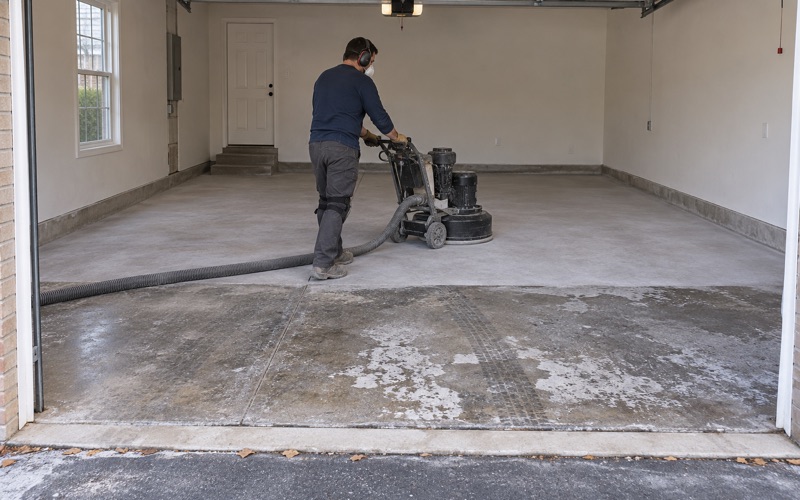
On a covered job the floor still gets the same preparation it would get anywhere. We map cracks, spalls and old coating first, open the slab with a diamond grinder or a shot blaster to the ICRI concrete surface profile the system calls for, and capture the dust at the machine with a vacuum. The difference is who is paid what for that labor, and how it is documented.
Moisture testing does not get lighter on a public job either. A calcium chloride test under ASTM F1869 or in-situ relative humidity probes under ASTM F2170 go into the written scope before the price is final, because a coating warranty typically excludes moisture vapor transmission and nobody wants to discover that after the payroll has been filed.
Why the Wage Rate Is Not on This Page
We do not quote a prevailing wage figure here, and we would be wary of anyone who did without checking. The rates are tied to Lake County, and which classification applies to a given task is the department’s question to answer. What we can say is that the rate has to be looked up for the county and the date of the work.
Payroll Filings, Posted Rates and Five Years of Records
The wage itself is only half of the obligation. The other half is paperwork that runs on a fixed rhythm while the job is open and long after it closes. A floor crew that has never done public work tends to underestimate this part.
Monthly Payroll Records to the Village
The Illinois Department of Labor’s contractor FAQ says contractors and subcontractors on public works submit certified payroll records at monthly intervals to the public body in charge of the project. On a Round Lake village building, that public body is the village. A two-day floor job still produces a filing for the month it ran in.
A floor sub working under a general contractor files too. The duty runs to contractors and subcontractors alike, so a resin crew brought in late under someone else’s package does not ride on the prime’s paperwork.
Posting the Lake County Rates on Site
The same FAQ says a contractor must post the prevailing wage rates for the county where the work is performed, or give written notice of them. For a Round Lake building that means the Lake County rates, posted where the crew works. On a job that moves room to room, the posting has to be somewhere the workers will actually see it.
Records Kept Five Years After the Last Payment
Payroll records on a public works job are kept for not less than five years from the date of the last payment on the project. That clock starts at final payment, not at the last day of grinding. The paperwork on a three-day recoat lasts far longer than the job itself.
None of this is unusual for a public body, and none of it is hard once it is planned for. It is simply time and overhead that a homeowner’s garage quote never carries, which is the first reason a village floor and a private floor of the same size are priced differently.
Public Price Versus Garage Price
A village pays a prevailing-wage price, not a garage price. The coating, the profile and the moisture test can be identical, yet the labor rate, the reporting and the record keeping add real cost. A contractor who quotes a village the way it quotes a homeowner’s garage is quoting the wrong job.
Bid Packages, Private Floors and What Stays the Same
Two questions follow from all of this. Where would a resin floor even fit in a project like the village’s, and what does any of it mean for a homeowner or a private business owner in Round Lake? The answers are short.
No Resin Package in the Current Bid List
The published bid packages for the village project include building and site concrete, tile, resilient flooring and carpet, and painting. No resin floor package is named in that list. So if the village ever wanted a coated floor in one of these buildings, it would have to sit inside one of those existing packages or be let as separate work afterward.
We have not read the village’s floor specifications, and we are not suggesting the village should change them. The point for any public body planning similar work is practical: a resin floor added to a painting or flooring package, or bid on its own later, carries the same prevailing wage and payroll duties either way.
Round Lake Homes and Businesses Work the Usual Way
None of the public works rules reach a private garage, basement or shop. A homeowner’s job here is priced on the slab, the system and the season, and its paperwork is a written proposal rather than monthly payroll filings. Even in a newer home we still test for moisture first, because the residential code has never required a vapor retarder under a garage slab.
More than one owner household in four lives in an attached home, so townhome garages often share a wall inside association-governed subdivisions. We schedule those around association rules and shared access before a date is set. Garage systems are chosen to stand up to the brine and rock salt that ride in on tires every winter, and cure times follow slab temperature and dew point.
Private businesses follow the same logic. Office, shop and kitchen floors are phased around operating hours, with overnight and weekend windows when a space cannot close, and a slip-resistant texture is specified by the broadcast and topcoat rather than promised. Whether the floor belongs to a village, a business or a family, the proposal tells you exactly what is going down and how thick it will be.
- 20+ Years in Business
- Moisture Test in Every Scope
- Diamond-Ground, Never Acid-Etched