Buffalo Grove Epoxy Flooring approaches epoxy flooring in Schiller Park with more than 20 years behind us, and the rooms we think hardest about here are the ones that make their own dust. In a dusty room the floor has a job beyond carrying forklifts and foot traffic. It has to show what has settled on it, and it has to let go of that layer when someone cleans.
That is a different question from the usual one about chemicals or impact. A slab that sheds its own concrete powder, or a coating worn into a rough, porous face, hides fine dust in its texture and in every open joint. A sealed, smooth floor does the opposite, which is why the surface we specify for a dust-generating room starts with how it cleans rather than how it looks.
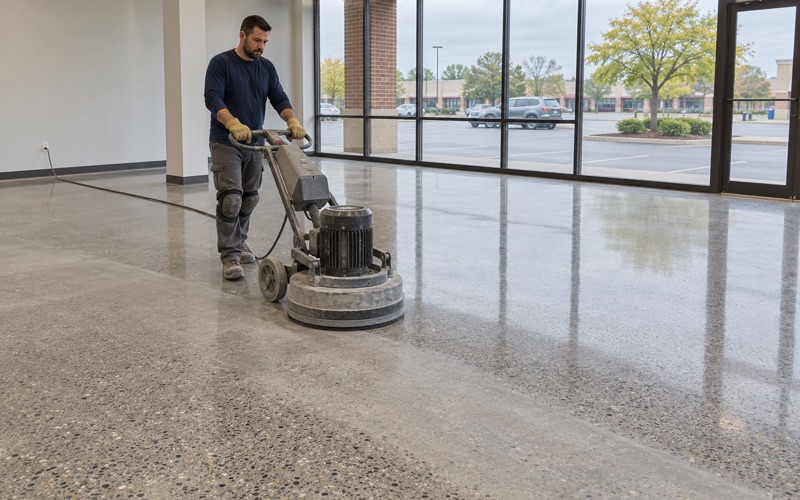
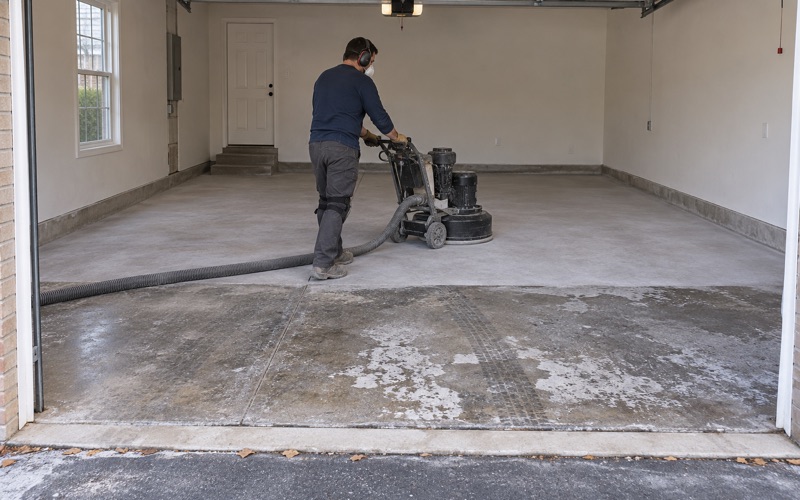
Every floor we coat starts the same way: the slab is opened with a diamond grinder or a shot blaster, never an acid etch, and the grinding dust is pulled into a vacuum at the machine. Our written proposal names the product line, the number of coats and the finished thickness, so a plant manager can hold the finished floor up against the quote.
Shredding, Baling and Paper Dust on Rose Street
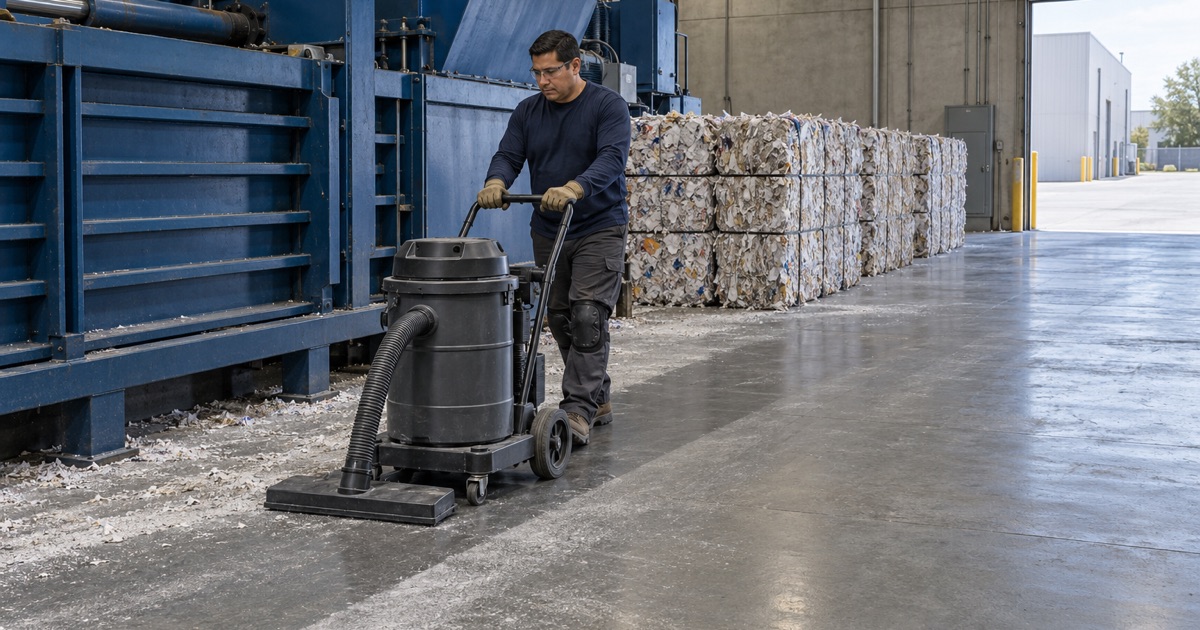
Schiller Park is a village in Leyden Township, Cook County, with 11,709 residents at the 2020 census. A document-shredding operation sits at 3811 Rose St, listed as Shred-it’s Chicago location; the brand is now WM Shred-it. A WM posting for a Shredding Specialist there lists a 5:00 a.m. to 2:00 p.m. shift and says the role ‘operates and maintains baling machinery at the branch.’
A Plant That Shreds and Bales All Shift
We have not seen the inside of that building, and nothing on this page describes its floors or its housekeeping. What the posting does describe is the kind of room this page is about: paper going through shredders and into a baler from the early-morning start onward. Any plant that does that work all shift settles fine paper dust on every flat surface, and the floor collects the most of it.
Shredded office paper is light, and the finest fraction drifts before it lands. It settles around the shredder infeed, under the baler, along conveyor runs and against walls, and it keeps arriving as long as the machines run. That is a floor that gets dirty again within the same shift, so the question is never whether it will be cleaned but how.
Paper on OSHA’s Combustible-Dust List
OSHA’s Revised Combustible Dust National Emphasis Program, Instruction CPL 03-00-008, took effect on January 30, 2023. It covers workplaces that generate or handle combustible dusts, and it lists paper by name among the other organic dusts, alongside sugar, flour, soap and dried blood. Wood, plastic, rubber and metal dusts sit on the same list.
That listing is the reason a shredding floor deserves more thought than a warehouse aisle. We want to be plain about the limit of our part, though: a coating does not stop a dust fire or make a facility comply with the program. Housekeeping does that work, and the most a floor can do is make the housekeeping easier to do well.
What Changes About the Work Here
Before any date is set, we check the Village of Schiller Park’s contractor rules with its Community Development Department. The village requires contractors to be licensed with it before construction starts, registered through its Community Core app with scope, cost, insurance, bond and workers’ compensation as applicable, and that license year runs May 1 to April 30. Commercial property makes up 55 percent of the village’s 2023 equalized assessed value, so this is a check we expect to run often here.
Looking for epoxy-flooring closer to Norridge? See Epoxy-Flooring in Norridge.
One Thirty-Second of an Inch: How the Layer Is Judged
OSHA’s April 21, 2015 interpretation on combustible-dust accumulation sets the benchmark. A layer about 1/32 inch deep, spread over five percent of the floor area of a room or building, or over 1,000 square feet, whichever is less, is the accumulation the interpretation flags. The figure assumes a bulk density of 75 pounds per cubic foot.
What 1/32 Inch Looks Like on a Floor
One thirty-second of an inch is about the thickness of a credit card. Spread across a floor, it reads as a haze that dulls the coating’s color and holds a clear footprint, not as a pile anyone would sweep on sight. That is the first problem with paper dust: a layer at the benchmark can look like an ordinary dirty floor.
Color matters for that reason. A mid-tone or darker solid color shows a pale paper film far sooner than raw gray concrete does, and a uniform solid shows it sooner than a busy flake blend designed to hide dirt. We talk through color with the people who will be cleaning the floor, because they are the ones who have to see the layer.
Where the Five Percent Collects
Five percent of a room is not much floor. In a shredding area it can be the strip around a baler, a conveyor’s underside and a few wall lines, and those are exactly the places a broom misses and a coating wears first. We map cracks, spalls, joints and worn coating across the whole slab before pricing, and we say so when a section needs repair or replacement before it should be coated.
On a large floor the 1,000-square-foot figure is reached before five percent is, so the allowance in a big processing room stops growing with the building. A floor that cleans evenly from wall to wall is worth more there than a showpiece finish in the middle.
Whose Call It Is
Measuring dust depth and deciding when to clean belongs to the facility’s own safety program, not to a flooring contractor. Our role is narrower and practical: build a surface on which the benchmark can be judged by eye and met with a vacuum.
A Floor That Shows Dust and Gives It Up
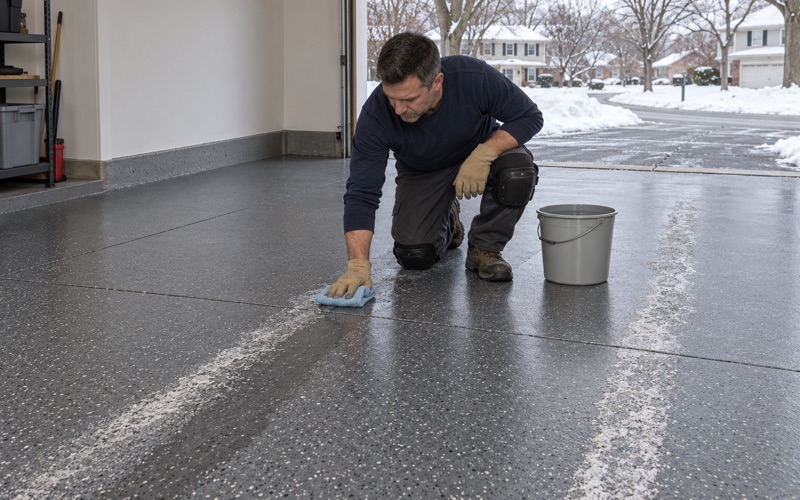
The difference is simple. On a smooth sealed floor, paper dust stays on top where it can be seen and comes up with a vacuum or a soft broom. On a dusting, porous or cracked slab, it mixes with powder from the concrete itself and packs into joints, and it never fully leaves.
Starting From a Ground Slab
A non-dusting floor starts with removing the weak top layer of the concrete. We grind or shot blast to a measurable ICRI concrete surface profile, capture the grinding dust at the machine, and only then prime. An acid etch gives a shallow, uneven result by comparison, which is one reason we never use one.
Before the price is final, the written scope includes a moisture test, using ASTM F1869 calcium chloride kits or ASTM F2170 in-situ relative humidity probes as the slab calls for. A plant floor laid without a vapor retarder can push moisture up under a coating, and a coating that lifts at the edges gives paper dust a new place to hide.
A Smooth, Sealed Wearing Surface
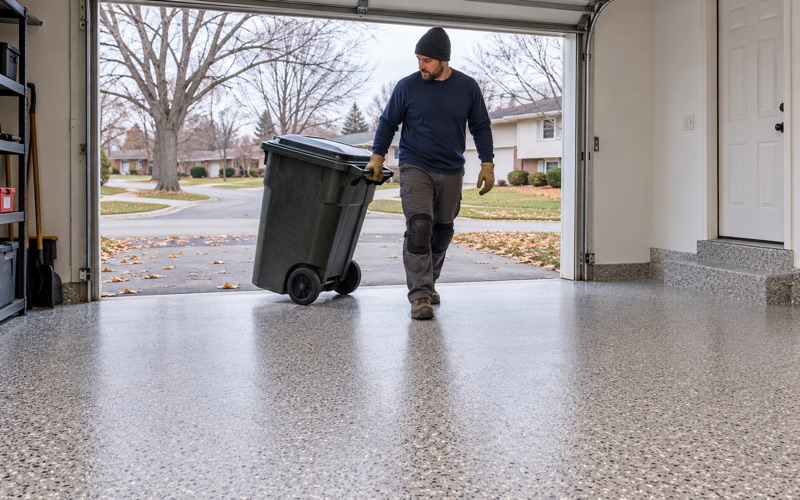
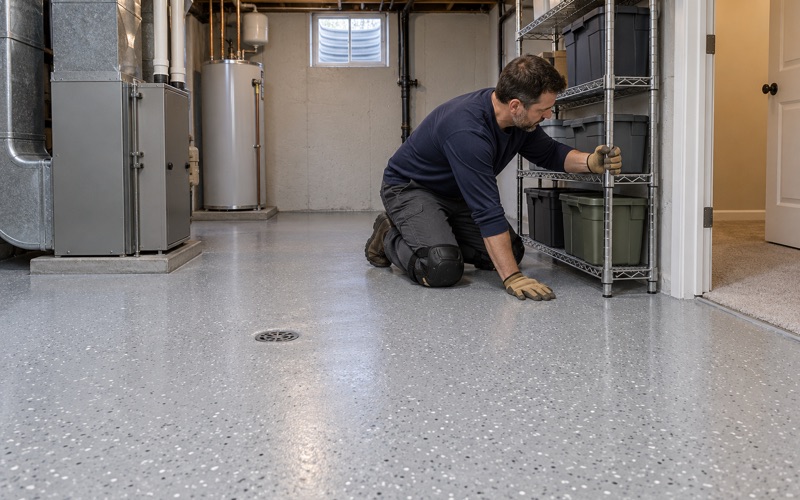
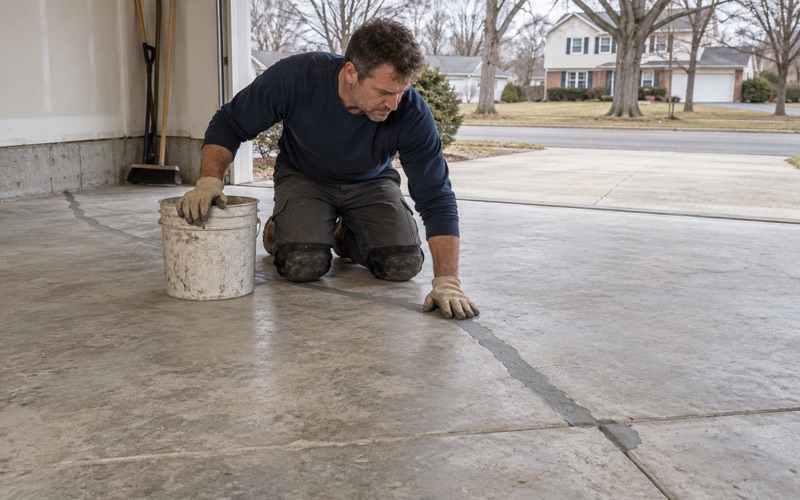
For a room that makes dust, we lean toward a 100% solids epoxy body coat with a tough topcoat such as a polyurethane or polyaspartic, finished smooth or with only a fine texture. Joints are filled flush and cracks are repaired before coating, so there is no open line for fiber and powder to lodge in.
The texture is a real trade-off. We specify slip resistance through the broadcast and the topcoat rather than promising it as a slogan, and on a paper floor the aggregate is kept fine, because a heavy broadcast texture holds dust in its peaks and valleys. Where a wet area or ramp needs more grip, we confine the coarser texture to that zone.
What a Coating Does Not Change
A sealed floor changes how completely the room cleans. It does not make paper dust any less combustible, and it does not replace a housekeeping program, dust collection at the machines or cleaning of ledges and beams overhead. We put that in writing in the proposal, next to the warranty exclusions, so nobody buys the floor expecting more from it.
Why Compressed Air Is the Wrong Way to Clean It
On a floor that holds dust in its texture and joints, the tempting fix is a compressed-air hose. It gets the floor looking clean fast, and it does so by lifting fine paper dust into the air, where it hangs as a cloud and settles again on ledges, beams and equipment. A dust cloud is the condition the emphasis program exists to prevent.
Vacuum and Soft Broom, Not Blowdown
A smooth sealed surface takes the temptation away. Paper dust that sits on top of the coating comes up with a vacuum pass or a soft broom, so an early shift can clear the floor without reaching for an air line. That is the practical case for coating a shredding room, and it is the only one we make.
We do not argue for one kind of vacuum over another; that choice belongs to the plant’s safety staff. Our part is a floor without the open pores, raised edges and unfilled joints that defeat whatever machine they choose.
Keeping the Finish Sealed Over Time
A coating worn through in the baler aisle starts dusting again at that spot. We point owners to a scheduled inspection of heavy-traffic lanes and a prompt scuff-and-recoat of the topcoat where wear shows, before bare concrete comes through and the cleaning problem returns. Recoating a topcoat is a far smaller job than grinding the whole slab back to concrete.
Scheduling Around a Running Plant
A shredding room rarely closes for a week. We phase floor work around operating hours, using overnight and weekend windows and finishing one bay before opening the next, and cure times follow the slab temperature and dew point rather than the calendar.
Coating products are chosen inside the Illinois VOC limits for floor and industrial coatings, which bind whoever applies them. If you run a dust-generating room in Schiller Park and want a floor that shows its dust and lets go of it, we will walk the slab, test it and put the system, coats and thickness in writing.
- 20+ Years in Business
- Moisture Test in Every Scope
- Diamond-Ground, Never Acid-Etched