Buffalo Grove Epoxy Flooring brings more than 20 years of work to epoxy flooring in Wauconda, and the jobs that take the most planning are the ones where the building cannot close. Offices, front counters and public lobbies keep running while we grind and coat, so the schedule, the product and the exit plan are settled together before a price is written.
That is a different job from a garage floor. Federal workplace rules decide two things before any resin is chosen: whether staff can stay inside while the floor is open, and what vapors they can be around while it cures. We plan the floor around those answers, then choose a system that fits the hours the space can spare, never the reverse.
Every proposal names the product line, the coat count and the finished thickness, so a facilities manager can check the result against the paper. It also shows which areas close on which days and where the walking route runs during each phase, because on an occupied job the phasing plan matters as much as the coating.
Floor Work in a Building That Stays Staffed
A village hall is the clearest example of a building that never fully closes. Wauconda Village Hall at 101 N. Main St was built in the 1970s across the street from the hall it replaced. Like most municipal offices, it keeps staff at their desks and residents coming through the door all week, with a drive-up drop box at the back.
Using the Hall as a Planning Model
To be plain about it, we have not inspected the floors at Village Hall and have no role in any work there. We use it here because it is the kind of public building we plan around: one with a lobby, corridors that double as the path to the doors, and offices that cannot simply send everyone home for a week.
The village’s own plans keep the current hall in service for now. It has bought land beside the police station toward a future combined building for Administration, Community Development and Police, but it has no plans to build yet. Until that changes, any floor work there would happen with the doors open.
Who Stays Inside, and Why It Matters
When a contractor shuts down a warehouse aisle, the crew and the forklifts simply go elsewhere. In an office that stays staffed, the people at their desks are employees under federal workplace rules the entire time we are working. That puts their exits and any vapors around them at the center of the job plan, ahead of color, texture or gloss.
We ask early who will actually be in the building on each work day, how many entrances are in use, and whether any after-hours activity runs on the evenings we would like to coat. Those answers set the phase lines more than square footage does, and they are cheaper to gather before the proposal than after the grinder arrives.
Who Answers Which Question
Different bodies own different parts of the decision. Building and community development questions go to the Village of Wauconda before a date is set. Fire protection is a separate body, the Wauconda Fire Protection District, which serves the village and unincorporated parts of Lake and McHenry Counties. The exit-route and vapor rules come from OSHA and protect the employees inside.
Looking for epoxy-flooring closer to Winnetka? See Epoxy-Flooring in Winnetka.
Exit Routes Stay Open While the Floor Is Wet
The federal exit-route standard, 29 CFR 1910.37, says exit routes must be free and unobstructed and that nothing may be placed in them, even temporarily. Section (d) adds that routes must be maintained during repairs and alterations, and that employees may not occupy a workplace during that work unless the required exit routes are available and fire protections are maintained, or an equivalent alternative is provided.
The rule names no product and approves none. What it does is turn a corridor into a scheduling problem: a freshly coated floor is an obstruction until it cures, so the route cannot be the area we are coating. Nobody should have to choose between a wet floor and the way out.
Coating a Lobby in Halves
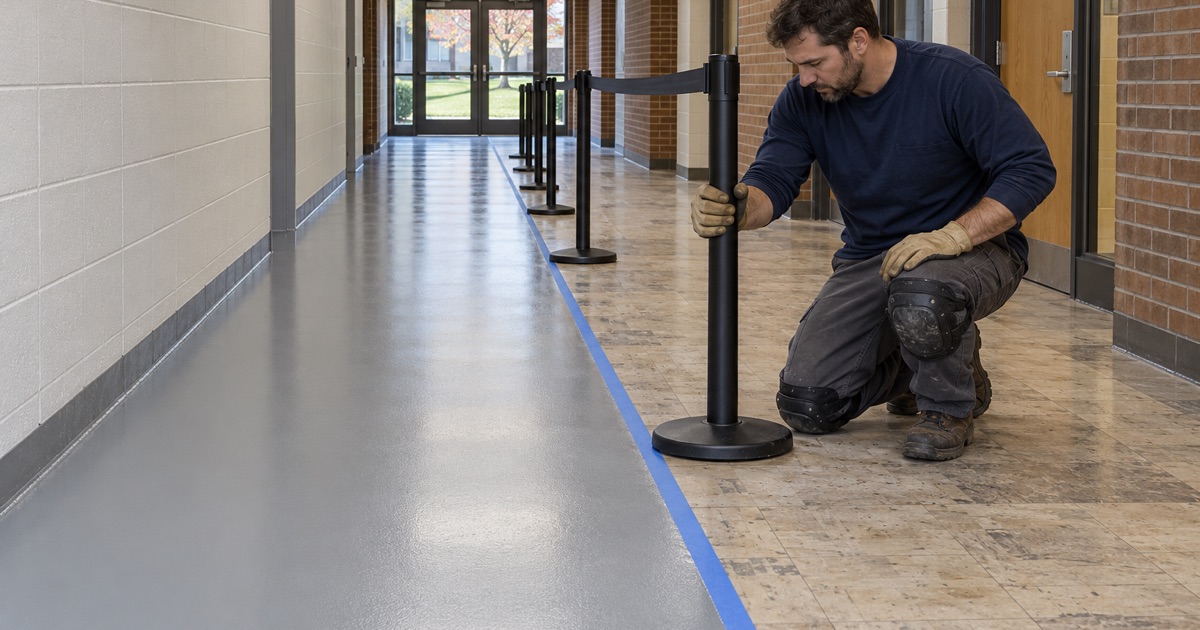
In a lobby wide enough to split, we coat one half while the other carries foot traffic, with tape, stanchions and signs marking the live side. Once the first half has cured enough to walk on, traffic shifts over and the second half gets the same grind, prime and build. The seam lands where it will be least noticed, usually along a natural line in the room.
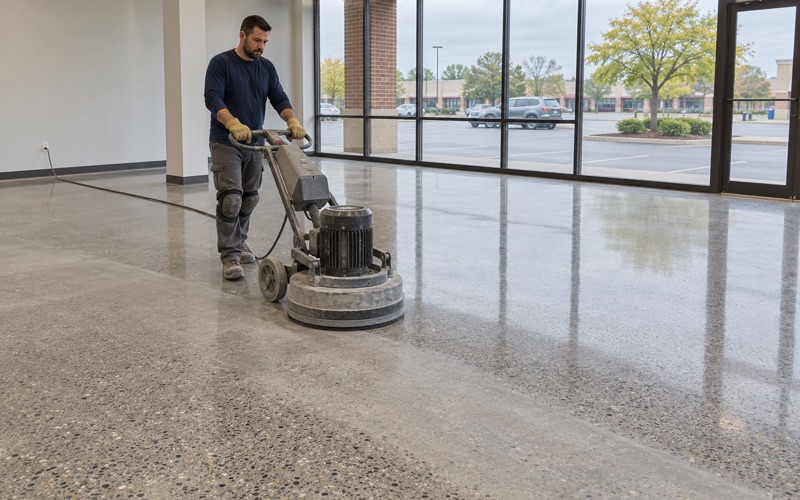
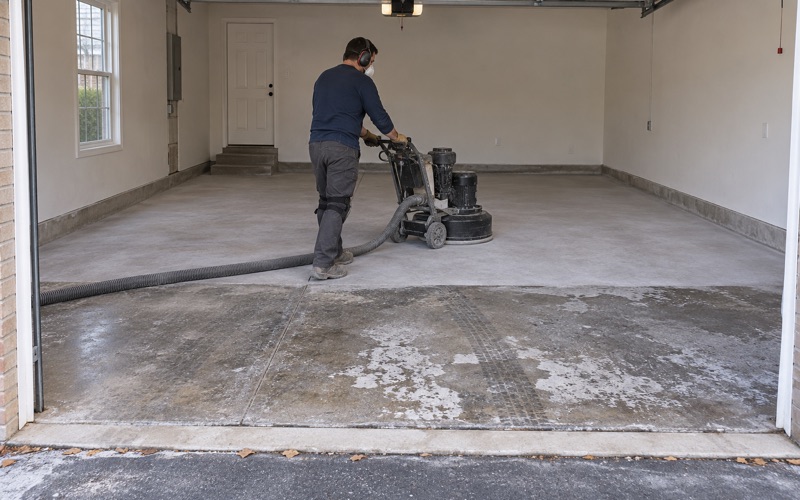
Both halves are opened the same way, with a diamond grinder and a vacuum shroud rather than an acid etch. That matters doubly indoors: the dust is captured at the machine instead of drifting down a corridor staff still use, and the profile on each half matches so both sides bond and wear alike.
Weekend Windows for Corridors
A corridor that is the only way to the exit cannot be split down the middle. Those we schedule over a weekend or a closed stretch, with exit traffic sent through another door that stays clear and marked for anyone who comes in. The floor goes back into service only when the cure schedule says it can, not when the weekend ends.
Weekend work also needs the cure window to fit. A product that needs a full day before foot traffic, applied Saturday afternoon in a cool building, may not be ready by Monday morning. We pick the system and the start time together so the corridor reopens on schedule rather than with a sign asking staff to walk around it.
Keeping Equipment Out of the Route
The standard bars materials and equipment from exit routes, temporarily included, so our staging is planned as carefully as the coating. Grinders, vacuums, mixing stations and resin pails sit inside the closed work zone, never in the live corridor, and hoses and cords do not cross the path people use to leave. If a cord has to cross, the phase is redrawn.
No Flammable Vapors, So Waterborne or 100% Solids
Section 1910.37(d)(3) is the second rule that shapes an occupied job. Employees must not be exposed to flammable or explosive substances used during repairs or alterations beyond the normal permissible conditions in the workplace, or to anything that would impede exiting. In practice, we read that as ruling out a lot of familiar flooring chemistry while people are inside.
Solvent-Borne Primers and Strippers Stay Out
Solvent-borne primers, solvent strippers used to take up an old finish, and fast-cure resins with flammable components are the usual offenders. Their vapors travel down corridors and through return air, and in a building with staff at their desks there is no clean way to keep them in the work zone. We leave them off occupied jobs entirely.
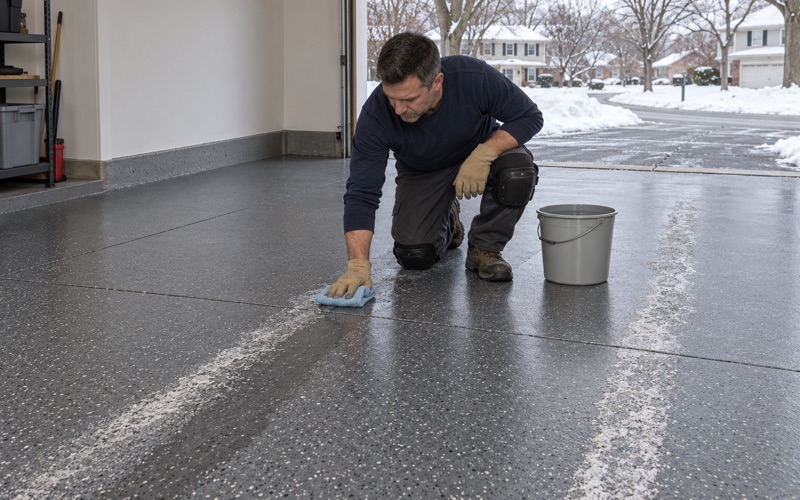
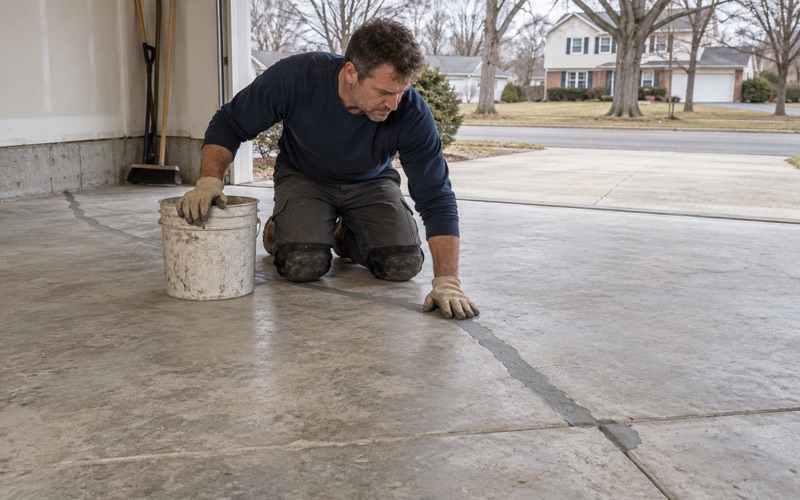
Old coatings come up mechanically instead. We map what is already on the slab, take it off with the grinder, and say so plainly when the concrete underneath needs repair before anything new goes down. A cracked or spalled slab gets fixed or flagged first, because a phased schedule leaves no room to discover that halfway through.
Waterborne Epoxy for Office Floors
Waterborne epoxy carries its resin in water rather than solvent, which makes it a practical primer and build coat in an occupied office. It goes down thinner than a solids system and suits lobbies and corridors that see shoe traffic rather than carts and pallet jacks. It still needs ventilation and a cure window planned around office hours.
100% Solids Where the Floor Works Harder
Where a floor takes heavier wear, such as a service corridor, a back hallway to a loading door or a records room with rolling shelving, we lean toward a 100% solids epoxy. With no solvent to flash off, it builds thickness in fewer coats. Its shorter pot life means smaller batches, mixed and spread in quick succession.
Both choices also have to sit inside the Illinois VOC limits for floor and industrial coatings under Part 223 of Title 35 of the Illinois Administrative Code, which bind the person applying the product. A low-solvent system is the easier way to meet them, and the right one for a building that never empties. We check each data sheet against them before ordering.
Phasing the Way the Village Phased Its Steps
The village’s own 2023 facilities improvement plan shows the kind of phasing an occupied public building calls for. Work replacing the front and back steps of Village Hall was planned for about two weeks, weather permitting, split into two phases rather than closing everything at once. That is the same logic we bring to a floor.
Phase One Kept the ADA Ramp Open
In the first phase, starting October 31, the front steps were replaced while residents could still use the ADA ramp at the southeastern corner. The building stayed reachable through a route that was never part of the work zone. On a floor job, that is the marked half of a lobby or the second entrance we keep clear and signed.
Phase Two Moved the Disruptive Part
The second phase, from November 6, closed the parking lot to the public and suspended the drive-up drop box at the back. Those closures had a window of their own instead of overlapping the front steps. We do the same with the loudest and most disruptive steps of a floor job, such as grinding, which we group into evenings or a weekend.
The quieter steps, such as rolling a topcoat in a closed half, can then run during the day if the product and ventilation allow it. Splitting the job by noise and vapor rather than by room is often what lets a public counter stay open through the whole project.
Moisture and Cure Before the Calendar
Phasing only works if each half cures on time, so moisture and temperature are settled before dates are promised. A moisture test, using ASTM F2170 in-situ relative humidity probes or ASTM F1869 calcium chloride testing, is written into the scope before the price is final. A slab that reads high gets a moisture-mitigation primer or a different plan, not a hopeful start date.
Cure times follow slab temperature and dew point at the surface, not the calendar. A building that drops its heat when it closes can stretch a cure well past the planned reopening, so we ask how the space is heated after hours. And the warranty conversation happens up front: moisture is the first thing a coating warranty excludes, and we say so before the job is sold.
- 20+ Years in Business
- Moisture Test in Every Scope
- Diamond-Ground, Never Acid-Etched