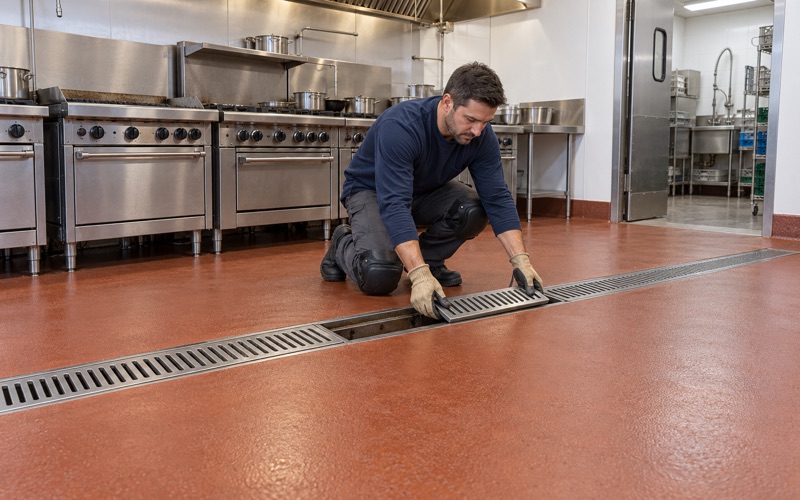
Buffalo Grove Epoxy Flooring has spent more than 20 years on epoxy flooring in Western Springs and across the western suburbs, and the floors that teach us the most are the ones that get wet with something other than water. Kitchens, prep rooms and pantry corners take acids and salts that a bare slab was never meant to hold. This page is about one of those: vinegar and brine.
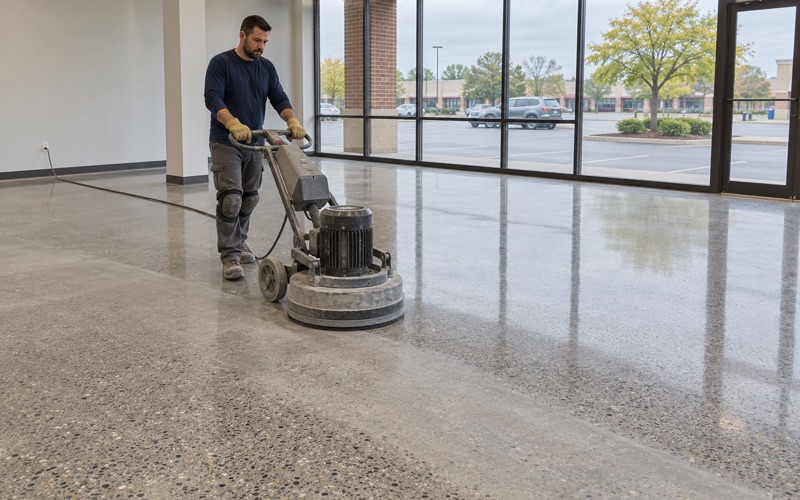
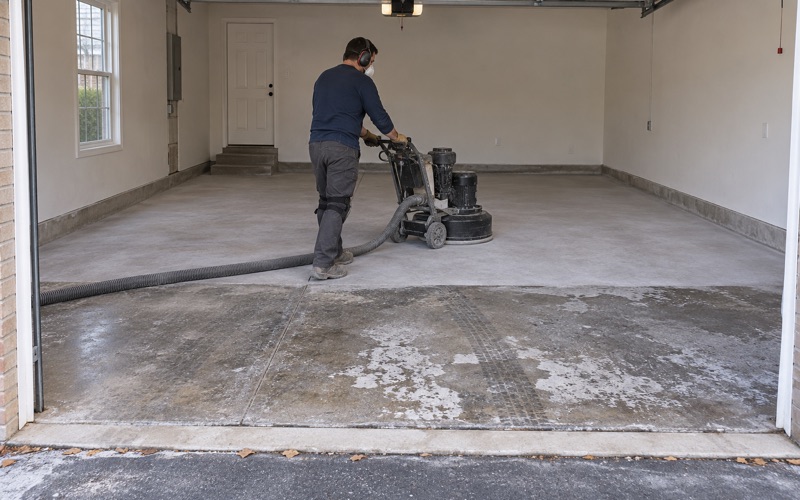
Every job starts the same way, whatever the room. We open the slab with a diamond grinder or a shot blaster rather than an acid etch, so the coating bonds into real profile, and we put a moisture test into the written scope before the price is final. The proposal then names the product line, the coat count and the finished thickness, which gives you something concrete to check the finished floor against.
Commercial kitchens add one more constraint: they rarely close. We phase prep and dish areas around service hours, using overnight and weekend windows, and we explain up front what a coating warranty excludes, starting with moisture coming up through the slab. Homeowners get the same candor, plus a written contract and the state consumer-rights pamphlet before grinding begins on any job above the Illinois threshold.
A Preserving Chef on Burlington Avenue
Petite Vie and Its House Pickles
Petite Vie sits at 909 Burlington Avenue, a French cafe and brasserie that Paul Virant opened after buying the building, just around the corner from his earlier restaurant Vie, which closed in October 2023 after a 19-year run. The room holds about 65 seats. A February 2025 Chicago Tribune review singled out its coveted house pickles, which were part of the plan before opening.
Virant also wrote The Preservation Kitchen, a cookbook on pickles, preserves and aigre-doux, and runs Jar Sessions, a small-batch line of pickled and preserved products. We have never worked in his kitchen and have not seen its floor. We use the restaurant here because it names, in one Burlington Avenue address, the kind of cooking that puts vinegar on a floor.
What a Pickle Program Spills
A kitchen that makes its own pickles handles vinegar and salt brine by the batch. Liquid gets poured into hotel pans, strained over a prep sink, ladled into jars and carried to the walk-in, and some of it lands on the floor at every step. Brine is heavy and slick, and vinegar left on bare concrete keeps reacting with it until someone rinses it away.
Those are batch spills, not one-off accidents. A preserving kitchen repeats them through the season, and the same few square feet in front of the sink and along the cooler door take nearly all of it. That concentration is why we map a kitchen by what lands where before we choose a system for it.
Who Answers for a Kitchen Floor Here
Western Springs sits in Lyons Township, and a restaurant kitchen in the village answers to the Cook County Department of Public Health. The state Sanitary Food Preparation Act asks for an impermeable floor in any room used to prepare food, one that can be flushed and washed clean with water. Building work runs through the village’s Community Development office.
Cement counts under that act, but bare concrete stops being impermeable once acid has opened it up. That is the gap a sealed resin floor closes. We do not promise an inspection outcome; the inspector judges the room, and our job is to give that room a surface that rinses clean and stays closed.
Looking for epoxy-flooring closer to Prospect Heights? See Epoxy-Flooring in Prospect Heights.
How Vinegar Opens Up Cement Paste
Lime First, Then the Binder
Concrete holds together because of cement paste, and that paste is alkaline. Acetic acid, the acid in vinegar, goes after the alkaline part first. In a 2022 laboratory study published in Materials, Berger and colleagues found that portlandite, the calcium hydroxide in hardened paste, dissolves first under acetic acid, and the calcium silicate hydrate phases that bind the paste then begin to decalcify.
Carried far enough, the attack leaves an amorphous silica gel where the binder used to be. That is a lab result on prepared samples, not a measurement of any floor in a restaurant, and we use it to explain the mechanism rather than to predict how fast a particular slab will wear.
Porosity Rises as pH Falls
The same study found that the biggest increase in porosity comes in the same range of acid concentrations as the biggest drop in pH. Put plainly, as the paste loses its alkalinity it also loses its tightness. Pores that were closed open up, and the surface takes in more of each spill than it did before.
That is where brine comes in. Salt water follows the acid into the opened paste, and once it is inside the slab it is not coming out with a mop. A floor that has taken in both is harder to clean, slower to dry and a poorer base for any coating applied later.
Reading a Slab That Has Already Taken Acid
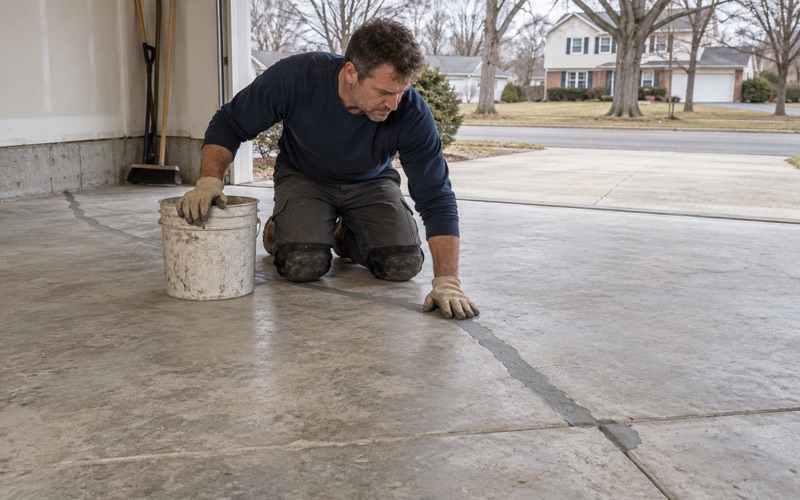
Before we price a kitchen, we map the damage. Etched, sandy patches near the sink, soft paste around the walk-in threshold and old coatings that have let go all get marked, along with cracks and spalls. If the top of the slab has lost too much paste to hold a bond, we say so and scope a repair or replacement first.
Grinding then takes the weakened layer down to sound concrete, with dust pulled into a vacuum at the machine rather than washed toward a drain. ICRI guidance puts thin coatings at CSP 1 to 3, and a trowel-applied urethane cement wants a rougher profile than that. Salt that has soaked in can also show up later as efflorescence, so we test moisture before committing to a primer.
Prep, Pickling and Dish Zones on a Sealed, Coved Floor
Choosing a Resin That Stands Up to Acid
Not every resin handles organic acids equally, and the general rule from food flooring work is blunt: oil, sugars and food acids such as lactic, citric and acetic acid eat away at inferior surfaces, concrete and tile grout included. For a pickling zone we look at urethane cement or a chemical-resistant epoxy system, and we check the product sheet against acetic acid specifically.
The thickness need not be uniform across the room. A heavier build matters at the sink and the walk-in door, where wear and spills overlap, and the written scope says where it goes. Products are also chosen inside the Illinois VOC limits for floor coatings, which apply to whoever puts them down.
Coving at the Walls and the Walk-In
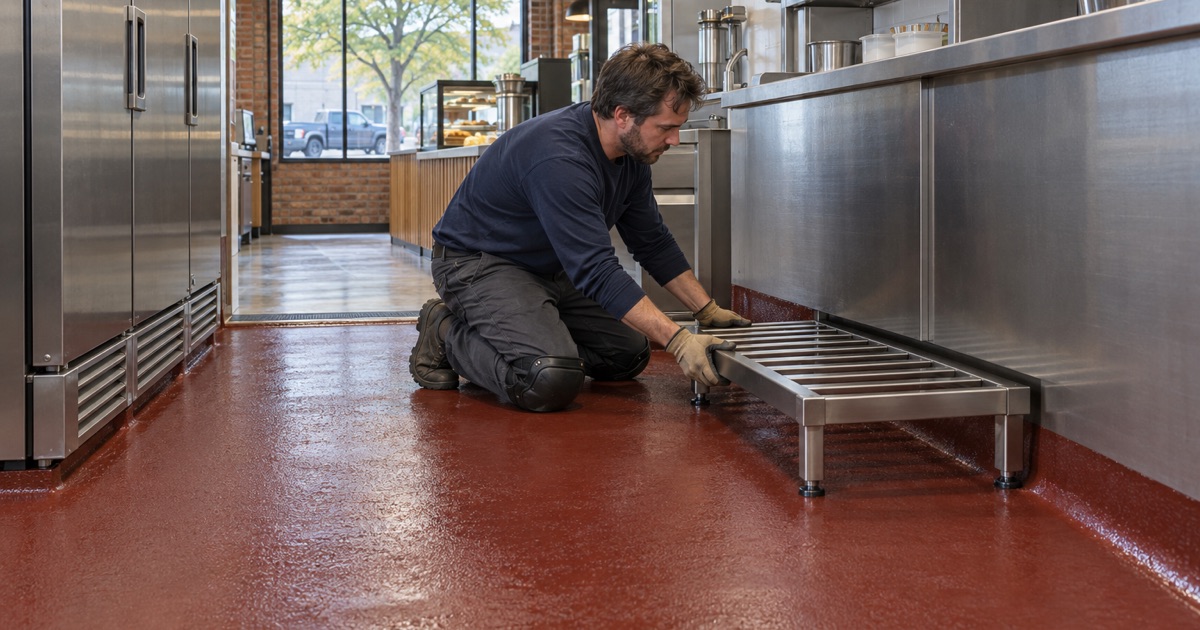
Brine finds the joint where floor meets wall, and from there it runs under a base and into the slab edge. A coved resin base turns the floor up the wall in one continuous piece, so there is no seam for liquid to sit in. The FDA Food Code takes up coved floor and wall junctures in section 6-201.13.
The walk-in threshold gets the same attention. Carts roll over it all day, wet product crosses it in both directions, and a cold box door can gather condensation along the edge. We carry the resin to the threshold and finish it cleanly against the door frame, rather than stopping short and leaving a strip of bare concrete to soak up whatever drips.
Texture, Rinsing and Cure Time
A wet kitchen floor needs grip, and we specify it by the quartz broadcast and the topcoat rather than promising it as a slogan. Too much texture holds brine and fights the squeegee; too little is a hazard with vinegar underfoot. The FDA Food Code recognizes that tradeoff with an antislip exception in 6-201.11.
The other half of the answer is habit. A sealed floor only protects the slab if spills are rinsed and squeegeed instead of left to soak, and state law already asks for food-processing surfaces to be cleaned daily. We hand over a written cure schedule, so the kitchen knows exactly when carts and mop water can return.
Canning and Pickling at Home
Kitchens and Basement Pantries
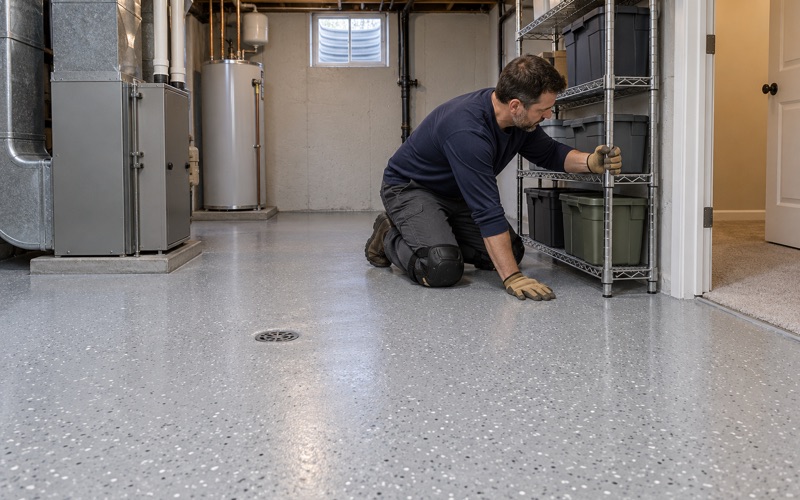
Pickling is not only a restaurant habit. Home cooks who put up pickles or can tomatoes in late summer handle the same vinegar and brine on a smaller scale, and the jars usually end up in a basement pantry or on garage shelving. The spills are smaller, but they repeat each season on slabs few people look at closely.
In a basement we read the slab for past water before anything else, because a coating does not stop seepage or a sump that cannot keep up. A moisture test goes into the written scope, and ASTM F2170 probes or a calcium chloride test tell us whether the slab is dry enough to bond.
What a Home Canning Spill Does
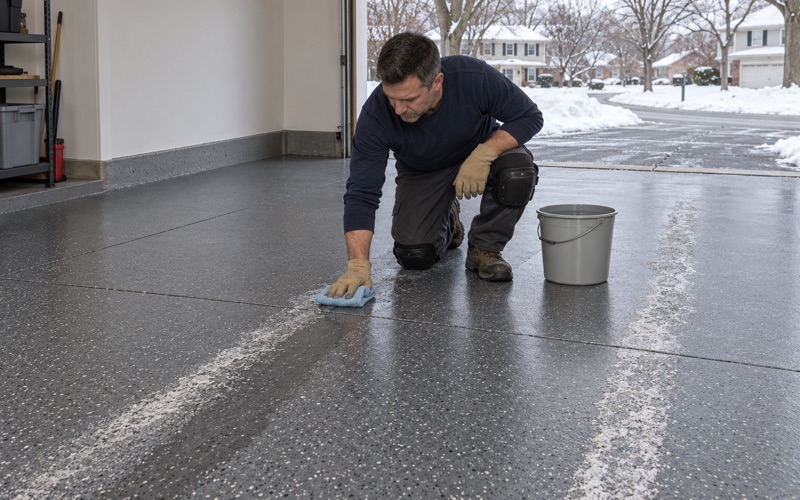
A broken quart of pickle brine on bare concrete is the restaurant problem in miniature. The vinegar works on the paste, the salt follows it in, and the stain that remains can be a soft, chalky patch rather than a mark on the surface. Shelving legs and dropped jars can then chip that weakened spot faster than the floor around it.
A sealed epoxy or polyaspartic floor in a pantry turns that spill into a wipe-up. We grind away any chalky patches first, fill the low spots and broadcast a light texture if the pantry doubles as a laundry or mudroom. Wiping the spill up promptly still matters, since no coating rewards leaving brine to dry in place.
Garage Pantries and Winter Salt
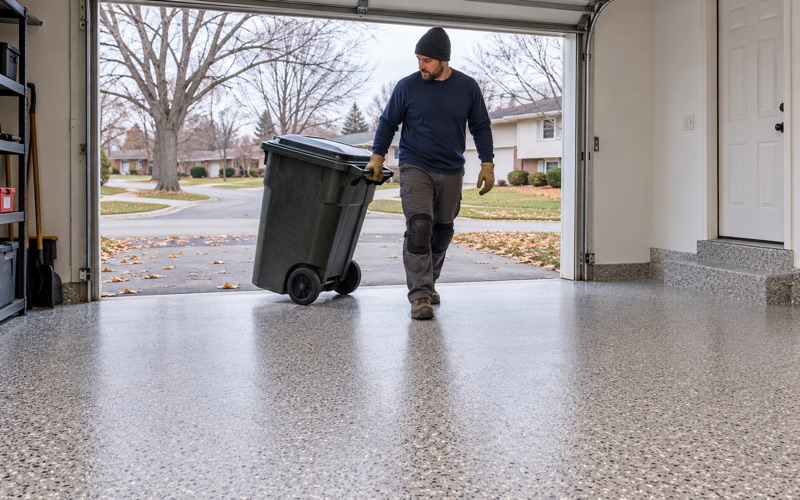
Plenty of overflow pantries live in the garage, on shelving beside the car. That floor already takes road brine and rock salt off the tires all winter, so a dropped jar of pickling brine lands on a slab that is already taking salt. We pick garage systems for that exposure, typically a flake-broadcast epoxy base under a polyaspartic topcoat.
Timing matters as much as product. Cure schedules follow slab temperature and the dew point spread at the surface, and an unheated garage in deep winter is told to wait for warmer weather. We would rather move a date than watch amine blush or a soft cure undo the work.
- 20+ Years in Business
- Moisture Test in Every Scope
- Diamond-Ground, Never Acid-Etched