Buffalo Grove Epoxy Flooring approaches epoxy flooring in Winfield with more than 20 years in the trade and a question most coating pitches skip: what a floor has to do after something spills on it. In a room where unsealed radioactive material is handled, gloss and color count for little. The floor is judged by whether a dried spill comes off completely, and the answer depends on details a brochure rarely mentions.
That is why we do not start a controlled-room job by recommending resin. We start by asking what the room handles, how spills are cleaned, which solvents touch the floor and what the radiation safety staff will test it against. Sometimes a seamless coating is the right call. Sometimes a welded sheet floor is, and we would rather say so before a proposal is written than after a floor fails its first survey.
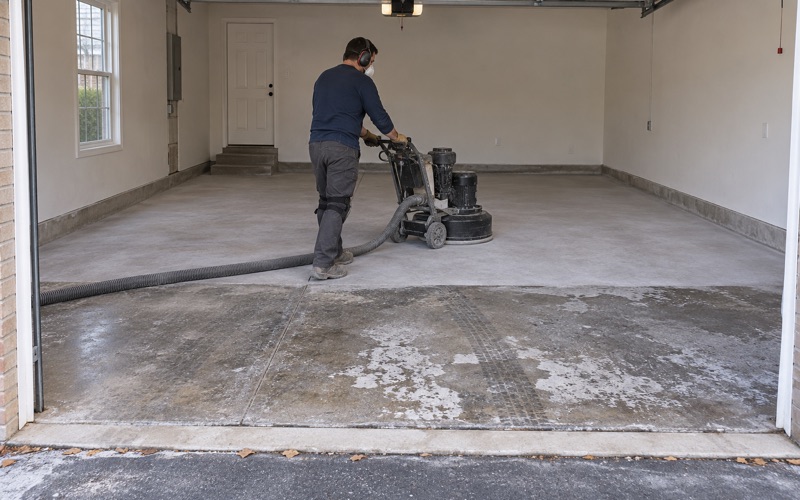
The same discipline runs through every floor we quote. Each slab is opened mechanically with a diamond grinder or shot blaster, moisture is measured as part of the written scope, and the proposal names the product line, coat count and finished thickness. For a regulated room, those written numbers matter twice: they are what the owner checks the finished floor against, and they are what a safety reviewer needs to read.
Nuclear Medicine at Central DuPage Hospital and the Floors Around It
Central DuPage Hospital sits inside the village of Winfield, on Winfield Road, and it is by far the largest employer here. Northwestern Medicine’s west-suburbs imaging chart lists nuclear medicine among the services available there. We have not seen those rooms and the hospital is not a customer, but the presence of that work in town makes the hot-lab floor a fair question for anyone specifying finishes in Winfield.
Where Radioactive Tracers Meet the Floor
Nuclear medicine uses small amounts of radioactive tracers, and where those are prepared, drawn up or injected, a drop can reach the floor. Many such drops are small, but a floor that holds onto any part of one becomes a recurring survey finding. The concern is not structural strength or impact resistance, which is what most epoxy marketing talks about. It is how much of a spill stays behind.
The Test: Does a Dried Spill Wipe Off?
A practical way to judge a hot-lab floor is a wipe test after the spill has dried. Fresh liquid on almost any sealed surface mops up. A spill left for hours or days soaks into micro-pores, scratches and texture, and the question becomes how many swabs it takes to clear it, and whether any activity remains after the last one.
That is a different standard from a garage or a warehouse, where a floor passes if it looks clean. In a controlled room the measure is residual contamination, and the floor finish, its age and its cleaning history all feed into it. A coating that performs well under a forklift can still be the wrong surface here.
What Design Guidance Asks For
A design guide published by the University of British Columbia, restating the Canadian Nuclear Safety Commission’s design compliance guide, asks radioisotope labs for an impervious, chemical-resistant, washable floor with no carpet. For intermediate and high-level labs it requires sealed joints or one-piece flooring, coved up walls and cabinets. That is a Canadian regulator’s guide, not an Illinois rule, but it describes the target clearly.
Notice what the guide does not say. It names properties, not a material, and the properties can be met by more than one kind of floor. We read it as a performance checklist. That leaves the choice between resin and sheet goods open, and it is where actual test data becomes more useful than any product claim.
Looking for epoxy-flooring closer to Westchester? See Epoxy-Flooring Services in Westchester.
What One Study Found When Epoxy Met Sheet Vinyl
In 2014 the Journal of Nuclear Medicine Technology published a study by Leonardi and colleagues that tested common laboratory surfaces against a radioactive spill. Samples of stainless steel, a Corian-type acrylic-mineral surface, an epoxy cover intended for benches and flooring, and a vinyl-based multipurpose flooring were contaminated with technetium-99m pertechnetate, left to dry for three days, then swabbed with soapy water.
The Numbers After Ten Swabs
The epoxy cover gave up 48.3 percent of the activity on the first swab, 71.5 percent after five and 79.3 percent after ten. The vinyl flooring released 52.6, 80.6 and 86.3 percent at the same points. Stainless steel came fully clean in two swabs. On untreated samples, then, the sheet vinyl beat the resin at every stage.
A seven-point gap after ten swabs may sound small. In a room where residual contamination is monitored, it can separate a floor that clears with routine cleaning from one that keeps generating extra work. That is the gap a buyer should weigh before choosing resin on looks.
Solvents Made the Resin Worse
The researchers also pretreated samples with methanol, methyl ethyl ketone, acetone and ethanol before contaminating them. Solvent exposure did not hurt the vinyl, but it impaired the epoxy cover, which released as little as about half its activity after ten swabs. Labs that wipe down with solvents, or spill them, may be undermining exactly the property the floor is there to provide.
The authors chose vinyl flooring and steel benches for their own lab and set the epoxy cover aside for lower efficiency combined with solvent interference. We think that conclusion deserves respect, not spin. A contractor who sells resin into a hot lab without mentioning it is selling a finish, not a floor that has been tested for the job.
What the Result Does and Does Not Prove
The study covered one epoxy product, one lab and four replicates, and the authors note their results cannot be extrapolated to other technetium compounds. It does not show that every resin system fails, and it does not show vinyl always wins. It shows that an untreated epoxy cover can hold activity, and that the topcoat chemistry needs to be proven rather than assumed.
For a buyer, the practical takeaway is to ask for decontamination data on the exact system proposed, not on epoxy in general. If a manufacturer cannot supply any, the radiation safety officer should know that before the floor goes down, and a sheet floor stays on the table.
Seams, Integral Cove and Texture: Where Contamination Hides
Even a good surface fails at its weak points. In a radioisotope room those are the joints between pieces, the line where floor meets wall or casework, and any roughness added on purpose. Each is a place where a dried spill can settle out of reach of a swab, so each deserves a decision on paper before installation starts.
Sealed Seams or One-Piece Flooring
Sheet vinyl only meets the guidance when its seams are heat-welded or otherwise sealed, because an open seam wicks liquid under the sheet. A poured resin floor has no seams across the field, which is its real advantage, but it still has saw-cut control joints and the edges of any patched areas. Those joints need a flexible sealant that can itself be wiped clean.
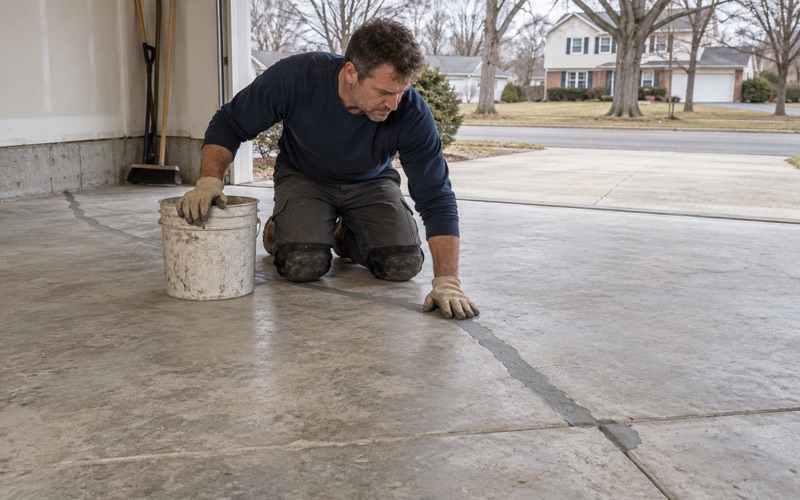
Before we price a controlled room, we map every crack, spall, joint and old coating edge on the slab. Some cracks can be repaired and bridged; a slab that is moving or badly broken should be repaired or replaced first, and we say so rather than coat over it.
Integral Cove Up Walls and Cabinets
An integral cove carries the floor up the wall in one continuous curve, so there is no square corner and no gap behind a base molding for a spill to run into. The UBC guide asks for flooring coved up walls and cabinets for exactly that reason. Both resin and sheet vinyl can be coved; what matters is that the cove is bonded and continuous.
With resin, the cove is troweled up on a cant strip and top-coated with the floor, which makes the corner part of the same surface. The cabinet toe kicks are the harder detail, because casework often goes in after the floor, so the sequence has to be agreed with the general contractor early.
Slip Texture Versus a Wipe-Clean Surface
Many commercial resin floors get a broadcast of quartz aggregate or vinyl flake for grip. In a hot lab that texture works against the floor, because every peak and valley adds surface area for activity to lodge in and for a swab to miss. Slip resistance still matters where staff move quickly, so the trade-off has to be made deliberately.
We specify slip resistance by the broadcast size and the topcoat that seals it, never as a slogan. In a controlled room that usually means a fine aggregate fully encapsulated under the final coat, with a sample panel the radiation safety staff can wipe-test before the whole floor is committed.
Specifying Resin for a Regulated Room, and When Not To
If resin is still the right answer after the questions above, the specification has to protect the property that matters. If it is not, we would rather point an owner toward welded sheet flooring than install a floor that looks good and clears poorly. Either way, the room’s own radiation safety program sets the bar, not us.
Topcoat, Porosity and Solvent History
The decontamination surface is the topcoat, so that is where the specification starts. A dense, nonporous topcoat over a fully cured 100% solids epoxy base, rolled without pinholes and checked for amine blush before recoating, gives a spill less to hold. We also ask which solvents the room’s cleaning protocol uses, because the 2014 result shows solvent exposure can impair a resin surface’s cleanability.
Moisture, Profile and Cure Before Anything Else
A coating that delaminates is not impervious, whatever the data sheet says. Each slab is opened by diamond grinding or shot blasting to a measured ICRI concrete surface profile, with dust captured at the machine rather than rinsed toward a floor drain. Moisture testing, by ASTM F2170 in-situ probes or ASTM F1869 calcium chloride kits, is written into the scope before the price is final.
Cure follows slab temperature and the dew point spread at the surface, not the calendar, and a room that cannot hold its temperature waits. We also explain the warranty exclusions before anything is signed, and moisture vapor transmission is the first one we name.
Who Answers the Code and Safety Questions
Radioactive materials in Illinois fall under the Illinois Emergency Management Agency, and we have not seen an Illinois rule that names a floor finish for those rooms. A floor coating does not block radiation; its only job here is cleanability. Fire code questions go to the Winfield Fire Protection District, a special district separate from the village, and permits to the Village of Winfield Building Department on Jewell Road.
Clinical and lab rooms are often hard to take out of service, so this kind of work is phased around operating hours, with overnight and weekend windows planned in advance. The schedule, the cure time and the date the room can be wipe-tested again are agreed with the facility before the first grinder is unloaded.
- 20+ Years in Business
- Moisture Test in Every Scope
- Diamond-Ground, Never Acid-Etched