Buffalo Grove Epoxy Flooring has spent more than 20 years installing epoxy flooring in Wood Dale, and the floors we think hardest about are the ones where a spill costs more than the cleanup time. A chemical warehouse is the clearest case. What lands on the slab, and what the slab does with it, decides how much waste a single dropped container creates.
Our approach starts with the slab rather than the color chart. Every floor is opened with a diamond grinder or a shot blaster instead of an acid etch, cracks and old coatings are mapped before a price is written, and the moisture test sits inside the scope. When concrete needs repair or replacement before it should carry a coating, we say so plainly.
This page walks through one kind of building that matters here: a warehouse that picks and repacks laboratory reagents. It covers the federal rule that turns spill cleanup debris into listed hazardous waste, why porous concrete makes that rule expensive, and how a sealed, continuous floor with honest joints keeps a dropped bottle a bag of absorbent instead of a concrete removal job.
A Reagent Distributor on Dillon Drive and the Federal Spill Rule
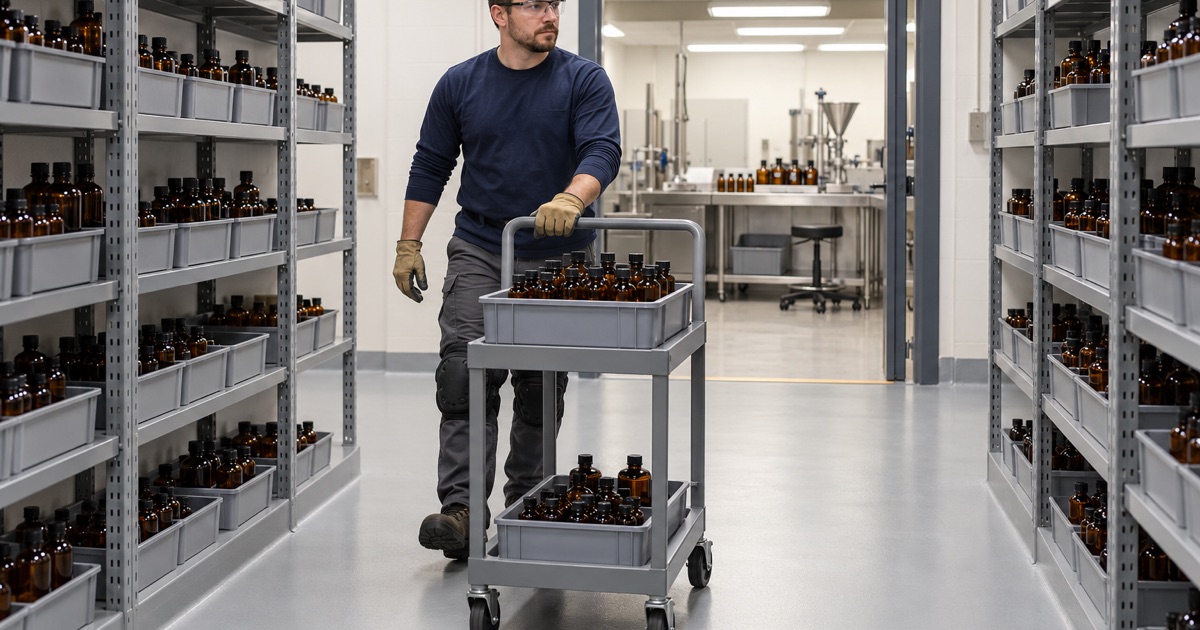
Wood Dale is a city in Addison Township, DuPage County, and its industrial streets hold more than truck docks. At 935 Dillon Drive, Chem-Impex International distributes and manufactures high-purity chemicals: amino acids and derivatives, peptide synthesis reagents, biochemicals and organic synthesis materials. It is a family-owned company, and it is not a customer of ours.
Twenty Thousand Reagents, Picked and Repacked
PubChem’s source record describes the company as providing over 20,000 laboratory chemicals, and its catalog lists sodium azide as a pure white crystal at 99.5 percent or better. In any building that picks and repacks reagents, bottles come off shelves, ride carts to packing stations and get handled again before they ship, so containers are in motion all day.
Every one of those touches is a chance for a drop, and the drops that matter are the ones that open on the floor. From that moment the question stops being about housekeeping and becomes a question of what the cleanup material legally is, and what it costs to get rid of.
What 40 CFR 261.33(d) Says About Cleanup Debris
Federal hazardous waste rules list certain commercial chemical products as hazardous waste when they are discarded. Section 261.33(d) goes further: any residue or contaminated soil, water or other debris resulting from the cleanup of a spill of a listed product is itself listed hazardous waste. In practice, the absorbent and wipes used on that spill are listed waste too.
That is why the floor under a reagent rack is not a neutral surface. Whatever the spill soaks into becomes part of the debris the rule describes. A floor coating does not change a waste’s regulatory status, and it does not make a facility compliant with anything. What it can change is how much material the spill reaches before someone gets to it.
Where the Generator Listing Fits
EPA’s ECHO database lists Chemimpex International at 825 Dillon Drive as a small quantity generator of hazardous waste. We note that only to show the rule is not hypothetical on this street; generator status is a regulatory matter between a facility and its agencies, and we do not advise on it. Our part is the slab, and keeping it from adding to the pile.
Looking for epoxy-flooring closer to Round Lake? See Round Lake Epoxy-Flooring.
Why a Dropped Bottle Can Become Acute Hazardous Waste
The federal lists are split. P-listed products are the acutely hazardous ones, and U-listed products are the broader group of toxic commercial chemicals. A warehouse carrying thousands of laboratory reagents can hold both, which means a drop on one aisle and a drop on the next can create very different waste.
Sodium Azide Sits on the P-List
Sodium azide is listed as P105. Because it is a P-listed product, debris from cleaning up a spill of it is acute hazardous waste, the category federal rules handle most tightly. The rule does not scale with the size of the bottle; a small container that opens on the floor brings its cleanup material under the same listing.
So the practical goal is plain: keep the volume of contaminated debris as small as the spill itself. That is a cleanup crew’s job first and a floor’s job second, but the floor sets the limit on how small the crew can keep it. A floor that lets liquid in has already decided the answer before anyone arrives with a spill kit.
Porous Concrete Holds What Absorbent Misses
Bare concrete is porous, and a cracked or worn slab is more so. A liquid reagent that lands on it does not wait on the surface for absorbent; it wicks into the pores and runs down into cracks and joint gaps. Absorbent pulls up what stayed on top. What went into the concrete stays there.
Getting it out can mean grinding or chipping the contaminated concrete, which then has to be managed as cleanup debris too. A spill that would have filled one bag on a sealed floor can become a saw-cut patch, a pile of listed rubble and a slab repair, all before the aisle is back in use.
Container Residue and the Empty Rule
The same section treats residue left in a container as listed waste unless the container meets the federal definition of empty. That is a packing-room issue more than a floor issue, but it points at the same habit: listed material is tracked wherever it ends up, and the floor is one of the places it can end up.
A Floor That Stays a Wipe-Up, Not a Demolition
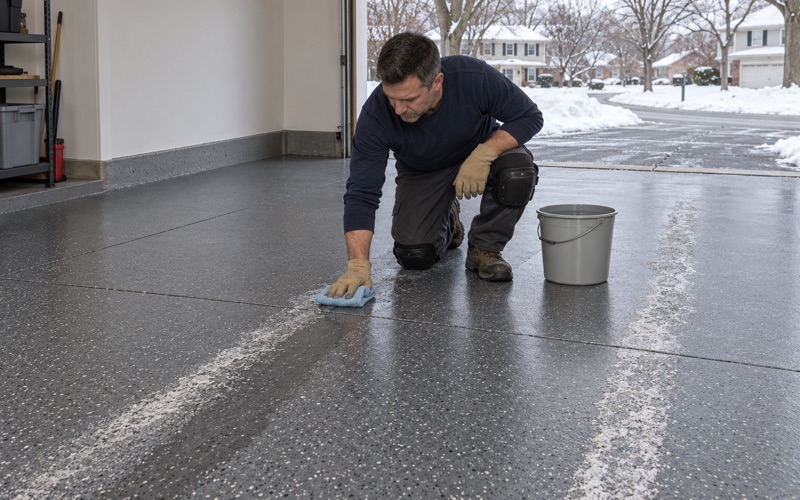
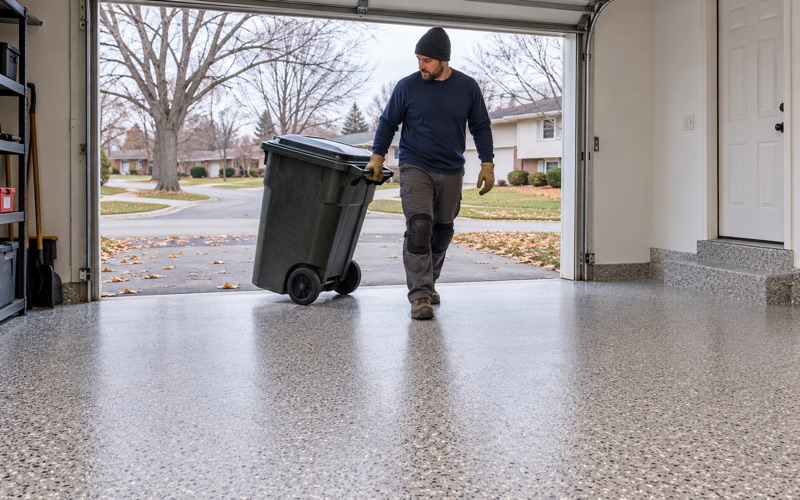
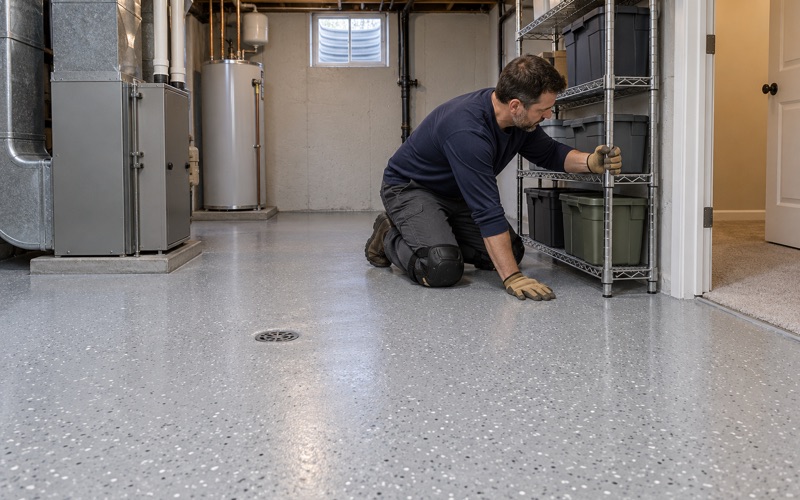
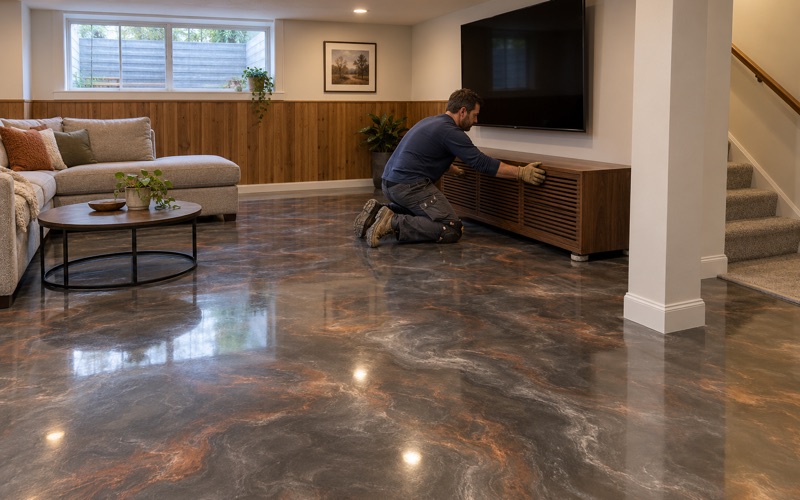
A sealed, continuous resin floor changes the geometry of a spill. The liquid stays on a nonporous surface where it can be absorbed and wiped, and the debris is a bag of absorbent and wipes rather than a section of slab. Getting there depends on the preparation, the system and the moisture under it.
Opening the Slab Before Anything Goes Down
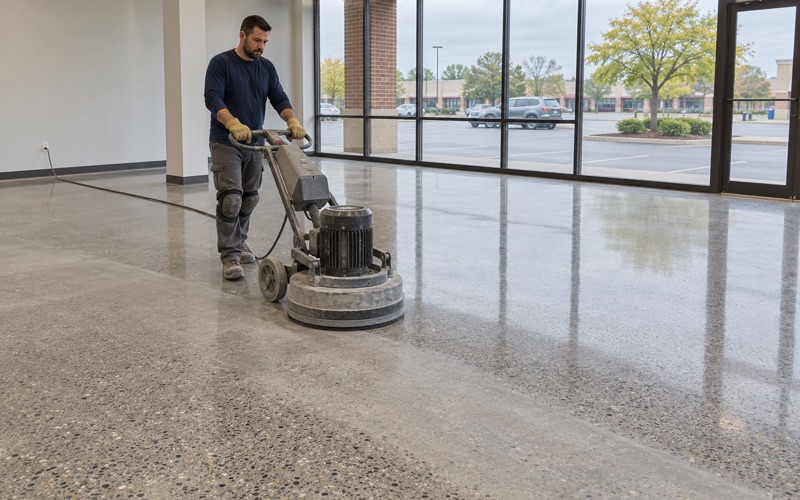
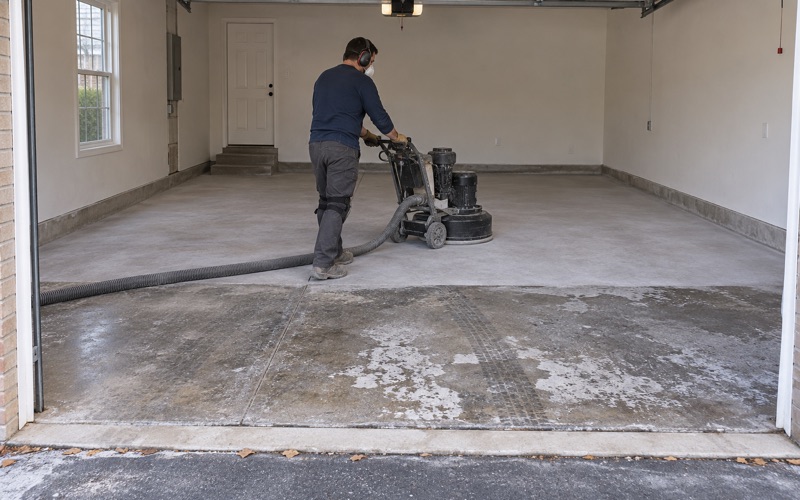
We open every slab mechanically, with a diamond grinder or a shot blaster, to a concrete surface profile on the ICRI CSP scale that suits the system going down. We never acid etch. An etch leaves a weaker profile and adds a liquid to a floor that may already hold old residue, which is the opposite of what a reagent warehouse needs.
Grinding dust is captured at the machine with a vacuum, never rinsed toward a floor drain, a sump or a storm inlet. In a building that handles chemicals, that matters twice over: the dust stays contained, and no wash water carries anything off the slab during the work. Work in an operating warehouse is phased by aisle, with overnight and weekend windows where a pick area cannot close.
A System Named on the Proposal
A chemical-handling floor is often built as a 100% solids epoxy system, sometimes under a polyaspartic topcoat, or as urethane cement where heat or heavier exposure calls for it. Our proposal names the product line, the number of coats and the finished thickness, so the floor that goes down can be checked against the quote.
Chemical resistance is product-specific, so the reagent classes a building actually handles belong in that conversation before a system is chosen. Slip resistance is specified the same way, by the broadcast and topcoat, because a pick aisle that gets wiped often still has to be walkable when it is damp. We keep that texture fine enough that a wipe still clears it.
Moisture Is Tested Before the Price Is Final
A nonporous floor only stays nonporous if it stays bonded. Moisture vapor rising through a slab can lift a coating into blisters, and a blister that breaks is an opening straight to bare concrete. We test before the price is final, with ASTM F1869 calcium chloride kits or ASTM F2170 in-situ relative humidity probes, and the method is written into the scope.
Where readings run high, a moisture-mitigation primer is added to the system and to the quote, not skipped to keep the number down. Moisture is also the first exclusion we name when we explain what a coating warranty does not cover, before the job is sold. Cure schedules follow slab temperature and dew point, not the calendar.
Seams, Joints and Edges Where Residue Hides
A coated field can be flawless and still fail the purpose if the spill finds a seam. Liquid moves to the low, open places on a floor: cracks, joints, the line where the slab meets a wall, and the base plates of racking. Those are the details we spend time on.
Cracks and Spalls Mapped First
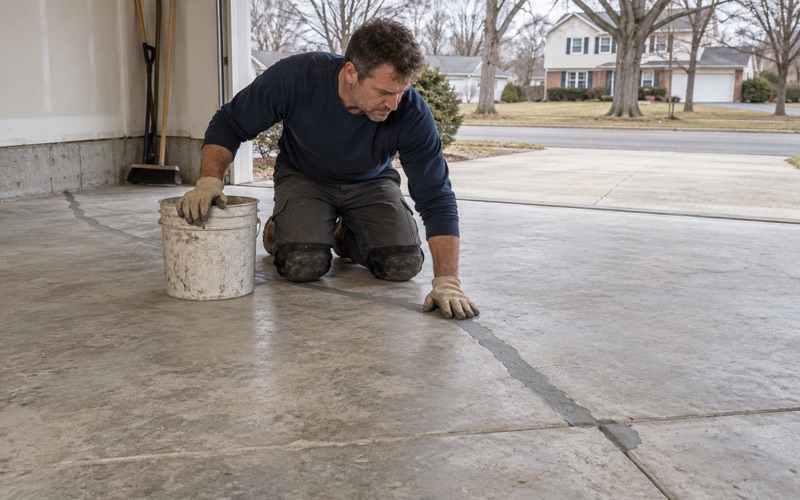
Before we price a floor, we map its cracks, spalls and any old coating. Each one is a path into the slab that a new coating has to close, not bridge with a thin film. Spalls are rebuilt with a repair material compatible with the system, and cracks are routed and filled so the coating lies over solid material.
Old coating gets the same scrutiny. A coating that has lost its bond can hide a gap under an intact-looking film. Sometimes the honest finding is that a section of slab needs repair or replacement before it should be coated at all, and we put that in writing rather than coating over it.
Joints That Move Need a Flexible Fill
Isolation joints, also called expansion joints, separate sections of slab that are meant to move. Epoxy does not flex, so a rigid coating bonded across a joint that moves can crack right above it, and many contractors will not warranty that cracking. A cracked line over a joint is exactly the kind of seam a spill finds.
Where a joint is filled, we use a filler with more elongation than the coating, so the joint flexes while the floor on either side stays intact. Those filled lines are checked and refilled as part of upkeep, because a sealant that has pulled away is an open seam again.
Edges, Walls and Rack Footings
Where the floor meets a wall, a coved base carries the coating up the wall so a spill meets a curve instead of a crack. Around rack base plates and column footings, the coating is worked tight to the steel and the anchors are sealed, since those small gaps are easy to miss with a roller.
Work in Wood Dale starts with the City of Wood Dale Community Development Department, which requires every contractor to be registered before a permit issues, with a certificate of insurance carrying $2,000,000 in public liability coverage naming the city as certificate holder. We settle registration and permit questions with the city before a date is set.
- 20+ Years in Business
- Moisture Test in Every Scope
- Diamond-Ground, Never Acid-Etched